
The 7 Figure Agency Roadmap
How to Build a Million-Dollar Digital Marketing Agency in the Age of AI

The Seven Figure Agency Roadmap 2.0: How to Build a Million-Dollar Digital Marketing Agency in the Age of AI
Copyright © 2025 by Josh Nelson and Yesenia Nelson. All rights reserved.
This publication is licensed to the individual reader only. Duplication or distribution by any means, including email, disk, photocopy, and recording, to a person other than the original purchaser is a violation of international copyright law.
Publisher: Seven Figure Agency LLC, 9555 SW 175 Terrace, #519, Palmetto Bay, FL 33157
Second Edition
"Scaling Smarter in the Age of AI"

JOSH & YESENIA NELSON · FOUNDERS, SEVEN FIGURE AGENCY
When we first published this book in 2018, we wrote it for agency owners who were grinding day and night, trying to figure out how to grow and often stuck in the feast-or-famine cycle and desperate for a way out.
Since then, the core challenges haven’t changed; agencies still struggle with inconsistent client acquisition, operational overwhelm, and retaining clients long enough to build true stability.
But one thing has changed dramatically: AI.
Over the past couple of years, artificial intelligence has redefined how smart agencies attract leads, deliver results, and retain clients, often with smaller teams, lower costs, and faster execution. We are deliberately not going to fill this book with the names of specific tools. By the time you read this, half of them will have changed, merged, or been replaced by something better. What will not change is the thinking, and that is what we are going to give you.
And here's what we want you to know:
The roadmap you're holding still works. It's still the blueprint. But in today's market, it's even more powerful because now you can scale it faster, leaner, and smarter using AI.
If you're already running an agency that's bringing in $10K/month or more, you've proven you can sell and deliver. The next level isn't about working harder or hiring a bigger team; it's about building the right systems and using the right tools to scale sustainably.
That's where this updated edition comes in.
Throughout this version, you'll find new sections showing you:
How agencies are running cold outreach that opens with real research on the prospect's business instead of a template, at a volume no human could sustain manually
How to systematize client delivery so your experts stop producing the work and start directing and approving it
How to decide which seats in your organization need a human being and which need a well-defined agent, before you make your next hire
How the best agency owners are catching client problems between monthly calls instead of discovering them on the call
We’ve worked with hundreds of agency owners since this book first came out. And the pattern is consistent enough that we'd stake our reputation on it: the owners who embrace systems and leverage technology grow faster, with less stress, and build true freedom.
So here’s our challenge to you: Don’t just read this book. Use it. And this time, pair it with the power of AI.
Let’s build something that scales, without sacrificing your time, your sanity, or your life.
Josh Nelson & Yesenia Nelson FOUNDERS , SEVEN FIGURE AGENCY
by Ryan Deiss

Building an agency is harder today than it's ever been. Prospects are jaded, existing clients demand more for less, and skilled help seems impossible to find. Add artificial intelligence reshaping how we deliver services, and the challenges multiply exponentially.
Then there's the work itself. Algorithms shift daily, channels emerge and disappear overnight, and tactics that worked last month become obsolete. At DigitalMarketer, staying ahead of these trends is our business, and even we struggle to keep pace.
Fortunately, Josh and Yesenia Nelson discovered a better way.
As long-time members of DigitalMarketer and our Certified Partner community, Josh and Yesenia have studied the game, built the skills, and outlined a straightforward plan that allowed them to build one of the most successful agencies in the industry, growing from startup to over $7 million annually with 47 full-time employees.
What makes this book unusually valuable is Josh and Yesenia's "do then teach" philosophy. They've applied every strategy in this book daily in their own agency, achieving something truly exceptional: making the Inc. 5000 list of fastest-growing companies multiple years running while maintaining 97%+ client retention.
But what really sets them apart, is that they've now helped 197 agencies reach seven figures and multiple seven figures using these exact methods. Their Seven Figure Agency community represents more than $280 million in combined annual revenue.
In this updated edition, you'll discover not just how to build a milliondollar agency, but how to do it in an AI-transformed landscape. Josh and Yesenia show you step-by-step how to implement the systems, build the teams, and create the processes that turn your agency into a scalable, profitable business that serves your desired lifestyle.
This isn't a theory, it's a proven blueprint. The roadmap is there. The system works. Now it's about execution.
Let's build your Seven Figure Agency.
Ryan Deiss CO-FOUNDER AND CEO OF DIGITALMARKETER
After two years of hard work and no pay, I closed the doors of my digital marketing agency and applied for a job.

JOSH NELSON
At that moment, I felt lucky that somebody hired me.
Two years later, I convinced my wife Yesenia I should leave that job to launch a new agency with her and our partner, Dean Iodice.
Within a year, we were making a nice living.
Today our agency, Plumbing & HVAC SEO, generates over $7 million annually ($580K MRR) with a team of 47 full-time employees. We're one of the top growth companies in the Inc. 5000, and through Seven Figure Agency, Yesenia and I have helped 197 agencies reach seven figures and beyond.
But the most valuable thing that matters more than the revenue numbers: I work 35-40 hours per week. I take real vacations. I'm present for my family. We've built a business that creates freedom, not just bigger problems.
So, what made the difference in our second agency?
In my first agency, every time I landed a new client, I hoped it was the sign I had finally broken through.
Somebody I met at BNI or the Chamber would tell a friend. I'd build their website, pay most of the bills I was late on, get them on a hosting package, and then... CRICKETS.
So, I'd try a few things to rank their site higher. I'd publish some articles. And I'd make sure I went to twice as many networking meetings the next month.
However, the recurring revenue barely trickled in. I'd get one or two gigs that helped me catch up on bills, and I told myself it would get better.
I remember looking Yesenia in the eye and telling her it was going to be alright, and she wouldn't be the only one supporting us much longer. Because that's what I wanted to believe.
So, I could barely look her in the eye when I had to tell her I was wrong.
The painful truth: I was working 80+ hours per week to barely survive financially. I had created the opposite of freedom; I had built an expensive, demanding job that consumed my life and provided no security.
I had to recognize that it wouldn't change. And I didn't know the way out.
I didn't have a strategy to grow to the next level. I didn't have a roadmap for success. Most importantly, I didn't understand that I was trying to be everything to everyone instead of becoming the obvious choice for a specific type of business.
Worst of all, I was building a business that required me to be present for everything. There was no freedom, no systems, no ability to step away. More clients just meant more personal demands on my time.
At that point, I didn't have a choice. So, I applied for jobs.
Two years later, I decided to set up another agency. Having supported me through the failure of the first one, Yesenia had every reason to be cautious about trying again.
But she also believed in what we could build together, and this time, we were going to build it differently.
This time, I had a strategy that would work. This time I had a roadmap for success that focused on creating systems that could operate without my constant involvement. And this time, we would build it as true partners from day one.
Yesenia didn't just support this vision; she helped to shape it. While I focused on business development and client acquisition, and Dean focused on web development and graphics, she built the account management systems and retention processes that became the foundation of our success.
Her insight that keeping clients was just as important as getting them transformed how we approached the entire business. More importantly, her systems-focused mindset helped ensure that client relationships didn't depend solely on my personal involvement.
We did have a strategy and a roadmap that would make it work this time. But more than that, we had each other's complementary strengths and shared commitment to building something that would create freedom.

Yesenia here, because you have only heard half of this story. Josh told you about closing the first agency and getting a job. Let me tell you about that stretch from where I was standing, because when people hear our story now, they hear seven million dollars and forty-seven employees and they miss the part where I was the only one with a paycheck.
I was working. He was building something that wasn't working yet. And for two years I was the reason we made rent.
So when he came to me two years later with a job in hand, a steady one, and said he wanted to leave it and start another agency, I want to be honest with you about my first reaction. It was not vision. It was not faith in the plan.
It was, are you kidding me.
Here's what eventually got me there, and it wasn't a better pitch.
It was that this time he wasn't asking me to believe in him. He was asking me to build it with him. There's a very big difference, and if you're reading this with a spouse who has watched you chase something once already, that difference is the whole conversation.
The first time, I was support. I was the safety net and the encouragement and the paycheck, and I had no hand in how the thing actually ran. The second time I owned something. Account management, our clients, how they were treated, whether they stayed. That was mine.
And that changed my answer, because it turns out I'm not afraid of risk. I'm afraid of being responsible for the outcome of something I have no control over.
So if you're the one with the vision, hear me on this. Stop asking the person who loves you to believe harder. Give them something real to own.
And if you're the spouse reading this because somebody handed you the book with a hopeful look on their face: you're allowed to ask what's actually different this time. That's not doubt. That's a completely fair question, and if there's no good answer to it, that's worth knowing now.
There was a good answer for us. Fourteen years later we're still building it together, and the systems I built in year one are the ones we teach in this book.
The first time around I was competing on price, chasing every opportunity that moved, and building a job I couldn't leave. The second time we made four different decisions on purpose: we specialized in a niche instead of taking any client, we sold systematized programs instead of custom everything, we built processes our team could run instead of processes that ran through me, and we communicated with clients proactively instead of waiting for something to go wrong. Those four decisions are the four pillars of this book.
We wrote this book together, because that is how we built the business.
Josh will naturally lead most of the conversations about the business model, choosing a niche, packaging your programs, filling the funnel, cold outreach, authority, the sales process, and the financial side of scale.
Yesenia will naturally lead most of the conversations about onboarding, client experience, retention, account management, hiring, culture, and the operating rhythm that holds all of it together.
When one of us is speaking alone, we will tell you. Otherwise, when you read "we," it means both of us, because most of what follows we decided, argued about, got wrong, and eventually fixed together.
But there is no clean dividing line between these subjects, just as there was never a clean dividing line in our company. Landing clients you cannot keep is not growth, it is churn with better marketing. Retention without a funnel behind it is a very pleasant way to stay small. A team without systems creates chaos, and systems without a team create a bottleneck named after you.
The real work has always been integrated. So is the book.
What I'm going to share with you in this book is the plan that Yesenia, Dean, and I started implementing from day one of our second agency.
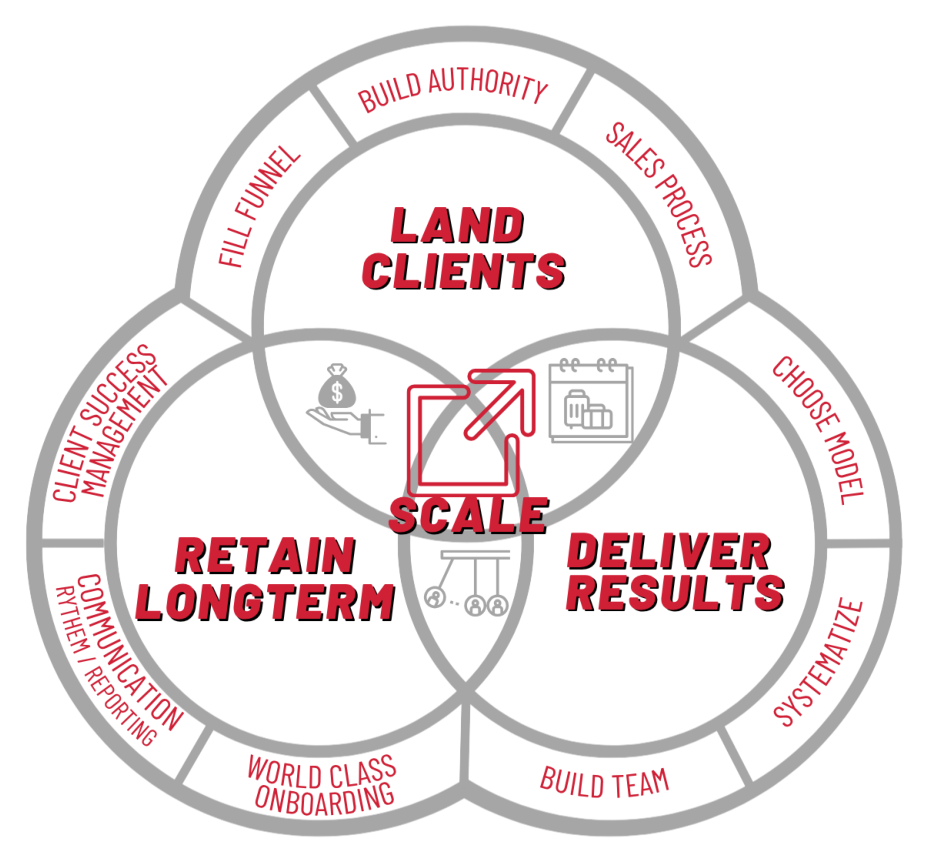
THE SEVEN FIGURE AGENCY MODEL
This took us straight to a successful business within a year. And it's pushed us forward to even bigger dreams, including our mission to help 500 agencies grow to seven figures and beyond while creating the lifestyle freedom they started their agencies to achieve.
We've evolved our original three-pillar framework of Land Clients → Deliver Results → Retain Long-Term into a complete four-pillar system that includes Scale Up (building your systems and team). But this is what makes our approach different: every pillar is designed to increase your freedom, not just your revenue.
It's a roadmap that we have fine-tuned in our own business and applied successfully across the more than 1,000 agencies that have come through our coaching programs.
Here's what that community has achieved:
More than 1,000 agency owners coached since 2018
197 of them have grown to seven figures
44 members at multiple seven figures
Median member revenue of about $56K per month
Combined community revenue of more than $280 million annually More importantly, here's the freedom they've created:
Members like Austin Houser, CEO of Base Coat Marketing went from -
$2K to $89K MRR while working fewer hours
Jim Ahlin and Brian Neibler, Founders of Roofer Marketers, grew from
$7K MRR to over $500K MRR and wound up selling their agency to a
large CRM in their niche
Jennifer and Kelsey Outram, Founders of Lift Auto Repair Marketing,
built multiple seven figures while maintaining work-life balance
Tony and Angela Ricketts, Founders of Lawnline Marketing, scaled to
$200K+ MRR through systematic team delegation
Cris Rodriguez, CEO of Grow Pro Agency, grew from $30K to $430K
MRR dialing in her retention and client delivery strategies
There is one more reason we rewrote this book. Everything we just described, the systematization that used to take a team of forty to pull off, is now within reach of an agency of eight. AI has not changed what needs to be true about your business. It has changed how much of it you can build, how fast, and with how many people.
Throughout this book you'll see where it fits inside each pillar. Not to replace your expertise, but to make your systems do more than your headcount should allow.
Let's build something that scales without sacrificing your life.
Josh and Yesenia Nelson FOUNDERS , SEVEN FIGURE AGENCY
This book is packed with the same strategies and tools we used to build our agency past $7 million a year, make the Inc. 5000 four years running, and get our hours back while doing it. You can download every worksheet, template, and tool at:
BONUS RESOURCES · SCAN OR VISIT WWW.SEVENFIGUREAGENCY.COM/KIT
Keep them handy and fill them in as you read. Reading about this and doing it are very different activities.
Read it straight through the first time so you can see how the pieces fit together. Some sections will feel more urgent than others depending on where you are, and that's the point. Then go back through a second time and actually implement the Growth Plan actions stage by stage.
Start with the business model fundamentals. If you're not clear on what you're selling, how you'll deliver it, and what the model underneath it looks like, there's no point optimizing marketing or operations. You'd just be building a more efficient trap.
Let's get started on the agency you started out to build.
This book is your roadmap to breaking $1 million in your digital marketing agency over the next 12-24 months.
But it's not really about the money.
It's about the freedom that seven figures creates. The ability to work 35-40 hours per week instead of 60+. To take a two-week vacation without your phone buzzing constantly. To build something valuable that doesn't require your presence in every decision.
It's about the impact that comes with running a systematized business; creating meaningful jobs for your team, transforming your clients' businesses, and becoming the go-to authority in your industry.
Most importantly, it's about building an agency that serves your life instead of consuming it.
I know that sounds almost too good to be true, especially if you've been grinding for years, thinking, "How could I ever get to a million dollars while actually having a life?"
Here's the reality: $83,000 per month makes you a Seven-Figure Agency.
If you can systematically land five new clients per month at $1,650 monthly (our current average), you're on track to hit seven figures. Even more conservative numbers work: retaining 50 clients at $1,500 monthly gets you there.
The math isn't the hard part. The system behind it is what most agencies never figure out.
That's what this book is about. My wife Yesenia and I are going to share the real frameworks from our $7 million agency and the members of our Seven Figure Agency community, 197 of whom have broken through to seven figures and beyond, but more importantly, who've created the lifestyle freedom they started their agencies to achieve.
Let me ask you this: What's the point of building a million-dollar business if you're still working 70-hour weeks, stressed about cash flow, and can't take time off without everything falling apart?
That's not success; that's a self-imposed prison with better revenue numbers.
Real success is building an agency that creates four things:
Financial Freedom: Enough predictable recurring revenue to live the lifestyle you want and provide for your family without constant worry
Time Freedom: Systems and team members that handle operations so you can focus on strategy, family, and what energizes you
Choice Freedom: The position to decide which clients you take, which work you do, and which opportunities you walk away from
Impact Freedom: The authority and resources to make a meaningful difference in your industry, your clients' businesses, and your community
When Yesenia and I started our journey, we were trapped in all the wrong ways. I had already failed once with my first agency; four years of 80-hour weeks that barely covered business expenses, let alone living expenses. I had to shut it down and tell my dad (who had invested $10,000 from his $24,000 missionary income) that I was sorry, but I needed to get a "real job."
That failure taught me something crucial: Working harder doesn't create freedom. Building the right systems does.
The Four Challenges Every Agency Owner Faces (And How to Turn Them Into Advantages)
Before we dive into the solution, let's acknowledge the real challenges you're facing. Growing a digital marketing agency to seven figures while maintaining your sanity comes with four major obstacles:
There are hundreds of agencies in every city. Major companies have millions to spend on marketing. Anyone with a laptop calls themselves a consultant.
Now this is what most agencies miss: The problem isn't competition, it's that everyone sounds exactly the same.
When you position yourself as the obvious choice for a specific type of business, competition becomes irrelevant. Our agency competes with hundred-million-dollar companies every day, but we win because plumbing and HVAC contractors know we understand their world better than anyone.
Cold calling and cold emails used to work. Now, every business owner gets bombarded with marketing calls and feels immune to outreach.
The solution: Stop chasing prospects and start attracting them. When you build authority in your niche, ideal clients call you, already convinced they want to work with you.
Most agencies try to scale by hiring more people to do more work. This typically creates more management headaches, higher overhead, and lower profit margins.
The better approach: Build systematized programs first, then hire people to operate those systems. This creates leverage instead of just more complexity.
When every client relationship requires constant attention to prevent churn, you're not building a business; you're creating a job with unlimited working hours.
The systematic solution: Implement retention communication systems that keep clients engaged and appreciative while requiring minimal owner involvement.
Over the past decade, working with hundreds of agencies, we've found that growth which actually increases your freedom requires four interconnected pillars. Each one takes something off your plate rather than adding to it.
Pillar 1: Land Clients. Instead of chasing prospects and hoping something sticks, you build authority-based systems that bring pre-qualified people to you. Client acquisition stops depending on you personally.
Pillar 2: Deliver Results. Instead of reinventing the wheel for every client, you build systematized programs that produce better outcomes through proven processes. Your team can execute them without your oversight.
Pillar 3: Retain Long-Term. Instead of landing new clients while hoping the old ones stick around, you run systematic retention communication. Recurring revenue compounds instead of leaking.
Pillar 4: Scale Up. Instead of doing everything yourself or hiring in a panic, you build systems and team deliberately, so the business runs and grows without your daily involvement.
Most business frameworks optimize for growth alone. This one optimizes for profitable growth that hands you your time back.
Build them in that order. Get consistent at landing and serving clients first, because that's your revenue foundation. Then build retention, because that's your cash flow security. Then scale, because that's what takes you past your personal capacity. Agencies that skip to pillar four end up with a bigger version of the same problem.
Today, Yesenia and I run a digital marketing agency that generates over $7 million annually ($580K MRR) with a team of 47 full-time employees. We've made the Inc. 5000 list of fastest-growing companies four years in a row with the agency, and five more times with Seven Figure Agency, nine appearances between the two.
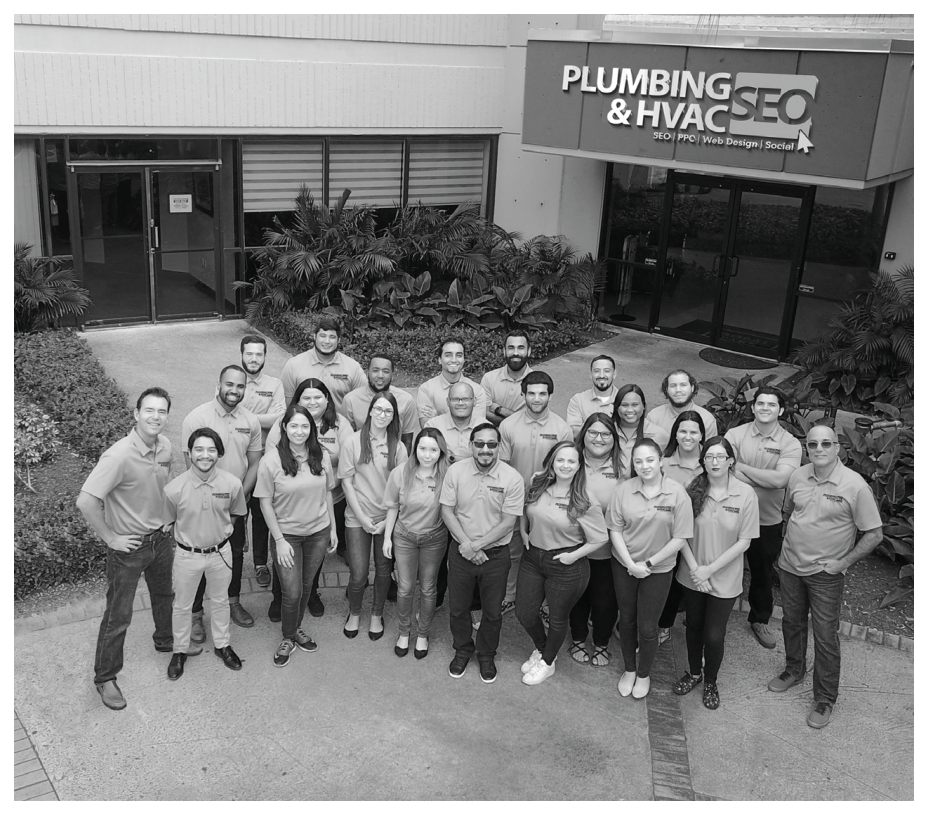
But more importantly, we work 30-40 hours per week. We take real vacations. We're present for each other and our three boys. None of that was luck. We learned, the hard way, how to build systems instead of dependency.
You already know how the first agency ended. What matters here is why it ended. I was selling websites for $1,000 to $1,500 plus $50 a month in hosting, and I was the classic owner-operator: if I wasn't personally involved in a project, it didn't get done right. I had clients. I didn't have a business. Four years of that taught me the distinction between revenue and freedom, which is the distinction this entire book is built on. (And because the second agency worked, I eventually paid my dad back more than double what he put in.)
After closing the agency, I worked in corporate America for several years at companies like ADP and ReachLocal. This experience was invaluable because I learned how real businesses operate:
Systematic sales processes that don't depend on the founder's personality
Standardized service delivery that maintains quality without custom
work
Team structures that enable growth without owner bottlenecks
Metrics and accountability that create predictable results I realized that my first agency failed not because I wasn't good at marketing or web design, but because I didn't understand business fundamentals.
When Yesenia, our partner Dean Iodice, and I launched Plumbing & HVAC SEO in 2012, we approached everything differently. Instead of just trying to land clients, we built the four-pillar framework from day one:
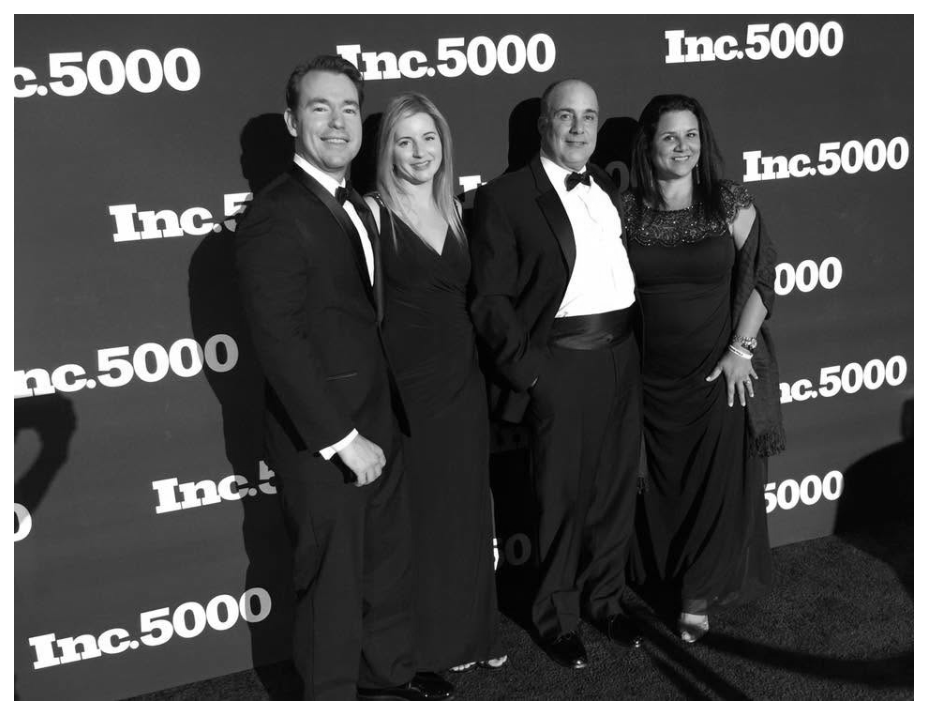
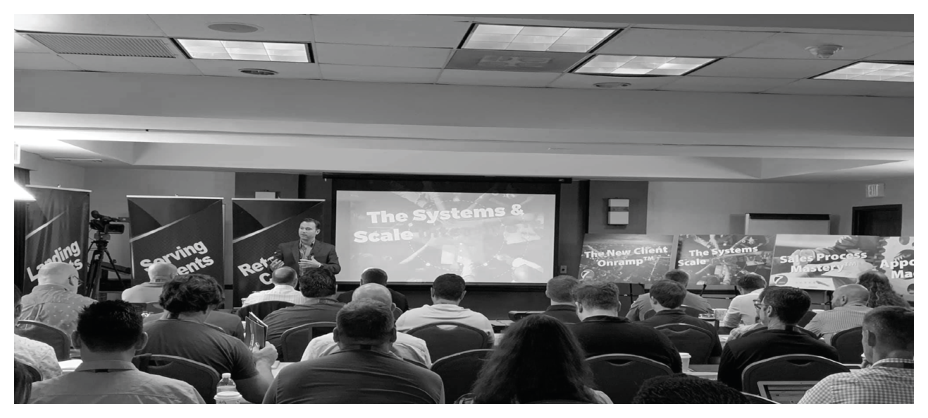
JOSH, YESENIA & DEAN AT INC. 5000 GALA
Year 1: We focused on niche specialization (plumbing/HVAC), systematic program packaging, and authority-building content
Year 2: We implemented predictable client acquisition systems and retention frameworks
Year 3: We began building team structures and standard operating pro-
cedures
Year 4+: We scaled systematically while maintaining founder freedom
The Transformation That's Possible When You Get This Right When the four pillars are working, three things change about your job. You stop sitting inside every client project and start working on vision, strategy, and the relationships that actually move the business, because your team delivers off documented systems. You stop reacting to crises and start making improvements that prevent them. And each new client stops costing you a piece of your week, because the work that serves them is systematic and delegable. That last one is the whole game: growth that adds to your freedom instead of spending it.
We didn't just do this once in our own agency. We've now watched more than 1,000 agency owners run this framework in their own markets, and 197 of them have crossed seven figures. Austin Houser went from minus $2K to $89K MRR across 46 clients while cutting his hours. Tony Ricketts scaled to $200K+ MRR by delegating systematically. Cris Rodriguez built multiple seven figures without giving up her life to do it. Dozens have gone on to sell their agencies for life-changing multiples.
These aren't outliers. They're what happens when you prioritize systems over raw revenue growth.
This book is for agency owners who want more than a bigger revenue number: something valuable, something that serves your life, something that makes a real difference for the clients and the people you employ. And it's rewritten for right now, because AI is changing what clients expect, specialization beats generalization by a wider margin than it used to, and systems can be built faster than at any point in this industry's history.
Before we dive into the strategies, here is what a week actually looks like once the systems are carrying the business.
You start Monday reviewing metrics and priorities instead of jumping into client firefighting, because your team handles operational issues using documented systems. You spend the middle of the week on strategic relationships and business development, because delivery runs without you standing over it. You disconnect on Friday afternoon and stay disconnected, because your retention systems keep clients satisfied and your team knows how to handle what comes up.
Then you take a two-week vacation and nothing breaks. You are present for the things at home you used to miss. And you have predictable recurring revenue underneath all of it, which is what makes long-term planning possible in the first place.
This isn't theory. It's the reality that hundreds of agency owners in our community have built using the frameworks in this book.
Building a seven-figure agency that gives you your life back requires committed implementation. It involves some difficult decisions about niching down, raising prices, and saying no to opportunities that don't fit your strategic direction.
Here’s what makes this different from other business advice: Every strategy is designed to increase your freedom while growing your revenue. It's a roadmap that transformed our lives and the lives of hundreds of others we've worked with. The question is whether you're ready to stop trading time for money and start building the agency that creates the lifestyle you actually want.
The clearer you are about what you're actually after, the more focused your implementation gets. Take a minute with these before you turn the page:
Current monthly recurring revenue: $__________
Desired monthly recurring revenue 12 months from now: $__________
The gap: $__________
Describe your ideal work week once you get there: __________
What would you do with the time and the money? __________
What would it change for your family? __________
From here we work the four pillars in order. You'll get the five stages of agency growth and how to tell which one you're actually in, the niche selection framework, program packaging, the client attraction system, cold outreach rebuilt for how prospecting works now, the sales process, the retention system, and the team and delegation frameworks that let you step out of the middle. AI runs through all of it rather than sitting in its own chapter, because that's how it shows up in a real agency.
Every chapter ends with action steps and a real member story from someone who did the work. These are not composites and they are not anonymous. Eleven agency owners let us put their names, their numbers and their faces in this book: Ricky, Sean, Matt, Wesley, Brady, April, Pam, Cohen and Justin, Austin, Luke, and Cris. Some of them were broke when they started. One of them ran his agency through brain surgery. You will meet each of them at the end of the chapter that tells their part of the story, and every one of them sat for a long-form interview you can watch. If you want to hear any of these in their own words rather than mine, they are all at SevenFigureAgency.com/case-studies.
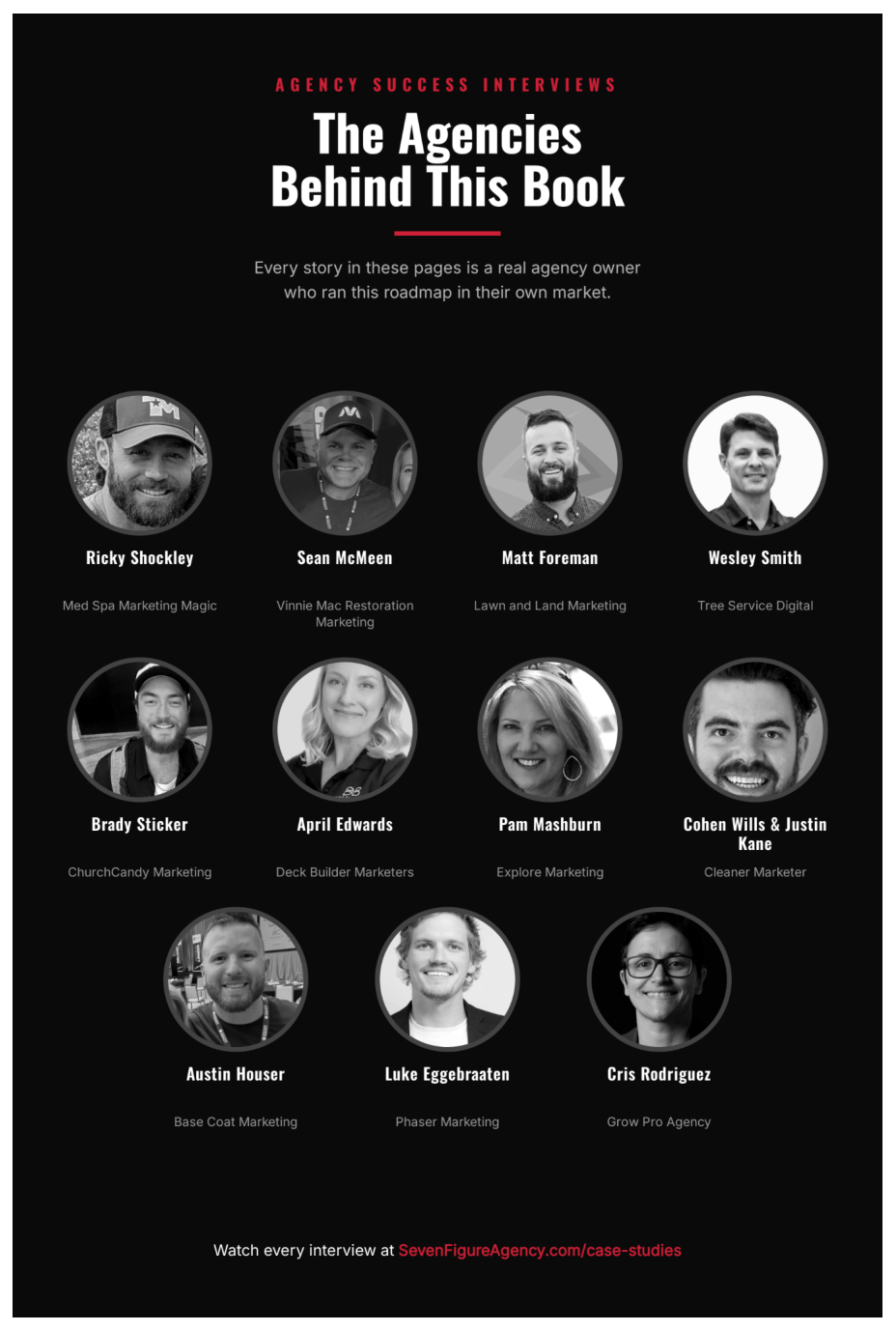
THE AGENCIES BEHIND THIS BOOK
Let’s build something that scales without sacrificing your life.
I ran two agencies. The first one nearly ended my marriage and did end in me applying for a job. The second passed $7 million. I was the same person both times, working roughly the same hours, with roughly the same skills. What changed was the model, and the difference between those two models is the whole reason this chapter comes first.
In the first agency I sold custom websites for $1,000 to $1,500 with $50 a month in hosting. Every month started at zero, which meant selling six websites just to break even. Every project was different, so nothing I built made the next one easier. I took any client who would say yes, which meant competing on price against everyone with a laptop. And all of it ran through me.
In the second agency, we made the opposite call on every one of those. Plumbing and HVAC contractors only, so we could be the obvious choice instead of an option. Recurring programs at $1,500 a month and up, no oneoff projects, so the revenue compounded instead of resetting. Systematized delivery, so the tenth client cost less to serve than the first. Authority marketing, so prospects arrived already convinced. And processes from day one, so the business didn't depend on me being in the room. Within a year it was profitable and I was working reasonable hours.
Same founder. Same work ethic. The variable was the model.
That's why this chapter comes before client acquisition, before service delivery, before anything else. You can be brilliant at marketing and still lose, because a bad model doesn't get fixed by working harder. It just gets more expensive.
So before we talk about landing a single client, we're going to fix the model: the five stages you move through, what actually changes at seven figures, the Rule of Five Ones, and the four pillars that hold it all up.
Across hundreds of digital marketing agencies, we've found that every owner is standing in one of five stages. Each one comes with a different set of options, and knowing which one you're in tells you what to work on next.
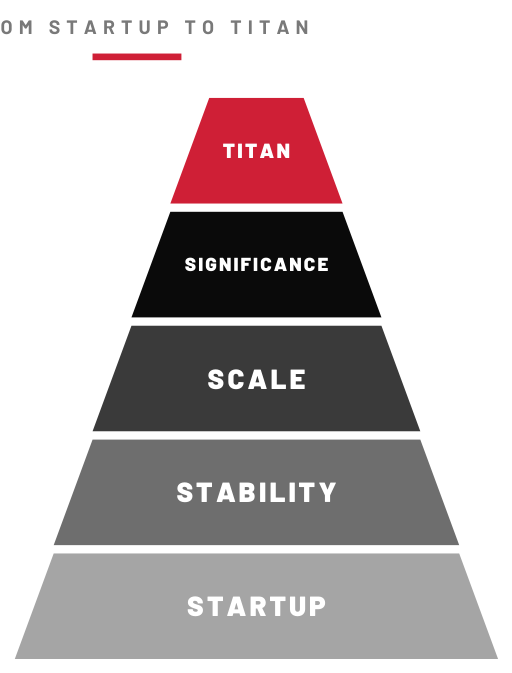
The Reality: No clients yet, no money coming in, and everything is on you. You land the clients, serve the clients, do the marketing, and execute the work.
The Urgency: If you're here longer than 3-6 months, you're in trouble. Without cash flow most owners go broke.
The Goal: Land your first 5-8 clients and get out. Document every process as you go, because what you skip now is what traps you later.
The Reality: 10-30 clients and enough recurring revenue to cover your base needs. You're out of survival mode and still doing most of the work yourself.
The Opportunity: You can finally reinvest. This is where you build repeatable processes for all four pillars and hire your first team members.
The Timeline: Move through this stage in 6-12 months, building toward $30K+ MRR.
The Shift: Stop thinking like a technician who trades hours for money. Start thinking like an owner who builds leverage.
The Reality: $30,000+ MRR, and for the first time you can afford dedicated specialists for account management, fulfillment, marketing, and operations. That's not just help, it's expertise that beats what you can do personally.
The Payoff: 40-50 hour weeks instead of 60+, and long weekends that don't blow up. Documented processes mean results stop depending on your oversight.
The Shift: You're no longer the bottleneck. You set direction, your team executes.
The Transformation: Seven figures is $83,000+ MRR. You're making real money, creating jobs, and moving the needle for your clients and your industry.
The Platform: The agency becomes a platform. You get invited to speak, you mentor other owners, and you start looking at adjacent opportunities.
The Payoff: 35-40 hour weeks on work that energizes you, travel measured in weeks rather than long weekends, and a business with equity value you could sell or pass on.
The Shift: You're the visionary. Your team runs operations.
The Elite Level: $166,000+ MRR, or $2 million a year and up. Very few agencies get here.
The Vision: TITAN is about the climb from multiple seven figures toward eight ($10+ million annually), which requires becoming an institutional-quality business builder rather than a successful agency owner.
The Scale: 50-100+ team members and hundreds of client businesses transformed a year. Your focus shifts from revenue to equity, acquisition readiness, and generational wealth.
The Team: A real leadership team, for example a COO, VP Sales, VP Client Success, and CFO, who operate and innovate without you in the room.
The Payoff: 25-30 hour weeks on only what energizes you, and the option to keep growing, acquire, exit, or move into an investor role while keeping ownership.
Current TITAN Members: We currently have 44 members at this level, showing that the path from seven figures to multiple seven figures is repeatable.
Take a moment to identify where you are now and set your freedom targets:
Current Stage: ____________
Current Weekly Hours: ____________ 12-Month Goal Stage: ____________
Desired Weekly Hours in 12 Months: ____________ 3-Year Freedom Vision: ____________
Most importantly: What will you do with your time when you're not trapped in daily operations? ____________
Yesenia and I called our community "Seven Figure Agency" because we believe something magical happens when you reach this milestone. It's not just about the money; it's about the complete transformation in every area of your life and business.
One of the primary reasons we got into business was to have the financial resources to live our desired lifestyle and serve our family well.
Just beyond the seven-figure mark is where our lives truly changed. We could take care of our family and our three boys, Brandon, Ryan, and Justin, in ways we never could before.
Getting to Significance gave us the ability to:
Buy our dream house in Miami
Drive the cars we wanted
Put the kids in the best schools
Travel when and how we want
Support my dad's missionary work (and yes, I did pay him back!)
Build investments for generational wealth But the money isn't the only benefit, or even the most important one.
The biggest transformation isn't just financial, it's the freedom to make choices about how we spend our time.
At seven figures, you can build a team and systems that deliver results without your constant involvement. You're not trapped in every decision or required for every deliverable.
What that actually looks like: 35-40 hour weeks instead of 60+. Two and three week vacations where your phone stays quiet. Making it to your kids' events without work running in the background. Having energy left over for the people you're doing all of this for.
Get here systematically and you have options most business owners never get. You can keep growing, hold your size and maximize margins, sell for real equity value, or step back and collect distributions while someone else runs operations. You can live where you actually want to live rather than where the math forces you to.
At seven figures you have the resources and the standing to matter beyond your own P&L. You become the authority in your niche and you shape how your industry thinks about growth. You create real jobs for 20-40+ people. You build something with value that outlasts your involvement. And your kids watch you do it, which is its own kind of return.
One of our biggest breakthroughs in accelerating to seven figures was discovering the "Rule of Five Ones."
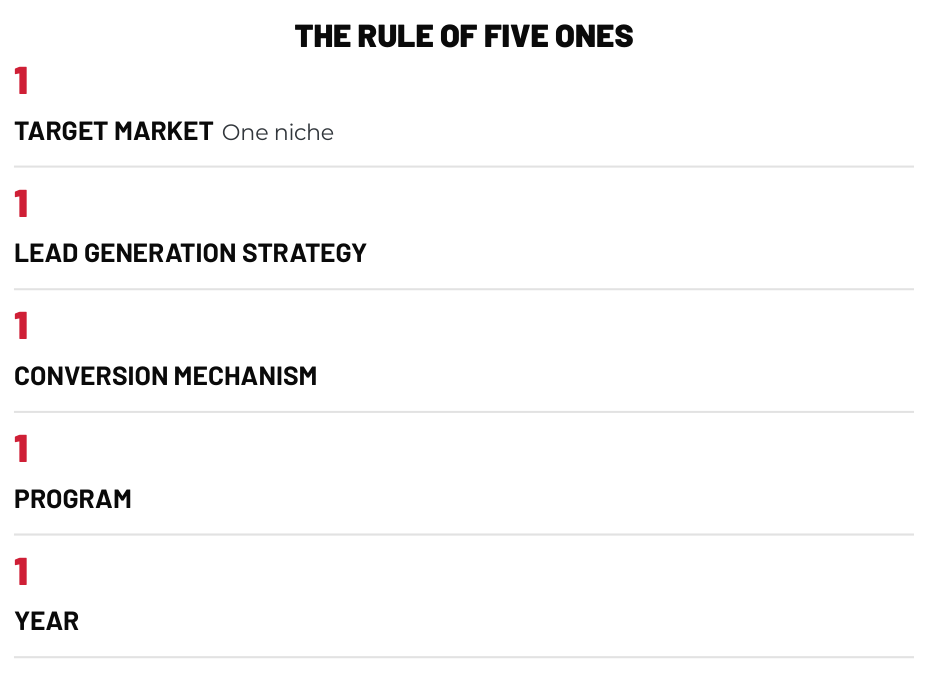
This concept came from Clay Collins (founder of LeadPages), who researched businesses that grow rapidly to multiple seven figures. He found they all had one thing in common: extremely simplified business models.
The Core Principle: If you can simplify your business, you can multiply your growth.
This is a process of deliberate simplification that goes against every instinct to diversify and chase opportunities. But it's the foundation of every fast-growing agency we've worked with.
Clay's research showed that the fastest-growing companies weren't the ones with the most sophisticated strategies or the most diverse offerings. They were the ones who had ruthlessly simplified their approach to focus on mastering a few key elements.
When I learned this concept, it was like a lightbulb went off. Looking back at my failed first agency, I was doing the opposite of everything Clay had discovered. I was trying to serve everyone, with multiple service offerings, using every marketing tactic I could think of, and constantly jumping to new strategies.
Our successful second agency? We did exactly what Clay's research suggested: we simplified everything down to five core elements and mastered each one before adding complexity.
1. One Target Market: Rather than trying to target everybody, focus on one specific niche or market. In our agency, we serve plumbing and HVAC contractors exclusively. When I moved from generalist to specialist in one particular market, everything accelerated: pricing, positioning, results, and growth.
Note: "Home services" isn't a market; plumbing and HVAC is. "Legal" isn't a market, bankruptcy attorneys is. The more specific you can be, the more resonant your marketing becomes and the better you can develop programs that deliver oversized results.
2. One Lead Generation Strategy: While there are many ways to get clients (personal branding, cold outreach, speaking at events, content marketing), the fastest path to success is mastering one really effective lead generation strategy and doing it consistently before adding others.
3. One Conversion Mechanism: Pick one way to sell clients into your program; typically, a Zoom call with a specific sales process, and follow that same conversion mechanism every time. Don't try webinars, live events, and one-on-one selling all at once.
4. One Core Program: Offer one flagship program that delivers the results your clients need. Not à la carte services scattered everywhere, but one comprehensive solution with possible variations for specific needs. A confused mind won't buy, and custom solutions are impossible to scale.
5. One Year: Allow enough time to get really good at each element before adding anything else. Most agency owners jump around too quickly due to shiny object syndrome and never master any single approach.
Repetition is the whole mechanism. Serve one market with one program and you get deep expertise instead of surface knowledge in six directions, processes that improve every time you run them, and pricing power that comes from being the obvious expert rather than one of forty options.
Alan Hillsberg started his agency in 2007 as a generalist serving "any small/medium business needing internet marketing." At one point, he was working with an attorney, a restaurant, a med spa, and an auto shop, charging around $300 per month, but his agency was failing to turn a profit despite working over 50 hours per week.
The Turning Point: After attending one of our training sessions, Alan embraced the Five Ones concept. I showed him something that changed his perspective completely.
I brought up InfoUSA (a business database) and said, "Type in plumbers." The search returned about 300,000 listings.
"That's not my market," I told him. "Now filter that to plumbers making over $1 million annually."
The list dropped to around 7,000 businesses.
"Those are my ideal clients," I explained. "Business owners making $83,000+ per month who understand that investing $2,000-$3,000 monthly in marketing makes perfect sense for generating new clients."
Alan had his lightbulb moment. Instead of competing with every generalist agency for any business that needed help, he could become the obvious choice for one specific type of business.
The Implementation: Alan chose the funeral home niche, a market he discovered through research that was underserved by digital marketing specialists. He completely repositioned himself as the funeral home marketing expert, developed a comprehensive $1,000/month program specifically designed for funeral directors, and built authority through industry-specific content and case studies.
The Results: By applying the Rule of Five Ones systematically; one niche (funeral homes), one lead generation strategy (content marketing), one conversion mechanism (consultative sales calls), one core program ($1,000/month comprehensive marketing), and committing to this approach for over one year, Alan grew his agency to over $160K monthly recurring revenue.
Alan's Transformation: "I was a mouse on a spinning wheel going nowhere. When I listened to Josh explain how he worked only with plumbers, I couldn't wrap my head around it. But once I understood that a plumber making $83,000 per month sees $2,500 in marketing as a smart investment, everything changed. Working with only one niche, you develop specialized knowledge. The same process that works for one funeral home in one city works for another funeral home in another city. My job got easier while making more money."
Life Impact: Alan now travels quarterly, his children's college educations are fully paid for, and he's started another business with the financial freedom his agency created.
Alan's transformation from a struggling generalist charging $300/month to a niche expert generating $160K+ MRR proves that the Rule of Five Ones isn't just theory; it's a proven pathway to seven-figure success.
Clay's five are the model. This is how you audit yourself against it.
Score each of these honestly, right now, on a scale of one to five. Anything you score below a four is where your growth is leaking.
1. Niche (Market Focus). Are you serving one specific type of business, or do you have a "primary" niche plus four exceptions you keep making? Deep expertise, standardized processes, premium pricing, and referral networks inside the industry all come from committing here.
2. Core Program (Service Focus). One comprehensive program, or à la carte services you rebuild for every client? Systematized delivery, trainable processes, and predictable costs all live in this decision.
3. Lead Source (Marketing Focus). Have you mastered one acquisition channel, or are you dabbling in four? You want a channel you can train someone else to run.
4. Price Point (Revenue Focus). One target monthly fee. I recommend $1,500 minimum, and higher if your niche supports it. This one isn't in Clay's original five, and we added it because we watched too many agencies pick a good niche and then underprice it into a business that could never afford a team.
5. Team Structure (Operational Focus). One consistent approach to hiring, training, and managing. This is the other one we added, because Clay's research looked at how companies grow revenue and we care about whether the owner still has a life at the end of it.
Notice that the first three map directly onto Clay's list. The last two are what we learned by doing this in our own agency and then watching hundreds of others try it. Clay's fifth element, one year, isn't on the scorecard because it isn't something you score. It's the commitment that makes the other five mean anything.
The counterintuitive truth: Constraining your options actually creates more freedom by enabling excellence.
Before we dive into each pillar in the following chapters, you need to understand the business model principles that make this kind of growth possible. These aren't optional, they're the foundation everything else builds on.
One of the most critical decisions for your freedom is this: sell monthly recurring revenue only, never project work.
SIX WAYS TO $83K A MONTH, SEVEN FIGURES A YEAR
1 client$83K per month 8–9 clients$10K per month 41 clients$2K per month 83 clients$1K per month 166 clients$500 per month 830 clients$100 per month
Here's why this matters for your lifestyle: In my first agency, I'd sell websites for $1,000-$1,500 one-time fees plus $50/month hosting. Even when I sold six websites monthly ($6,000), every month I had to start over and sell six brand new clients just to stay at the same level.
The Project Work Trap: Even if you do big project work ($50,000 projects), you're constantly restarting. Worse, when you mix project and recurring work, the projects always get priority because they're "urgent," and you can't focus on building the systematic recurring revenue that creates freedom.
The Recurring Revenue Advantage: When you sell monthly recurring fees at the right price point, that number grows and compounds month after month. This creates the momentum and predictability needed for both sevenfigure growth and lifestyle freedom.
Our Rules:
Everything is monthly recurring; no one-off projects that restart the clock
Everyone gets set up on auto-charge (no invoicing or payment chasing) Minimum fee of $1,500+ per month (ensures client quality and business profitability)
12-month agreements to protect our investment in setup and enable longterm planning
Your monthly fee needs to be at least $1,000, ideally $1,500+. Here's why this directly impacts your freedom:
Below $1,000/month clients:
Require constant price justification
Demand maximum personal attention for minimum revenue
Create high-maintenance relationships that trap you in daily operations
Generate insufficient profit to hire quality team members $1,500+/month clients:
Understand and appreciate the value of systematic marketing
Give you permission to build teams and processes
Generate profit margins that enable quality hiring
Create business relationships instead of service relationships The chain reaction: Higher-value clients → Better profit margins → Quality team members → Systematic operations → Your freedom
Let's make seven figures tangible. Seven figures = $83,333 monthly recurring revenue (x12 = $1,000,000 annually).
Here are the different paths to get there:
1 client at $83,333/month (rare but possible for enterprise accounts)
8-9 clients at $10,000/month (high-end positioning)
42 clients at $1,995/month (sweet spot for most niches)
83 clients at $1,000/month (volume approach)
166 clients at $500/month (high-churn, low-margin trap)
The Sweet Spot: Most successful agencies we work with charge between $1,500-$3,500 monthly. Here's why:
Same Effort, Different Results: You do as much work to sell and retain a $2,500/month client as a $500/month client
Better Client Expectations: Higher-paying clients often have more realistic expectations and understand ROI timelines
Manageable Client Load: 30-50 clients is much easier to manage than 150+ clients
Sustainable Growth: Higher monthly fees create more margin for team building and systems
Market Reality: I've found that there are a TON of businesses in just about any niche you can imagine willing to pay $1,500-$3,000 per month (plus ad spend) if you can drive results, and they will stay with you long term.
The key is positioning yourself as the expert who delivers measurable ROI rather than competing as a commodity service provider. When you can demonstrate that your $2,500/month investment generates $10,000+ in additional revenue for their business, the decision becomes obvious.
Real Example: If you can land 5 new clients monthly at $1,995/month and maintain strong retention, you'll hit seven figures within 12-18 months.
The Effort Reality: It takes almost as much energy to sell somebody a $2,000/month program as it does to sell them a $200/month program. You'd be much better served to land fewer clients at a higher dollar amount.
Our Current Model: Our minimum fee is $2,500/month plus ad spend. We're dealing with better clients who are already spending at a certain level and can see the social proof of great results we've achieved for other clients.
Brian Tracy said, "Success is goals, all else is commentary." Without clear goals for the next 12, 24, and 36 months, you're stuck in what he calls "commentary"; another word for busywork that doesn't drive real progress.
You've probably heard the Harvard study about written goals, the one with the 3% who wrote them down earning ten times the rest of their class combined. I've quoted it from stage myself. I stopped, because when you go looking for that study you can't actually find it. It gets attributed to Harvard, sometimes to Yale, and no one can produce it.
I don't need it, and neither do you. I have something better, which is several hundred agency owners I've watched up close.
Here is what I can tell you from that vantage point. The members who hit their numbers are, almost without exception, the ones who write the number down and look at it every week. Not once a year on a planning retreat. Every week. The ones who tell me their goal from memory, with a little bit of rounding and a lot of optimism, are usually the ones who end the year roughly where they started.
That's not a controlled study and I won't dress it up as one. It's a pattern, and it's held for long enough and across enough agencies that I'd bet on it.
That's why our most successful members religiously use goal-setting and tracking systems. It isn't just about having a target. It's about:
Writing it down (makes it real and concrete)
Creating a specific plan (breaks the big goal into actionable steps)
Tracking progress consistently (creates accountability and course correc-
tion) Without goals, you're like a boat at sea with no wind; sitting stagnant with no momentum, completely stalled out. But when you write down clear goals and put accountability mechanisms in place, you create your own wind. You generate momentum and accelerate in your intended direction.
The framework that's transformed our business and hundreds of others in our community:
You need three timeframes:
Monthly goals (tactical and achievable)
Quarterly goals (strategic milestones)
Annual goals (vision-level outcomes) And here's the crucial part: you need structured reflection periods:
End of each month: Stop and reflect on progress
End of each quarter: Assess what worked and what didn't
End of each year: Major strategic review and planning This was a game-changer for us because we used to set goals and write them down, then they'd disappear into the ether with no accountability.
The structured review process develops one of the most important business muscles: the ability to set an intention, take action, and accomplish the desired outcome.
This mechanism enabled Yesenia, Dean, and me to move forward systematically rather than hoping things would work out.
That pattern is why we built a tracking system, and why our most successful members use it religiously. Here's how it works:
Current monthly recurring revenue: $______
Average monthly client fee: $______
Current close rate on sales calls: _____%
Target monthly recurring revenue (12 months): $______
Months remaining in year: ______
New clients needed: $______
New clients needed per month: ______
Sales calls needed monthly (based on close rate): ______
Lead generation activities required: ______
go.SevenFigureAgency.com/Tracking →
Brian Kaskivalcian ran a successful roofing and remodeling agency that plateaued at $60K monthly recurring revenue; solid business, good income, but no momentum for years.
The Problem: Without clear goals and tracking, Brian got comfortable. $60K MRR was enough to pay bills and live well, so he lost the drive to grow.
The Solution: We sat down and implemented the exact tracking system above. Brian started holding monthly team meetings, reviewing:
Goal for the month
Actual results vs. target
Sales and retention metrics
Action plan for next month The Results: That simple tracking mechanism created momentum again. Brian grew from $60K to over $300K monthly recurring revenue and eventually sold his agency for millions to a private equity firm.
Brian's Quote: "The one tip I'll give you is what Josh gave me; clarity and focus. It was that one damn spreadsheet that changed everything. We knew month after month exactly what our target was in new monthly recurring revenue, and we knew exactly where we were based on our gains and losses. That one thing is a game-changer."
Before we can dive into the Four-Pillar Framework discussed earlier in this chapter, we need to crystallize the core business model principles that separate seven-figure agencies from those that struggle. These aren't suggestions, they're the foundation requirements for building an agency you own instead of one that owns you:

BRIAN KASKAVALCIYAN · GFOUR MARKETING GROUP
The Seven-Figure Agency Model Requirements:
One target niche: Specialize in serving one specific type of business to
become the obvious choice
Recurring monthly revenue is the ONLY way to go: No exceptions, no
one-time projects that restart the clock each month
No check payments, credit card or direct debit only: Eliminate payment
friction and chasing
No partial deposits: Full monthly payments on automated recurring
billing
Minimum monthly needs to be at least $1K: Ideally $1,500+ to ensure
quality clients and sustainable margins
Each one removes a specific failure mode. Recurring revenue stops your clock from resetting to zero every month. Higher monthly fees attract owners who already understand marketing as an investment, which is most of client quality right there. Automated payments kill the collections problem that quietly strangles cash flow. And one niche with standardized programs means your systems scale instead of getting customized to death.
Break these and you've built a job that traps you. Follow them and you've built the foundation for everything in the rest of this book.
Take a moment to assess your current business model against the seven-figure fundamentals:
Gap Analysis Questions:
What's the biggest gap between your current and ideal situation?
Which fundamental would have the most immediate impact if implemented?
What's preventing you from making these changes right now?
What would need to happen in the next 90 days to align with these fundamentals?
You've done the exercises in this chapter. Now pick the one change that matters most and put a date on it.
Identify your #1 priority change, and set a 30-day deadline for implementing it
Rate each of the four pillars twice: how strong it is, and how much it still needs you personally
Start with whichever pillar scores worst on the second question
Download the complete implementation toolkit at www.SevenFigure-
Agency.com/KitThe foundation is set. In the chapters ahead we'll build each pillar in order,using what has taken 197 agencies through to seven figures and beyond. Let'sbuild it together.

Ricky Shockley had a dozen clients and no idea where the next one was coming from.
That is not an unusual position. It is also not an agency. Every new client arrived by word of mouth, which meant the growth of his business was governed entirely by whether somebody happened to mention his name that month. He described it himself as more of a job than an agency, and the description was exact. He owned the work. He did not own an asset.
What changed was not effort. Ricky was already working hard. What changed was that he built the four pillars of a real business model underneath the work he was already doing: a defined market in med spas, a packaged offer he could sell repeatedly, a predictable way to acquire clients that did not depend on luck, and delivery that did not route through him personally.
He now serves roughly forty clients and is approaching $100,000 a month. More to the point, the growth showed up somewhere other than the revenue line. It showed up in flexibility, in what he could pay his team, and in the results his med spa clients get, because an agency that is not fighting for its own survival can afford to be good at its job.
That is the whole difference between a job and an agency. The job pays you for your hours. The agency pays you for what you built.
The niche you choose will determine whether you struggle for years or accelerate to seven figures. It's not about picking any specialized market; it's about choosing the RIGHT market using proven criteria that predict both financial success and operational freedom.
A generalist agency that serves everyone stays trapped in custom work, endless client education, and constant firefighting. A strategically chosen niche creates premium pricing power and the ability to scale without your personal involvement in every decision. This chapter lays out the exact methodology our most successful Seven Figure Agency members have used to build million-dollar businesses.
Everybody wants to work with an expert in their type of business. Whether you're dealing with roofers, dentists, or chiropractors, when they're choosing someone to help with their website, SEO, or lead generation, they want someone who has gotten results for businesses exactly like theirs.
When I worked at ReachLocal as a generalist, prospects would constantly ask: "What other dentists have you worked with? Can you show me examples?" I'd stumble through generic responses because I was serving everyone from restaurants to law firms.
The moment I could say, "We've helped several other plumbing companies," everything changed. Prospects immediately relaxed because they knew I understood their world.
Specialization didn't just make sales easier. It made everything about running the agency exponentially more efficient.
When you specialize, you don't just get better at selling, you create freedom:
Marketing Becomes Magnetic: Instead of generic "digital marketing services," you can create "The Complete Guide to Internet Marketing for Plumbing Contractors." Your target market immediately knows it's for them, and you spend zero time explaining why you're relevant.
Service Delivery Becomes Systematic: We know exactly which keywords matter for plumbing companies, which directories they should be listed in, what content converts for their audience, and which local search strategies work best. No custom research for every client; we have proven playbooks.
Project Management Becomes Streamlined: Our project management system is pre-loaded with the exact steps needed for plumbing and HVAC companies. Every new client follows the same proven process, enabling team members to execute without constant guidance.
Results Become Predictable: When you've worked with dozens of businesses in the same industry, you can confidently say, "If you give me $2,500 per month, I'm going to get you a great return on investment" because you've proven it repeatedly.
Team Building Becomes Efficient: Instead of training team members on dozens of different industries, you train them to become experts in ONE industry. They develop deep knowledge that exceeds what you could provide as a generalist, creating leverage instead of dependency.
When you jump around between industries, every client becomes a custom project that requires your personal involvement: a restaurant client needs social media focus, a law firm needs content marketing, a med spa needs reputation management, and each requires different expertise, processes, and team training.
Generalists hit a hard ceiling here, because every new client is a new problem and you're the only one who can solve it. When you specialize, you can handle exponentially more clients because every implementation follows the same framework. This is why we can manage hundreds of plumbing and HVAC clients while I work 35-40 hours per week instead of 60+.
Started: $15K MRR serving generalist clients across medical, banks, local businesses, and ecommerce
The Problem: "Every single project that we took on, it was different for every site, every type of client. Although we were successful with those clients and got great results for them, it's extremely hard to replicate that each and every time. It's honestly not fair to my team to consistently do that. Trying to implement processes and procedures by one-off projects is very difficult."
Niche Decision: Water, mold, fire, and disinfecting restoration contractors exclusively
Result: Doubled client base in restoration niche specifically, grew from $15K to $28K+ MRR in 8 months, and has recently crossed over $100K MRR.
What it made possible: "Since focusing on our specific niche, which is restoration, we've doubled our client base in just that specific niche and increased our recurring revenue significantly. We felt comfortable talking with those types of clients - it just felt good. And we've gotten tremendous results for them."
Sean wasn't failing as a generalist. He was getting great results across medical practices, banks, local businesses, and ecommerce. But success across multiple industries was trapping him in operational chaos: constant relearning of each new business ("we'd have to relearn that business and relearn about what they do, what their goals are, and what they're trying to accomplish"), no repeatable process, and a team stretched thin. He didn't pick restoration randomly; he analyzed his existing client base and found where he felt most comfortable talking with clients and where his results were strongest.
Not all niches are created equal. Use these four criteria to evaluate any potential market for both profitability AND operational freedom:
Criterion 1: Do They Clump Together and Self-Identify?
Your niche must be specific enough that when you create content and say their industry name, they immediately think, "That's for me. This person is talking to me specifically."
Positive Examples:
"The Complete Guide to Internet Marketing for Plumbers"
"SEO Strategies for Bankruptcy Attorneys"
"Lead Generation for HVAC Contractors"
When your messaging resonates immediately, you spend zero time explaining why you're relevant.
Negative Example - Too Broad: At one point, we tried expanding from "Plumber SEO" to "Contractor SEO," thinking we could capture all home service companies. We created "The Complete Guide to Internet Marketing for Contractors," launched a podcast, and built a comprehensive website.
The Result: The contractor label didn't resonate with anyone. It was too generic. Plumbers didn't feel it was specifically for them, nor did roofers, electricians, or landscapers. We got occasional leads, but nothing like the response we got with plumber-specific content.
The Test: Can you create a lead magnet, video, or website where you name their industry and they would immediately say, "That's exactly what I need"?
Criterion 2: Do They Have a Propensity to Invest in Marketing?
Some industries have never had to spend money to generate customers, making it nearly impossible to sell marketing services at premium pricing.
The Yellow Pages Test: If an industry used to advertise heavily in Yellow Pages, they'll spend money online. Industries that historically had big sections in the phone book understand that marketing drives business.
Why this matters: Industries with marketing propensity not only buy more easily, they buy at higher price points because they understand the value. This creates the profit margins needed to hire quality team members.
High-Propensity Industries:
Home Services: Plumbing, HVAC, roofing, electrical (Yellow Pages legacy)
Legal Services: Personal injury, criminal, bankruptcy (heavy advertising tradition)
Healthcare: Dental, cosmetic surgery, weight loss (patient acquisition fo-
cus)
Automotive: Auto repair, body shops, dealerships (local advertising herit-
age) Research Methods:
SEMRush Competition Analysis: Search "[industry] marketing" and see how many agencies are already competing (competition validates market spending)
Check Local Advertising: Look at local magazines, radio sponsorships, and truck advertising. Industries that advertise offline will invest online
The Competition Test: If there are already 5+ agencies serving that niche, it validates that the market spends money on marketing services
Criterion 3: Are There Enough of Them?
You need sufficient market size to build a sustainable seven-figure business, but going too broad defeats the purpose of specializing.
Research Tools - Data Axle (Formerly InfoUSA):
Go to Data Axle and select "Business Lists"
Search by industry (use SIC codes for precision)
Filter by annual revenue ($750K-$5M is often the sweet spot)
Check geographic distribution and verify contact information quality Example Analysis: Let's say you're considering bankruptcy attorneys. Search "bankruptcy attorneys" in Data Axle, filter to those doing $1M+ annually (can afford your services), then check total count and geographic distribution nationwide.
The Revenue Filter Strategy: Focus on the top 20% of any industry. While there might be 150,000 plumbing companies total, filtering to those doing $1M+ annually might give you 25,000 qualified prospects; more than enough to build a multi-million dollar agency.
Minimum Viable Market Size: Our rule of thumb is at least 10,000 companies nationwide in your niche that meet your revenue criteria. That's not a scientific threshold, it's the number below which we've watched members run out of market before they ran out of ambition. It provides enough prospects for sustainable growth even with market exclusivity arrangements.
Criterion 4: Is There an Industry Association?
This is the most overlooked criterion for creating both rapid growth and authority building.
Why Associations Accelerate Everything:
Clean, Verified Lists: Association member lists are the highest quality you can get. These businesses have paid for membership, verified their information, and actively participate in their industry.
Built-in Trust: When you're a member of their association, you're not just another cold caller. You're part of their professional community.
Event Opportunities: Associations hold regular meetings, trade shows, and conferences where your target market gathers in one place.
Content Distribution: Many associations have newsletters, websites, and social media groups where you can share valuable content.
Our Association Strategy:
National Level: We joined the PHCC (Plumbing-Heating-Cooling Contractors Association) nationally
State Level: Then joined PHCC chapters in Florida, California, Utah, and other key states
Local Level: Participated in Miami PHCC, West Palm Beach PHCC, and other local chapters
Event Strategy (Long-term Investment):
Consistency is Key: Agencies that attend one event and don't get results often never return, which is great for us because it reduces competition
Trust Building Over Time: Many of our best clients came from relationships built over multiple events
Why Home Services Dominates:
High propensity to advertise (Yellow Pages heritage)
Immediate online search behavior
Good transaction values ($500-$50,000+ jobs)
Local service area focus, emergency-driven demand
Similar business models across the niche enable standardized delivery Important Note: Don't say "I'm a home services expert"; that's too broad. Pick a specific subcategory.
Top Home Service Niches:
Plumbing: Our specialty - emergency needs, good margins, proven approach
HVAC Repair: Emergency-driven, consistent year-round demand, highvalue transactions
Garage Door Companies: Specialized niche with strong association (Barry Nix - $97K+ MRR)
Deck Builders: Growing market with premium pricing (April Edwards - Member success)
Roofing: Weather-driven demand spikes, high values, insurance work opportunities
Why Legal Works:
Established propensity to advertise (radio, TV, billboards, Yellow Pages)
High transaction values justify significant marketing spend
Strong online search behavior for legal problems
Clear geographic territories, urgent need drives immediate searches Specific Legal Opportunities:
Bankruptcy Attorneys: High volume, clear value proposition, financial desperation drives searches
Personal Injury: Competitive but extremely lucrative, contingency fee
model
Divorce Attorneys: Consistent demand, emotional buyers, life-changing
events
Criminal Law: Time-sensitive needs, immediate search behavior
Healthcare (Selective Opportunities) Important Note: Avoid insurance-dependent practices. Focus on cash-pay or elective procedures.
High-Opportunity Healthcare Niches:
Dentists: Competitive but proven (people search for dentists online)
Cosmetic Surgery/Med Spas: High values, elective procedures, cash pay
Chiropractic: Pain-driven searches, wellness focus, regular treatments
Weight Loss Centers: Strong search behavior, recurring potential
Brian Stearman (Landscape Marketing Mechanics)
The Struggle Phase: Brian was initially focused on restaurants, trying to build a digital marketing agency serving restaurant owners. After months of effort, he wasn't getting any momentum; prospects didn't seem to connect with his value proposition, and he was struggling to get consistent results.
The Pivot Conversation: During a coaching session, we went through the niche selection criteria. When we got to background and affinity, Brian mentioned almost casually, "I hadn't considered it, but before I started this agency, I actually ran and sold a landscaping company."
The Lightbulb Moment: That was the obvious answer. Brian had deep industry knowledge from the inside, credibility to speak authentically about the industry, an existing network of relationships and referral opportunities, and genuine passion for helping landscaping business owners.
The Results: Grew to seven figures within 12 months, built to over $150K monthly recurring revenue, and became the recognized expert in landscaping marketing - a business aligned with his natural expertise and passion.
Greg and Paulo (Asphalt Marketers)
The Challenge: Started as generalists serving various construction companies while also running a separate niche agency for asphalt contractors. They were spread thin across multiple industries and struggling to gain momentum.
The Decision: Made the choice to abandon their generalist approach and focus 100% on asphalt contractors only.
The Transformation: "Once we decided on going niche only, it's like the law of attraction or the universe; all of a sudden now your niche leads start coming in and booking discovery calls with you. I don't know what it is, but something happens when you make that decision to focus."
By focusing exclusively on asphalt companies, they were able to create standardized programs that work across all clients, develop deep industry expertise that justified premium pricing, and attract ideal clients through focused authority building.
AI tools now let you create industry-specific content at scale, analyze industry trends and competitor strategies quickly, and personalize outreach to niche prospects while still delivering more sophisticated services (SEO analysis, content creation, ad optimization) with less manual work.
Research Acceleration: Use AI tools to rapidly analyze potential niches, competitor landscapes, and market opportunities before making your decision.
Authority Building Speed: Create industry-specific content, case studies, and thought leadership pieces faster than ever before.
Competitive Advantage: Early adopters of AI in niche marketing will have significant advantages over generalists and late adopters.
The Excuse That No Longer Works: For years, the number one reason people gave me for staying a generalist was some version of "I don't know that industry well enough yet." And honestly, it used to be a fair point. Learning an industry's language, their economics, who the competitors are, when their busy season hits, what makes them finally pick up the phone and buy something - that was weeks of homework before you could sit across from one of them and sound like you belonged. It isn't weeks anymore. It's an afternoon of focused research to get genuinely competent, and you can do that for three candidate niches in the time it used to take you to do one. Now, that doesn't make you an expert. Expertise comes from getting clients results, and there's no shortcut for that. But it does take away the last good reason to stall. So if you've been telling yourself you need to learn the industry first, go do it this week. Then the only thing standing between you and a niche is the decision, which is where it always was.
Start with your experience: What industries have you worked with successfully? Do you have family or friends in specific businesses? What industries do you understand naturally? Where do you have existing relationships or networks?
The "Affinity Test": Ask yourself, "Could I talk to people in this industry all day, every day?" If you had to create webinar content, attend their events, and immerse yourself in their world, would you get energized or exhausted?
The "Referral Audit": If you have existing clients, look for patterns: Which clients refer you most often? Which industries get the best results? Where do you have the strongest case studies? Which clients do you most enjoy working with?
Run each candidate niche through the four criteria above: does it self-identify with a specific headline, does it have a real propensity to spend, is the market big enough (our 10,000-prospect rule of thumb), and does it have an active association?
The Commitment Decision Method: Get a coin (or credit card). Assign one niche to heads, one to tails. Flip the coin, but don't look at the result immediately.
As the coin was in the air, there was probably one outcome you were hoping for. That slight preference, that gut reaction, is often your subconscious telling you which niche resonates more deeply. That's your niche - your subconscious has already processed the logical criteria, but your gut reveals which industry you'll have the passion to serve long-term.
If you're currently running a generalist agency, here's how to transition without destroying your existing revenue:
Phase 1: Coexistence (Months 1-6)
Keep serving existing generalist clients excellently
Focus 100% of new marketing on your chosen niche
Join relevant associations and start building industry presence Create niche-specific content and case studies, and document current processes for future systemization
Phase 2: Growth (Months 6-12)
Niche clients should represent 30-50% of revenue
Begin developing niche-specific service packages
Start attending industry events and building authority
Start hiring specialists who can handle niche delivery
Phase 3: Transition (Months 12-18)
Niche clients represent 60-80% of revenue You're recognized as having expertise in the industry, and referrals come consistently from within the niche
Can begin being selective about non-niche opportunities
Team can handle most niche clients without your involvement
Phase 4: Full Specialization (Months 18-24) 80%+ of revenue comes from your niche
You're recognized as an expert in the industry and can confidently turn away non-niche prospects
You have waiting lists, or you can be selective about clients
Business operates systematically with you in a strategic role only
Mistake 1 - Analysis Paralysis: Spending months researching niches without ever making a decision. Every month you delay is another month trapped in generalist complexity. Set a decision deadline; any niche that meets the four criteria can work with proper execution.
Mistake 2 - Going Too Broad: "We help contractors with digital marketing" is wrong. "We help residential painting contractors get more leads online" is right. Why it matters: broad positioning requires custom work for every client, while specific positioning enables systematic delivery.
Mistake 3 - Choosing Based on Market Size Alone: A huge market with no propensity to spend is worse than a smaller market that actively invests in marketing. Low-spending markets force you to compete on price, eliminating the profit margins needed for team building and systems.
Mistake 4 - Giving Up Too Quickly: Most agency owners give up on a niche after 2-3 months of slow results, but in our experience authority building takes six to twelve months before it starts compounding. The temporary discomfort of building authority creates long-term systematic client acquisition.
Mistake 5 - Ignoring Association Opportunities: Trying to build authority without leveraging industry associations is like climbing a mountain when there's an elevator available.
When you choose the right niche using these criteria, you create multiple competitive advantages that directly translate to lifestyle freedom:
Authority: You become the recognized expert instead of just another agency, enabling premium pricing and systematic client acquisition
Pricing Power: Specialists command premium rates, creating profit margins for team building and system development
Referral Engine: Happy clients refer others in their industry, creating systematic lead generation
Operational Scale: Same processes work for 10 clients or 100 clients, enabling growth without proportional complexity increase
Your Foundation Is Set. Now Let's Build the Offer.
With your business model fundamentals clear and your niche strategically selected, you know WHO you're serving and WHY they'll choose you over generalist competitors.
Now comes the critical next step: designing WHAT you're going to sell them. Having a niche without a results-driven program is like having a target without arrows. You know where to aim, but you need the right weapon to hit the bullseye consistently.
In the next chapter, we'll dive deep into Program Packaging: how to design service offerings that solve complete problems for your chosen niche while creating maximum value and profitability for your agency, and the delivery systems that create the freedom you started your agency to achieve.
Your niche selection is the foundation. Your program packaging is what turns that foundation into a machine.

Sean McMeen describes his agency before he niched down as fighting for scraps.
He was a generalist in a local market, competing against every other generalist in town for the same work, which meant he was competing on price whether he wanted to be or not. Around $15,000 a month in recurring revenue. Med spas, chiropractors, a few local mom and pops. No specialty, no reputation in any one space, and no reason for a good prospect to choose him over anyone else.
He had the skills. He had been programming since his dad taught him on a Commodore 64 in third grade, built websites in college, then spent fifteen years in technical sales at Thomson Reuters doing white label fulfillment for other agencies on the side. He knew how to get results. What he did not have was a market that knew he existed.
So he niched. He chose med spas, got real momentum, and then concluded it was not the right one and changed again, this time to restoration contractors: water, mold, fire, disinfecting. Changing twice cost him ground he had already earned, and he did it anyway.
Restoration is a brutally competitive space, which made his next decision matter more than the niche itself. He refused to sell leads.
His words: you want to build a company, you don't want to just go lead by lead by lead. You want to build a brand.
That distinction is what let him charge for a comprehensive program rather than compete on cost per lead, and it is the difference between an agency a client keeps and a vendor a client shops.
Vinnie Mac Restoration Marketing went from $15,000 a month to roughly $110,000. Sean can leave for a week now and the agency runs.
Everything he knew how to do, he already knew how to do as a generalist. The niche is what made it worth something. And note that he got the niche wrong on the first attempt, which is worth saying plainly, because most owners treat that possibility as a reason not to choose at all. Picking wrong is recoverable. Staying a generalist because you might pick wrong is not a decision, it is just a longer version of the same problem.
The foundation of your seven figure agency is your service offering and how you deliver it. The way you package and systematize your services is crucial for your ability to attract ideal clients, deliver consistent results, and scale profitably.
In this chapter, we're going to map out your complete service offering: what you're selling, how you'll deliver it, what you'll charge, and how you'll systematize everything for maximum efficiency and profitability.
It's critical to have this clarity before you start selling. When you know exactly what you deliver, how much it costs you, and what results you can guarantee, you'll communicate with more authority and conviction.
Let me start with a story that illustrates the power of getting program packaging right.
When Yesenia and I launched our second agency, we made every mistake possible with our service offering. We were selling websites for $1,000-$1,500 one-time fees plus $50/month hosting. We'd build custom solutions for each client, reinventing the wheel every time.
The math was broken from day one. Even when I sold six websites in a month ($6,000), it barely covered business expenses; forget about paying ourselves or building for the future.
The problem wasn't our skills, it was our model.
Fast forward to today: our agency generates $580K monthly recurring revenue with a comprehensive program that delivers predictable results at scale. The difference isn't that we got dramatically better at marketing, we got dramatically better at packaging and systematizing our value.
Before we dive into the solution, let's identify the most common mistakes agencies make with their service offerings:
1. Piecemeal Services Instead of Complete Solutions: agencies sell individual services (Facebook ads, social posting, website builds) like an à la carte menu, and clients don't get tangible results from isolated services at $1,500-$2,000+ per month.
2. Constantly Reinventing the Wheel: without standardized packages, you rebuild your delivery process for every client, which makes it impossible to scale or predict outcomes.
3. Focus on Activity, Not Impact: too many agencies get caught up in deliverables that sound impressive but don't make the phone ring. If it doesn't drive measurable revenue, it shouldn't be in your core offering.
4. Numbers Don't Add Up: selling low-impact services for premium prices breaks the value equation, and everyone loses.
5. Impossible to Scale: if delivery requires your personal involvement in content, strategy, or client communication, you've built a job, not a business.
After analyzing our most successful members, including the 197 who've reached seven figures, we've identified five non-negotiable foundations that separate scalable agencies from those stuck in the struggle.
This is a simple analogy with profound implications. When someone goes to Home Depot to buy a drill, do they care about drill capacity, speed settings, or battery life? For the most part, no. They need a hole in the wall.
As digital marketers, we understand click-through rates, landing page optimization, and technical jargon. Your clients don't care about those details. What they care about is revenue growth.
The "hole" in our case is tangible, measurable business growth. We're selling the outcome (more leads, more sales, more revenue), not the deliverable (SEO, PPC, social media).
Example Transformation:
Old way: "We'll optimize your website for 15 keywords and build 10 citations monthly."
New way: "We'll increase your qualified leads by 40-60% while improving your cost per acquisition."
Instead of selling individual services (just SEO or just PPC), package complementary services that work together to deliver consistent results.
The Synergy Effect: PPC provides immediate leads while SEO builds long-term authority. Marketing automation converts leads generated by all channels. Website optimization improves conversion rates from all traffic sources. Combined, the impact is greater than the sum of the parts.
Only include services that make the phone ring and the cash register ring. Ask yourself: "If I were building a strategy for my brother-in-law's business, what would actually drive growth?"
The Filter Questions:
Does this service directly generate leads or sales?
Would I recommend this to my own family member's business?
Can we measure the ROI of this service clearly?
Will this service work even if other marketing efforts fail?
Every service must be deliverable at scale without your personal involvement. If you can't imagine delivering the same service to 100+ clients, it doesn't belong in your core program.
The Scale Test: For every service component, ask:
Can someone else on my team deliver this?
Will this work if I'm on vacation for three weeks?
Does this require custom work for each client?
Can we systematize and document this process?
If you're still required for deliverables like writing content, doing optimization, or creating graphics, that becomes a scaling bottleneck. Document processes, build quality control systems instead of doing the work yourself, and train your team to run them without you.
Before setting prices, you must understand the relationship between costs, pricing, and profitability. Most agencies fail because they don't properly value their time or account for all costs.
Map out all delivery costs in a comprehensive spreadsheet:
Setup Costs (One-time):
Website development: $850-$1,000
Content creation: $450-$1,125 (15-25 pages)
Initial SEO setup: $200-$400
Citation development: $200-$500
Campaign setup: $300-$500 Monthly Recurring Costs:
Hosting: $10-$25
Citations/directories: $50-$75
Content creation: $50-$150
Link building: $100-$300
Reputation management: $50-$100
Call tracking: Variable ($2-$5 per hour)
Owner time investment: $400-$700 (4-7 hours @ $100/hour)
Critical Pricing Formula: To ensure healthy gross margins and long-term profitability, your monthly pricing must be at least 3.5X your total cost to deliver, including all hard costs AND the value of your personal time.
Here's why this multiplier is essential:
1X covers your direct delivery costs (tools, outsourcing, materials)
1X covers overhead (office, software, marketing, admin time, client acquisition costs)
1.5X provides actual profit for growth, team building, and owner compensation
Example Calculation: If your total cost to deliver a service is $800/month (including $300 hard costs + $500 of your time valued at $100/hour), your minimum price should be $2,800/month.
Time Valuation Framework:
New agency owner: $75-$100/hour
Experienced agency owner: $150-$250/hour
Expert/authority in niche: $300-$500/hour Include ALL time spent: strategy calls, reporting, optimization, client communication, and account management.
Most successful agencies offer 2-3 clearly differentiated programs that serve different client needs and budgets within their niche.
Why Three Programs Work: Clients naturally gravitate toward the middle option (Good/Better/Best psychology), it serves different budgets within your niche, it gives clients an upgrade pathway, and it's easier to present options than to justify a single price point.
Target: Smaller businesses or those new to professional marketing
Price Range: $1,500-$2,500/month
Core Focus: Essential marketing foundation and lead generation
Target: Established businesses ready to scale marketing efforts
Price Range: $2,500-$5,000/month ← Primary seller
Core Focus: Comprehensive marketing system with advanced strategies
Target: Market leaders wanting to dominate their local area
Price Range: $5,000-$10,000+/month
Core Focus: Full-scale marketing dominance with premium services
Use outcome-focused names rather than generic tiers like Basic/Standard/Premium or Package A/B/C:
"The Foundation Builder" → "The Growth Accelerator" → "The Market Dominator"
For Dental: "New Patient Starter" → "Practice Growth System" → "Market Domination Program"
For HVAC: "Lead Foundation" → "Steady Stream System" → "Service Area Dominator"
The Goldilocks Effect: Price your middle program as your primary seller. Make it 2-3x your starter package and position your premium as 1.5-2x your middle package.
Example Pricing Structure:
Foundation Package: $1,500/month
Growth Package: $3,500/month ← Primary seller
Premium Package: $6,500/month
Service Delivery Framework: Making It Systematic and Scalable Now let's break down exactly how to deliver each component efficiently and profitably. This operational framework is what separates agencies that struggle to scale from those that grow.
Here's our complete service model that we've refined and proven across hundreds of clients. This generates $3,000-$5,000+ per month plus ad spend:
Mobile-optimized, fast-loading WordPress design
Conversion-focused layout with clear calls-to-action
Professional imagery and authentic content
Lead capture forms and click-to-call functionality
Service-specific landing pages
Complete on-page SEO optimization
Google Business Profile optimization
Comprehensive citation building and management
Monthly content creation and link building
Local search optimization for service areas
Google Ads and Local Service Ads setup and optimization
Landing page creation and testing
Conversion tracking and attribution
Minimum $1,000-$1,500 monthly ad spend requirement
HighLevel CRM for lead management and follow-up
Automated lead response within 5 minutes
Email and SMS follow-up sequences
Pipeline management and lead scoring
Post-service review request automation
Multi-platform review monitoring
Review response management
Negative review mitigation strategies
Lead tracking and attribution by source
Cost per lead analysis by channel
ROI calculations and projections
Monthly performance dashboards
Core Platform: HighLevel (CRM + Marketing Automation)
Website Management: WordPress + consistent theme
SEO Tools: AHREFS + BrightLocal + SearchAtlas
Paid Search: Google Ads + Facebook Ads Manager
Reputation: HighLevel + Elfsight for review display
Social Media: SocialPilot or Hootsuite
Reporting: Integrated dashboards + client-facing reports A tight, integrated stack means less training time, fewer platform fees, better data flow, and easier quality control.
Short-Term Strategy: Do in-house what you're great at. White label other services initially while building internal expertise.
Long-Term Strategy: Eventually bring core services in-house for better margins, superior outcomes, and improved retention.
The Critical Rule: Never outsource your core competency. Build your competitive moat around your strongest capabilities.
Transition Timeline:
0-30 clients: White label 1-2 services while focusing on your strengths
30-40 clients: Begin building internal teams for previously outsourced services
40+ clients: Full in-house capabilities for all core services
Everything up to this point in the chapter has been about what you sell and what it costs. Now let's talk about who actually does the work once they sign.
Let me start with the uncomfortable part, because it was true in our agency for years.
Your expertise is trapped.
Some of it's in your head. You know how to build the site, structure the on-page, run the campaign, set up the automation. Some of it's in one or two key people, and if you've built a leadership team you know exactly who I mean. Our SEO director has our whole process dialed in, and most of it lives in his head. The rest of it? It's scattered. Some in a Google Doc from three years ago. Some in a spreadsheet. Some buried in a message thread where you and your team figured something out, agreed on it, and never wrote it down anywhere anybody could find it.
It exists. It just isn't accessible, and it isn't deployable.
That's why quality depends on the person. If you've got three people touching content and two touching web development, your client's experience comes down to who got assigned. One client's thrilled. The other one is quietly wondering whether you know what you're doing.
And because delivery is inconsistent, you get afraid to sell.
Be honest with me. Have you ever had a great sales month and felt a little sick about it? You normally close five and this month your team brought in eight, and instead of celebrating you're thinking, "Let's pump the brakes, because we can't deliver eight."
I've been there. That's not a sales problem. That's a fulfillment problem wearing a sales problem's clothes.
Outbound makes the cash register ring. Fulfillment is what creates enterprise value. And fulfillment is where AI changes the math of your agency the most, because it's the one place where the ceiling has always been human hours.
Level 1 is assisted execution. Your team uses AI to draft content, spin up service and city pages, build reports, get through onboarding paperwork faster. Most agencies are here, and don't let anybody tell you it's nothing. It's real leverage. But the human is still the producer, the process is still ad hoc, and nothing compounds.
Level 2 is orchestrated delivery. This is where it gets structural. Work moves through a defined sequence, and every client has a state, so you can answer "where is this client right now in their onboarding" without asking anybody. Quality assurance runs on its own after a site goes live or content publishes, and it flags errors for a human to fix. Client health gets scored every week instead of remembered anecdotally. This is where the good agencies are headed this year.
Level 3 is autonomous delivery. Client fills out the onboarding form, their profile and brand guide get built from what they submitted plus the transcript of the kickoff call, the client file gets created, and the whole launch sequence flows from there while a human approves at each gate.
That's the vision. It is not today's reality, and if somebody tries to sell you a system that does all of that while you sleep, keep your credit card in your pocket.
Here it is, and I want you to sit with it for a second because everything else in this section hangs off it.
The system doesn't create your expertise. It organizes it.
You already know what works in your niche. You and your team have built up real knowledge that a generalist doesn't have. So the question was never "how do I get AI to be smart about marketing." It already is. The question is how you get what you know out of your head, out of your key people's heads, and out of those buried threads, into a shape something can actually execute against.
That shape has four parts, and here's the thing I want you to notice: they're the same four parts that make a job work for a human being.
The outcome. Not the task. Not "write eight service pages." The outcome is "this client ranks and converts for the services that actually make them money, in the areas they serve."
The context. Your playbooks, this client's history, their brand voice, real examples of work you'd be proud of, and the rules you learned the hard way.
The boundaries. What it can decide on its own and what it absolutely cannot do. Nothing goes to a client unapproved. Nothing spends money.
The gate. Where your person reviews and signs off before anything ships.
This is where most owners get nervous, so let me be direct. You are not handing your clients to a robot and hoping for the best.
Think about it as ten, eighty, ten.
The first ten percent is you or your service lead saying, here's the outcome, here's the context. The eighty is execution - the draft, the audit, the page set, the campaign build, the report. The last ten percent is your expert reviewing it and approving it.
That last ten isn't a rubber stamp. It's the whole point. Your SEO director shouldn't be spending her day producing on-page recommendations. She should be spending it deciding whether the recommendations in front of her are right, which is a far better use of the most expensive expertise in your company. Your best people stop being producers and become the quality gate. And a quality gate scales in a way a producer never can.
Then here's the part that compounds: when she catches something wrong, that correction goes back into the context, so it doesn't happen on the next client. Client signs, work gets done, your person approves, results improve, the system learns, and the next client gets served better and faster than the last one.
That's not automation. That's operational intelligence stacking up month after month.
They will. Tracking breaks. Rankings drop. Ads stop converting. A client goes radio silent. Reviews dry up. Build your delivery system so it catches those things and puts them in front of a human, instead of assuming somebody will notice on the monthly call. Somebody usually doesn't.
Now go back to the 3.5X rule with all of this in mind. When delivery shifts from "our team produces everything" to "our system produces and our experts approve," your cost to deliver changes and so does your capacity. Two things follow, and you need to be deliberate about both.
First, do not immediately drop your price. I mean it. You're not selling hours, you're selling the hole and not the drill, and your client's revenue growth is worth exactly what it was worth last year. That improved margin is what pays for your team and your systems. Give it away and you've done all this work to end up in the same place.
Second, put the recovered time back into the client relationship, not just into more clients. The agencies winning right now aren't the ones delivering the same thing cheaper. They're the ones delivering noticeably better work while their people spend more time on strategy and the relationship, which is one of the strongest predictors we've seen of whether that client is still with you in three years. More on that in Chapter 9.
One last thing before you go build something. This is not a replacement for your team, and it's not a switch you flip on a Tuesday. It's a way to get what your team already knows out of their heads, so your clients stop getting a different experience depending on who was available that day.
Use this audit to evaluate how well your current service offering aligns with seven-figure agency standards. Rate each element on a scale of 1-5 (1 = Needs Major Work, 5 = Excellent).
Complete Solution Design ___/5, Clear Value Proposition ___/5,
Integrated Service Delivery ___/5, Measurable Results Focus ___/5
Do you sell a comprehensive, integrated system built around measurable
outcomes, or disconnected individual services?
Specific Target Market ___/5, Industry Expertise ___/5, Niche-Specific
Positioning ___/5, Industry Case Studies ___/5
Do you serve one clearly defined niche, with messaging and case studies to
match, or "any business that needs marketing"?
Monthly Recurring Revenue ___/5, Profitable Pricing Structure ___/5,
Payment Automation ___/5, Contract Length ___/5 Do you charge $1,500+ recurring fees on the 3.5X rule, on autopay, with 6-12 month agreements? Documented Processes ___/5, Quality Control Systems ___/5, Team Delegation ___/5, Technology Integration ___/5 Do you have written SOPs, QC checklists, and integrated tools that let your team deliver without you? Unique Market Position ___/5, Premium Pricing Justification ___/5, Authority and Credibility ___/5, Scalability Design ___/5 Do you have a clear competitive advantage that justifies premium pricing and scales without proportional increases in your time? 90-100 (Excellent): Your program packaging is seven-figure ready; move on to the client acquisition and retention strategies in the following chapters. 75-89 (Good): Minor adjustments needed before scaling; address your lowest-scoring areas first. 60-74 (Fair): Significant improvements required; complete the implementation roadmap below before moving forward. 45-59 (Poor): Major restructuring needed before attempting to scale. Below 45 (Critical): Stop everything else and focus exclusively on program packaging for the next 60-90 days. Without this foundation, marketing and sales efforts will be inefficient and unsustainable.
Use your lowest-scoring sections above as your priority order. Audit what you currently sell and deliver against the five foundations, then design 2-3 comprehensive packages built around your niche's real revenue drivers. Map your delivery costs and apply the 3.5X rule so every package is priced to be profitable. Document each service component into a step-by-step process, build the quality control checklists that let your team deliver without you, and get your technology stack integrated so data flows automatically. Then train your team on the new system and build the presentation materials, case studies, and onboarding process that carry a prospect smoothly from sale to first results. You don't need perfect systems to start selling, but you do need clear packages, defined processes, and confidence in your delivery capability.

Barry Nix, from Door & Gate Domination, exemplifies the power of getting program packaging right. His transformation shows exactly what happens when you move from scattered services to a systematic, comprehensive offering.
Before joining Seven Figure Agency, Barry was stuck at $5,500 in monthly recurring revenue. His biggest frustrations were classic packaging problems: unclear service offerings he couldn't articulate, no systematic approach to pricing, difficulty communicating value to clients, clients who weren't sticking around, and scaling bottlenecks that required his personal involvement in everything. Barry was technically competent but struggled with the business fundamentals that separate successful agencies from those that plateau.
Working through the Seven Figure Agency framework, Barry implemented the key foundations covered in this chapter. Instead of selling individual marketing services, he developed complete growth systems specifically for garage door and gate contractors. By focusing exclusively on that niche, he could create industry-specific solutions that competitors couldn't match. He implemented the 3.5X profitability rule and standardized packages that ensured healthy margins, and he designed every service to be replicable and scalable, removing himself from day-to-day delivery.
From $5,500 to $97,361 in monthly recurring revenue: 17X revenue growth in approximately 2 years, improved client retention through better value delivery, and scalable operations that didn't require constant owner involvement.
Barry didn't just learn the concepts; he implemented them systematically. As he put it: "The more you pour into it, the faster it's going to fill in and make sense." Instead of competing on price, his packages delivered measurable business results that justified premium pricing, and he understood that building a proper foundation takes time but creates exponential returns.
As Barry noted: "If you're really wanting to learn how to scale and grow and go deep into the digital marketing agency business, I would say jump in and do it. Don't think about it. The number one thing you can do is take action and go as fast as possible."
The difference between $5,500 and $97,000 in monthly recurring revenue isn't just about working harder; it's about having the right systems, packages, and processes in place to deliver exceptional value at scale.
Program packaging is the foundation that everything else builds on. Without clear, profitable, scalable service offerings, no amount of marketing or sales skill will create sustainable growth.
In the next chapter, we'll explore the first pillar of the Seven Figure Agency framework: how to land ideal clients who are pre-positioned to buy your premium packages.
But first, take action on what you've learned here. Your program packages are the engine of your agency; make sure they're built for the journey ahead.
Matt Foreman used to charge $99 a month.
Not as a loss leader on the way to something better. Ninety-nine dollars was the business model, and he can still explain the logic that got him there: it would be so cheap that he would sign a thousand clients, and a thousand times ninety-nine is an insane amount of money, and it would be easy.
It was not easy. It nearly broke him, and the two reasons are the whole argument of this chapter.
First, $99 a month is genuinely hard to sell, because that price puts you in front of the smallest businesses in the market, and the smallest businesses are the ones with the least cash and the most anxiety about spending it. A low price does not reduce sales resistance. It selects for the customers who have the most of it.
Second, the volume required to make the arithmetic work arrives as burnout long before it arrives as income.
Matt rebuilt around one industry, lawn care and landscaping, and around packaged programs rather than a cheap commodity service. Lawn and Land Marketing now serves over fifty clients at more than $100,000 a month, on two programs sorted by what stage the client is at.
The tell that the packaging is right is not the revenue. It's this: he gets to choose. In his words, we get to pick and choose our clients, and they obviously pick and choose us.
Same operator. Same skills. Same hours in the day. What changed was what he put in front of the market.
"Complexity fails. Simplicity scales." - Josh Nelson
Everything up to this point has been about the shape of the business. You chose a niche. You built a program worth paying for every month. You know what a seven-figure agency actually costs in clients and in dollars.
None of it produces revenue on its own.
What produces revenue is a set of activities happening on a schedule, whether or not you feel like doing them, whether or not this month is busy. That's what this chapter is. We call it the Agency Growth System, and it is the single most useful thing we teach.
Here's where it came from. As our agency grew past seven figures and started making the Inc. 5000 list, I became a student of my own business. Not in a self-congratulatory way. In an anxious way. I wanted to know what was actually causing the growth, because if I couldn't name it, I couldn't repeat it, and I certainly couldn't teach it.
So I started interviewing our members. Hundreds of conversations with agency owners who had crossed seven figures, asking the same questions every time. What niche did you choose and why. How do you land clients. What's working best right now. And I kept looking at their answers through one lens: is there a pattern here, or is every one of these a special case?
There was a pattern. It boiled down to a chart simple enough to draw on a napkin.
THE AGENCY GROWTH SYSTEM
Consistent growth requires three things to be true at once.
You have to fill the funnel. There must be a reliable supply of people in your niche who know you exist and have raised their hand.
You have to land clients. Those raised hands have to convert into recurring revenue, not just pleasant conversations.
You have to deliver and retain. The clients you land have to stay, because an agency that lands five and loses four is running very hard to stand still.
That's it. Three engines. Fill Funnel, Land Clients, Deliver and Retain.
Most agency owners are running one of them well, one of them badly, and one of them not at all. And here's the trap: the one you're running well is usually the one you enjoy. You like sales, so you sell, and delivery quietly rots. You like the craft, so you do beautiful work for clients you took two years ago and never fill the funnel again.
The system exists to stop you from choosing based on preference.
The question isn't which client acquisition strategy is best. The question is what should be happening daily, what should be happening monthly, and what should be happening quarterly.
Daily, three things.
Some form of outreach. You need a list of prospects in your niche, and every day a number of them who had never heard from you now have. It doesn't matter whether it's email, a direct message, the phone, or physical mail. What matters is that it happens daily and that the message leads with value rather than a pitch. Here's a cheat sheet I made for your industry. Here's a result we generated for a company like yours. Here's a book I published. Do that consistently and you build a database of people who know you, and a database that knows you is the raw material for everything else.
Ads, including retargeting at minimum. Running ads gets dramatically easier once you're in a niche, because you stop being a marketing agency talking to everyone and start being the person who helps plumbing companies book more jobs. Even if you never run a cold campaign, everyone on your outreach list and everyone who enters your funnel should be seeing you on Google, Facebook, and YouTube. Omnipresence to a small, correct audience beats reach to a large, wrong one.
Content. Short, useful, specific to your industry, going out on the channels where your prospects actually spend time.
Monthly, two things. If you do nothing else on this list, do these two.
A webinar. Once a month, a genuine educational session for your niche. How to get your website ranked. How to convert more of the leads you're already paying for. Not a pitch. Actual teaching. It creates a fixed date and a reason to email your database, and afterwards you have an anchor asset: load it to YouTube, strip the audio into a podcast, transcribe it for your site, slice it into short clips. One webinar can feed a month of content.
A podcast interview. Once a month, interview somebody in your niche. A client, or somebody visibly doing well. Tell me about your company. How many trucks do you run. What's working for you right now. What did you try that didn't work. It's the easiest content you'll ever make, it's more interesting than your educational content because it's about someone else, and it gets you a conversation with people who would never take a sales call but will absolutely take an interview request.
I want to be honest about what these two activities do. They are not lead generation tactics. They are positioning. Do them every month for a year and you stop being one of the agencies in your niche and become the person in your niche. That shift is worth more than any individual campaign.
Quarterly, two things.
Get in a room. Your niche holds conferences, continuing education, regional meetups, association events. Once a quarter, leave the office. Take a booth. Look for a chance to speak. The direct client conversations are the smallest part of the return. The bigger part is meeting the people who already sell to your market, because that's where joint ventures come from, and Jay Abraham was right that you may be one joint venture away from a very different business. We can point to members who reached multiple seven figures largely on the back of a single relationship formed at an event.
Build a client case study. Pick one client, go deep, and document it properly. Where they were when you started, what you actually did, and what happened. A short explainer plus a real interview with the client about why they chose you and what's different now. Anyone can publish opinions about marketing. Almost nobody in your niche has documented proof. Once a quarter is enough to make you the exception.
The KPI for this engine is fifteen strategy sessions per month.
That number is not arbitrary and it is not a stretch goal. Below fifteen, agencies stagnate. It's the level at which momentum stops depending on any single deal. If you're getting eight, the problem is almost never your sales ability. It's that the daily and monthly activities above are not actually happening on schedule.
Fifteen conversations a month is worthless if they don't convert. Two things make them convert.
An appointment funnel. Not just a scheduling link. A path where a prospect can book time, get qualified, and then get warmed up before you ever speak. Confirmation, a short video, a case study or two, enough that they arrive knowing your philosophy and leaning in rather than arriving cold with their arms crossed. Add a follow-up sequence behind the appointment so nobody who was interested quietly falls out of your life. The unglamorous truth is that most agencies lose more deals to no-shows and non-follow-up than to being outsold.
Sales process mastery. A consultative conversation that moves someone from interested to signed. Ask real questions. Show them the gap between where they are and where they want to be. Show them the specific pieces missing from their marketing. Then ask for the business. Sales is the one part of this system you cannot learn by watching a video. You learn it by having conversations, recording them, and getting coached on them.
The KPI for this engine is a 30% close ratio.
If prospects are showing up pre-positioned and your process is sound, three in ten should be reasonable. Plenty of our members run well above that. What matters more than hitting the number on any given month is that you know your number. Most agency owners do not, which means they're guessing about the single most important conversion point in the business.
Yesenia here. This is my half of the system, and it's the half most agency owners treat as an afterthought until it costs them a year of growth.
Everything in the first two engines is spent effort if clients leave. When we lose a client we don't just lose their monthly fee, we lose everything we spent to acquire them, and we have to win a replacement before we've grown by a single dollar. That's why I care about this engine more than any other.
Three things make retention work.
World-class onboarding. What happens in the first week decides whether that client is still here in two years. The launch call, the welcome package, the collection of everything you need without making them repeat themselves, the quick win you engineered in advance so they see something happen fast. Our best account managers have launch calls that run two hours, not because there's two hours of paperwork, but because there's two hours of relationship available and they take it.
A communication rhythm. Not automated reports going out into silence. A structure. Here's the practical version we run: every client, every week, two touches, tracked on a simple sheet. Did we touch them twice, yes or no. Did we have the monthly review call, yes or no. And if they were too busy to meet, did they get a recorded video walking through their results anyway. When we put that in place, our retention improved significantly, and the reason is unglamorous. What gets measured gets done. Once you're past a hundred clients you cannot hold in your head who has been neglected. The sheet holds it for you.
The account manager advantage. You cannot personally hold every relationship, and the moment you try, growth stops. Plan for roughly one account manager per twenty-five to thirty accounts. Hire ahead of the need, train them properly, hold them to the same communication KPIs, and run a client health board where every account is green, yellow, or red. The point of the board is not reporting. It's that a yellow client gets attention while they're still yellow.
The KPI for this engine is 97% monthly retention.
Let me be precise about that number, because precision matters here. 97% is the standard we ask our members to hold themselves to. It means losing less than three clients in a hundred each month. It is a target, not a boast, and it is achievable with the three things above in place. Our own agency has run above it, and there have been stretches where we fell below it and had to go find out why. Those stretches taught us more than the good quarters did.
Fifteen strategy sessions. A 30% close ratio. 97% retention.
Our members started calling these three numbers the Trifecta, and the name stuck because of what happens when all three are true at the same time. Fifteen conversations converting at 30% is four to five new clients a month. At $2,500 a month each, that's a compounding line rather than a flat one, and if you hold onto them, twelve months of that is a seven-figure agency.
Run the math backwards and it stops being abstract. Seven figures is $83,000 a month in recurring revenue. That's thirty-three clients at $2,500. Or twenty-eight at $3,000. You do not need hundreds of clients and you do not need a single enormous one. You need thirty-something good ones in a niche that can support them, and a system that reliably produces four or five a month while you keep the ones you have.
That is the entire business, expressed as three numbers.
Here's the diagnostic use, which is where the Trifecta earns its keep. When growth stalls, you now know exactly which of three questions to ask. Are we getting fifteen conversations? If not, the problem is upstream in daily and monthly activity, and no amount of sales training will fix it. Are we converting at 30%? If not, it's the funnel or the process, and it's usually the warm-up rather than the close. Are we holding 97%? If not, nothing else matters yet, because you're refilling a bucket with a hole in it.
Most agency owners, when growth stalls, respond by working harder at whatever they're best at. The Trifecta tells you where the actual constraint is.
Every remaining chapter builds one part of this grid.
Chapter 5 is your appointment funnel, the conversion infrastructure that everything else feeds into. Chapter 6 is the daily outreach engine. Chapter 7 is the monthly and quarterly authority engine, the webinars, the podcast, the events, the case studies. Chapter 8 is sales process mastery. Chapter 9 is the entire third column, onboarding, communication rhythm, and account management. Chapter 10 is the team and the systems that let the whole thing run without you. Chapter 11 puts it on a ninety-day calendar.
Read it that way and this stops being ten separate disciplines to get good at. It's one system with named parts, and you're always working on the part your numbers tell you is weakest.
Draw the grid. Three columns, three rows. Fill Funnel, Land Clients, Deliver and Retain across the top. Daily, Monthly, Quarterly down the side.
Score every cell red, yellow, or green. Red means not happening. Yellow means happening inconsistently. Green means running reliably without you remembering to do it.
Write down your three numbers. Strategy sessions last month. Close ratio last quarter. Monthly retention. If you don't know one of them, write "don't know," and understand that this is itself the finding. You cannot improve a number you don't track.
Pick one red cell. One. Not four. Build it out this quarter until it's green, then pick the next one.


Most agency owners pick one column of this grid and hope it carries the business. Wesley Smith ran all three, in order, and did not skip a row.
When Wesley joined Seven Figure Agency he was at $20,000 a month, working with roofers, tree companies, carpet cleaners, towing services, anything that would say yes. He had been a lead generation guy until Google started suspending accounts, which meant he was constantly starting over. Then he picked one niche, tree care, and built the grid on top of it.
Daily outreach first, because that was the thing he controlled. Then the monthly webinar, which he will tell you has landed more clients than any other single activity in his business, and which he turned into YouTube videos, podcast episodes, blog posts, and short clips. Then the monthly interview podcast, which he could run in a niche where almost nobody else was publishing anything. Then, once those were consistent, he started showing up at the industry events and conferences in person.
Cold outreach, then authority, then presence in the room. Exactly the sequence in this chapter, built one cell at a time over years rather than all at once.
"Once you start implementing these tactics, strategies, and techniques, you have a proven blueprint and roadmap. It's not like you're waking up every day trying to figure out something else to do to get your niche client's attention. You already know. It's step-by-step, one through five, exactly how to put everything in place."
Tree Service Digital is now at $201,000 a month in recurring revenue. That is a multiple seven figure agency serving tree care companies, a niche most marketers would have told him was too small to matter.
"The biggest differentiator that accelerated our growth from startup to $7 million annually wasn't working harder, it was shifting from chasing prospects down to having them come to us pre-positioned to buy." - Josh Nelson
Have you noticed it's kind of hard to get your prospects' attention?
They're busy running their own businesses, inundated with other marketers trying to sell them the same services. Your average client gets a handful of calls every single day from people wanting to sell SEO, Facebook ads, Google ads, and lead generation services.
More importantly, how we get their attention will dictate how the sales relationship goes. If you rely solely on traditional methods like cold calling, cold drop-ins, and sitting in network meetings, you'll often find yourself chasing prospects down. This typically leads to a hard sell situation where they give you two minutes of their time, but you're not in a powerful position.
Hard sales don't tend to convert. Across the agencies we've worked with, an owner running a pitch-first process typically closes somewhere around one in ten of the prospects they meet. That leads to either a low calendar (not enough appointments) or a low close ratio, making it nearly impossible to achieve consistent deal flow.
What we want to engineer as part of our client acquisition strategy is to get prospects to raise their hand and express some level of interest in what we do. We want them to come to us pre-positioned to buy.
FOUR LEAD SOURCES , STACKED BY LEVERAGE
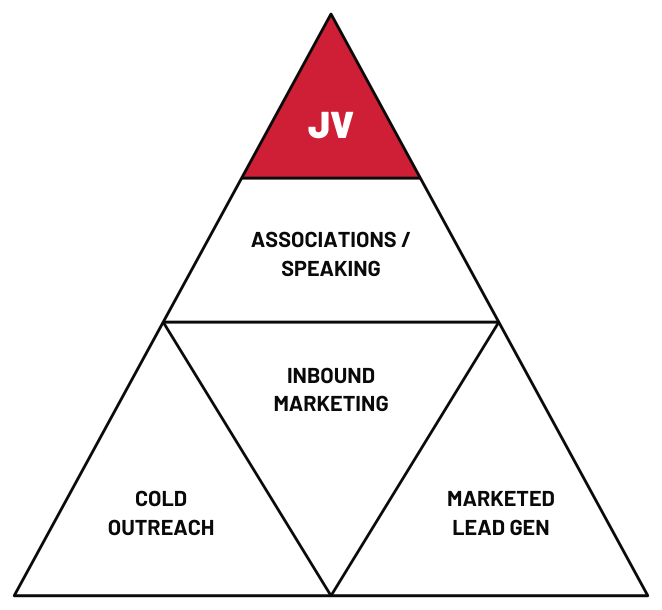
Instead of saying, "I'll give you five minutes of my time, but I'm really busy and not interested," we want them coming in saying, "Look, I've already seen what you do. I've seen your case studies. I read your content. I want to hire you. Just tell me how much it costs."
The secret to getting plenty of appointments and consistent deal flow: You've got to get out of the habit of one deal a quarter or one deal every now and then. Instead, you want to move to consistently landing clients on a monthly basis. When you do that, that's when you're starting to build a seven-figure agency.
This isn't theory. Here's what the Ultimate Agency Funnel has produced in our own agency, followed by the scale of the community running these frameworks:
Individual Agency Results (Plumbing & HVAC SEO):
32,000+ leads opted in
2,712 strategy sessions conducted
561 retainer-based clients sold
$1.2 million in MRR generated
Over $32 million in total revenue
Current status: $7M annually with 47 team members Community-Wide Impact (Seven Figure Agency Members):
More than 1,000 agency owners coached since 2018
Hundreds of active members implementing this system today 197 agencies at seven figures and beyond
44 agencies at multiple seven figures
Median member MRR: about $56,000 per month. The average is nearly twice that, because a handful of our members are past $500,000 a month.
Now that you understand the complete Growth System framework, let's dive deep into your foundational piece: The Ultimate Agency Funnel.
FROM STRANGER TO STRATEGY SESSION
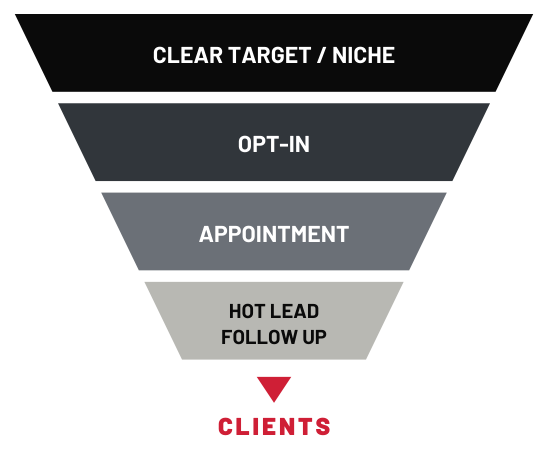
This is your infrastructure for capturing leads, nurturing prospects, and converting them into strategy sessions. Without this foundation, all your other client acquisition activities (cold outreach, authority building, paid ads) won't convert effectively.
Think of the funnel as your conversion engine; it takes interested prospects from any source and moves them toward becoming clients.
The Four Key Elements:
First, you need a clear definition of your core niche or market. We'll be looking at that more closely later, but this is the foundation of everything.
You need a Lead Magnet of some sort that people can opt in for. Whether it's a cheat sheet, a guide, a printed book, or a case study, you need something that causes them to raise their hand to opt-in to your world.
What I've found is that the cheat sheet works best; something very simple like "The Ultimate Plumbing and HVAC Online Marketing Cheat Sheet" or "The Ultimate Dental Marketing Cheat Sheet." It's high desire, low commitment, and you can create one without investing a ton of time.
Alternative lead magnets: an internet marketing guide for your industry, keyword lists (most commonly searched keywords in your niche), case studies ("How This One Company Got This Outsized Result"), or website optimization frameworks.
You need an appointment funnel where it's easy for them to go from raising their hand to getting onto your schedule. Once they opt in by giving you their email, give them the opportunity to get to your calendar, where they can schedule themselves for an appointment.
The key insight: They didn't just download the cheat sheet because they want the information. They want the result, and the result is best if they have somebody who can implement it for them. So offer them the opportunity to sit down, one-on-one, so you can talk about their business and how you can execute this for them.
Once you have the lead, it's important that you have an effective followup process. First, you want to have a great follow-up package that can go out after the appointment. When you do that consistently, you can start to close deals consistently.
This is called a hot lead follow-up campaign; the process is engineered in advance, so you know the exact touches the client is going to get to move them from interested to closed.
In an agency model, the end goal is clear: a credit card authorization form for monthly retainer services. Don't get confused by information business models with trip wires and lead maximizers; we're focused on recurring monthly revenue.
What would prospects have to experience to reach the point where they're giving you their credit card authorization? Map this journey backward from the sale.
What would your prospect find interesting enough to give you their name, email, and cell phone number? The bait must be relevant and compelling to your specific niche.
Critical: Always collect name, email, AND cell phone number. You'll get fewer opt-ins but higher-quality prospects you can actually reach.
Regardless of your lead magnet (book, guide, cheat sheet), most people won't consume it fully. Offer the shortcut: "I'm sending you the book; you'll love it. But if you want help now, go ahead and schedule a time."
Your business owner prospect is Type A, busy, with a million things going on. They may request a book, but probably won't read it. Always offer the immediate path to the conversation they actually want.
Don't rely solely on automated sequences. Follow up via phone, social media, email, and SMS across all channels where prospects might be thinking about your services.
Landing Page Elements:
Hero image of your lead magnet
Clear value proposition specific to your niche
Simple form: Name, Email, Cell Phone Number
Compelling call-to-action button Key Performance Indicators: target 25-30% opt-in ratio on landing pages. Always ask for a cell phone number despite reduced conversions; quality over quantity, you need to be able to reach them.
There's one change to this stage that matters more than anything else in this chapter, and most agencies haven't made it yet.
For years the rule was simple. Collect name, email, and cell phone number, and accept that you'll get fewer opt-ins in exchange for people you can actually reach. That rule still holds. It just isn't enough anymore, because of what you can do the second a lead hits your system.
In the next chapter you're going to see how to open a conversation by showing a prospect something specific and true about his own business. Where he ranks for the searches that actually drive his revenue. The gap between him and the guy beating him. What his website is doing to the leads he's already paying for. That analysis takes minutes to produce now instead of an afternoon.
But you can only produce it if you asked for the inputs. So add these four fields: Company name, City or primary service area, Website URL, The services they want more of.
Four more fields. Will that cost you some opt-ins? Yes. Do it anyway, and here's the math on why.
A lead where all you have is an email address goes into a generic nurture sequence and waits. A lead where you know the company, the city, and the website can trigger a real analysis of that business before you ever speak to them, which is a completely different conversation with a completely different close rate. One name-and-email lead is worth a fraction of one complete lead. You don't want a bigger list. You want a list you can do something with.
And make the fields feel earned instead of nosy. "So we can pull your current rankings before we talk" converts a whole lot better than a blank box, and it's true.
Look back at the five-stage pipeline for a second. Stage 1 is raw opted-in leads, and you know what's in there - wrong industry, fake emails, tire kickers mixed in with real prospects. Stage 2 is qualified leads. The way we've always bridged that gap is with a person, usually a VA, grinding through the list one at a time.
That step doesn't need a human anymore. Every lead that comes in can get researched the moment it arrives. Is this a real business? Are they in your niche? How big are they? What does their online presence look like? Where are their social profiles? Is the contact info even real? The lead lands in your pipeline already sorted, already enriched, with a verdict attached.
The thing that changes isn't the cost of that step. It's the speed. Speed to lead has always been the highest-leverage variable in this entire funnel, and the gap between reaching a qualified prospect in five minutes with real context versus a day later with none is enormous.
Your salespeople will feel this immediately. They stop digging through junk to find the good ones, which is a conversion win and, just as importantly, a morale win.
Set the boundary clearly, though: the system researches, enriches, and recommends. A human decides who gets pursued and how.
Now here's the opportunity I think most agencies are sitting on without realizing it.
The cheat sheet works because it's high desire and low commitment. But it's got one weakness that's always been there, and it's a big one: it's generic. Everybody who downloads it gets the same PDF. That's exactly why Principle 4 exists, because most of them are never going to read the thing.
But if you can produce a personalized analysis of somebody's business in minutes, then the analysis is the lead magnet. So instead of "download our marketing cheat sheet," the offer becomes: "Put in your website and we'll show you where you actually stand in your market."
Why does that beat everything else in your funnel? Because it's about them, not about you. Nobody has ever been excited about your PDF. Everybody is interested in their own ranking report. Because it qualifies while it converts: they hand over the company, the site, and the market just to get their result, so every opt-in is a complete lead by definition. Because it creates the gap early: they show up to your strategy session having already seen the problem, which means you're not spending the meeting convincing him something is wrong. It's the same psychology as the pre-meeting homework back in Stage 5, moved all the way to the top of the funnel. And because it's genuinely useful whether they hire you or not, it feels like a gift instead of a trick.
Two rules if you build one. First, the analysis has to be real. A "report" that's a thin template with their business name pasted into it will hurt your credibility faster than sending nothing at all. Business owners can smell that in about four seconds. Second, it ends with the shortcut, exactly like Principle 4 says. Here's what we found, and here's the link to sit down with somebody who can fix it.
This isn't a replacement for your cheat sheet. Run both. Then watch which one produces people who show up already believing you can help them.
Critical Elements: an autoplay video (not just text confirmation), immediate value delivery acknowledgment, clear path to appointment scheduling, and social proof and case study links.
Video Script Framework: "Hey, thanks so much for requesting [lead magnet]. I'm going to go ahead and send that right over to you. If you're like most [industry] businesses, you understand the concepts but really just want someone who can implement this for you. Let's go ahead and schedule a time where I can show you exactly how we can execute this in your business."
Pre-Screening Process: Before calendar access, ask 1-2 disqualifying questions: "Do you run a [industry] business?" and "Are you spending at least $1,000/month on marketing?" This filters out unqualified prospects and reduces wasted time.
Appointment Landing Page Elements: a video explaining the "Lead Flow Acceleration Session," clear benefits ("We'll analyze your website, current rankings, and show you exactly where there's room for improvement"), easy calendar scheduling, and a professional presentation that builds anticipation.
Most people send prospects to a basic "add to calendar" page. Instead, use video to warm them up: "Awesome, so glad you scheduled! I'm really looking forward to connecting with you. Please block this on your schedule because our team will do significant preparation. We'll pull up your website, do keyword research, and come prepared. To help you get mentally framed, please review these case studies before we meet."
Additional Elements: link to calendar for easy adding, pre-appointment questionnaire, case studies and social proof, clear expectation setting.
Create a self-assessment video explaining your methodology: "To grow your [industry] business, we need to do three things: drive leads, maximize conversion of those leads into sales, and optimize ROI. Please rate yourself in each area before our meeting."
The Psychology: Prospects who watch this homework arrive having already identified gaps in their current strategy, making the sales conversation much easier.
Assessment Areas: Lead Generation (SEO, paid search, database marketing), Conversion Optimization (website, reputation, speed to lead, automation), ROI Tracking (cost per lead, true ROI measurement).
They come to the appointment saying, "I don't have the marketing automation piece dialed in. My tracking isn't helping me see my true ROI. I think you can solve these problems."
The Problem: You've done your prep work, have all your tabs up, you're excited about the meeting... and they don't show up. It's frustrating and disrespectful.
Step 1: Connect on Social Media. After they schedule, find them on Facebook or LinkedIn and send a connection request. When they see you're a real person trying to connect, they're much more likely to show up.
Step 2: Send Their First Name. Once connected, send a simple message with just their first name: "Rocco." They'll almost always reply with "Hey," "Yeah?," or "Who's this?"; now you've started a human conversation.
Step 3: Personalized Video (Bonus). Record a quick 10-second video: "Hey Brian, I see you just scheduled. Looks like you're doing great things at XYZ Plumbing. Really excited to meet and show you what we're seeing with your internet marketing."
This simple process can double or triple your show-up rates.
Stage 1: Opted In. Raw leads from all sources, including non-qualified leads, wrong industry, and fake emails. Requires research and verification.
Stage 2: Qualified Lead. Your team verifies they're a legitimate business in your target industry, meet minimum revenue/marketing spend requirements, and have accurate contact information.
Stage 3: Scheduled Strategy. Appointment booked; a pre-qualified prospect with a confirmed meeting, warmed up through the confirmation process and ready for a consultative sales conversation.
Stage 4: Hot Lead Follow-up. Interested but not yet closed; they had the strategy session, see the value, and need additional nurturing to a final decision.
Stage 5: Won/Lost. Final outcome, a clear resolution to move them out of the active pipeline and data for optimization.
Having this visual pipeline makes a huge difference in tracking and moving prospects from interest to signed contracts.
Performance Benchmarks: 5% opt-in to appointment conversion (with proper follow-up) and a 30% close ratio minimum (20% acceptable starting point) for 15+ strategy sessions monthly to sustain momentum.
You have a great meeting. They're interested. They see the value. They agree there's a problem you can solve. You present your program and pricing. They say, "This sounds great, let me think about it." Most agencies stop here. They send a proposal and hope for the best. Seven-figure agencies implement hot lead follow-up.
Physical Mail Component: Send a branded package containing a copy of your book, a program overview document, client case studies and references, and professional presentation materials.
The Psychology: Everything up to this point has been digital. A physical package is outside the norm, impressive, and tangible.
During the sales call: "Can we both agree to come to a decision within the next two weeks?" Most prospects agree because it seems reasonable. Now you have permission for urgency-based follow-up and the ability to use takeaway closes.
Email Sequence Timeline: Day 1, package shipping notification. Day 3, "Did you receive the package?" Day 6, additional case studies. Day 9, client references offer. Day 12, "Approaching our two-week deadline." Day 14, takeaway close.
Day 14 Message: "It's been two weeks since we spoke, and it seems like you've decided to go a different direction. Not a problem, I appreciate the opportunity. I would love your feedback on how we can do better next time."
What Happens: If they were truly interested, this often triggers immediate re-engagement: "Whoa, whoa, whoa! I do want to do this. Let's get started." If they don't respond, you know they were never going to buy, and you can free up mental space and pipeline capacity for real opportunities.
Complete Funnel Setup in HighLevel: landing pages (drag-and-drop builder with mobile optimization), email automation (sophisticated sequences with tagging and segmentation), SMS integration (two-way text messaging for immediate engagement), calendar booking (embedded scheduling with automatic confirmations), pipeline management (visual funnel with stage automation), and retargeting (pixel tracking and ad campaign integration).
Opt-In Sequence: immediate email with lead magnet delivery, SMS welcome message with next steps, 5-minute phone call trigger, social media connection task creation, retargeting pixel activation.
Appointment Sequence: confirmation email with calendar link, SMS reminder 24 hours before, email with case studies and prep materials, SMS reminder 2 hours before, pipeline stage update.
Hot Lead Follow-Up: package shipping notification, 7-email nurture sequence over 14 days, SMS check-ins at key milestones, automatic pipeline movement at deadline.
Case Study: The $450K MRR Exit Strategy
Jim and Brian Neibler (Roofer Marketers)
Starting Point: $13,000 monthly recurring revenue
Niche: Roofing contractors exclusively
Implementation: Complete Ultimate Agency Funnel system
Growth Period: Several years of consistent execution
End Result: $450,000 monthly recurring revenue
Exit: Multiple seven-figure sale to Job Nimbus (major industry CRM) Key Success Factors: niche focus made roofing the obvious choice; every lead went through the same proven funnel; the focus stayed on high-value, longterm relationships over volume; industry integration built relationships that led to the acquisition opportunity; and execution was daily, not occasional.
The Lesson: You don't have to be overly fancy or overthink it. If you implement this process and put some traffic behind it, you can have accelerated growth leading to significant exit opportunities.
Your 90-Day Implementation Roadmap
Days 1-30: Foundation Phase Week 1, Strategic Setup: choose your primary lead magnet (start with cheat sheet for speed), set up HighLevel account and basic automation, create optin landing page with hero image, write email sequences for lead nurture.
Week 2, Content Creation: develop confirmation page videos (opt-in and appointment), create case studies and social proof materials, build prequalification survey questions, design appointment booking workflow.
Week 3, Appointment System: build appointment landing page with prescreening, set up calendar booking with HighLevel integration, create confirmation page with warm-up video, develop pre-meeting homework assessment.
Week 4, Testing and Optimization: test complete funnel flow from opt-in to appointment, set up social media connection protocols, train team on speed-to-lead procedures, launch soft traffic to identify any issues.
Week 5-6, Traffic Generation: begin cold outreach to qualified prospects, start daily content creation and posting, launch initial paid advertising campaigns, implement social media advertising to niche audience.
Week 7-8, Conversion Optimization: optimize landing pages based on initial performance data, refine email sequences based on engagement metrics, begin first strategy sessions with prospects, implement pipeline management protocols.
Week 9-10, System Refinement: implement hot lead follow-up system, create physical package for interested prospects, establish two-week deadline protocols, train team on takeaway close methodology.
Week 11-12, Growth Acceleration: scale advertising spend on proven funnels, develop a systematic case study process, refine qualification and appointment booking, optimize conversion rates across all funnel stages.
Expected Outcome: Agencies following this sequence typically add $15K$35K in new monthly recurring revenue within 90 days, setting the foundation for seven-figure growth.
Perfectionism Paralysis: don't spend months creating the "perfect" funnel. Start with good enough and improve through iteration.
Platform Jumping: pick one system (recommend HighLevel) and master it rather than constantly switching tools.
Skipping Follow-Up: the money is in the follow-up. Automation alone won't convert; you need human touch and persistence.
Neglecting Speed to Lead: the first 5 minutes after opt-in are critical. Have systems for immediate contact.
Generic Messaging: tailor all copy and content specifically to your niche. Generic messaging doesn't convert.
Technology Stack: Budget $500-$1,500 monthly for HighLevel, design tools, automation platforms, and team communication systems.
Time Commitment: Plan for 10-15 hours weekly, implementing these strategies while maintaining current client work. This isn't passive; it requires focused execution.
Mindset Shift: Stop thinking like a technician who trades time for money. Start thinking like a CEO who builds systems that generate leverage.
Success Indicators Timeline: Month 1, consistent opt-ins and basic funnel functionality. Month 2, first strategy sessions from funnel-generated leads. Month 3, initial client closes and process optimization. Month 6, predictable monthly appointment flow. Month 12, seven-figure growth trajectory.
The Ultimate Agency Funnel is your foundation for consistent lead generation and conversion, but it's just one component of your complete client acquisition system. Chapter 6, the Cold Outreach Formula, gives you proactive prospecting to fill your funnel. Chapter 7, the Client Attraction Method, builds the authority that makes clients seek you out. Chapter 8, Sales Mastery, converts appointments into signed clients.
The Ultimate Agency Funnel creates the infrastructure. The question isn't whether this system works. We've proven it across hundreds of agencies, generating more than $280 million in combined revenue. The question is whether you'll implement it.
Time to stop chasing and start attracting.


In one month, Brady Sticker signed 108 clients.
Everyone assumes there was a secret ad. There wasn't. In his words: it was not a special Facebook ad and not a special hook, it was the right offer to the right audience, and trust that had been built over time.
Here is what actually happened, because the mechanics are the lesson. Brady runs ChurchCandy Marketing, serving churches, on a single offer at $750 a month. He had roughly 1,500 people in his database who had taken a sales call over the years and never signed. In March, the month before Easter, when every church in the country is about to have its biggest Sunday, he waived his setup fee and went back to that list. Then a full-time SDR worked the replies inside the CRM and got them onto calendars.
That is this chapter in one story. The funnel is not the ad. The funnel is the list you have already built, the offer that makes acting now obviously better than acting later, the timing that matches your market's calendar, and a system that catches the responses before they go cold.
Brady will tell you the reason it converted was three years of books, podcasts and speaking that meant those pastors already knew who he was. He was twenty-five when he crossed seven figures. He has since passed $175,000 a month.
He also made one mistake worth stealing: he sent all 1,500 texts at once instead of dripping them. Build the system so a good month cannot break it.
"The reason you need to have an aggressive cold outreach strategy is so you can control your destiny. If you just wait for inbound leads or marketed leads, you might be waiting all year and only get a couple of clients." - Josh Nelson
In Chapter 5 you built your appointment funnel. Now it's time to fill it with the daily activity you control completely.
This is the daily row of the Fill Funnel column, and don't mistake daily for minor: it's controllable, gets you results without the 6-12 month wait inbound or marketed leads require, and every contact becomes part of the database that feeds your funnel and accelerates everything else, including the content and authority building in Chapter 7.
The Critical Understanding: your ultimate goal is prospects coming to you pre-positioned to buy, but you need cash flow and momentum now, and cold outreach provides both while you build that long-term positioning.
Let me tell you why this chapter looks different than it did in the last edition.
Every time I'm in a room full of agency owners, I ask for a show of hands: who loves prospecting, making the calls, sending the emails, circling back? I have asked that question dozens of times. I have never gotten a single hand.
We all know we need to do it, so eventually we build a team: I'll hire someone to own this.
Finding somebody who will do that work consistently and well is easier said than done. They'll do it for a couple of months, burn out, then ask to be a closer or move into some other role, because sending emails all day and getting ignored is a hard job. The activity starts strong and tapers off: momentum builds, clients start coming in, and the outreach quietly stops.
There's a second problem too, and it's new. Anybody can send thousands of emails at the drop of a hat now, so generic messaging gets ignored, straight to spam or the promotions tab. Volume used to be an advantage. Now it's a liability.
So we have to ask a different question: not "who can I hire to do this?" but "what if we could train an agent to handle this?" That's what changed, and it changes the whole chapter.
Let me describe a real morning.
While I was asleep, a sales development rep on our team picked a city. Tacoma. It identified 29 prospects in that market, researched every one of those companies, found the owner names and contact details, generated 29 personalized market intelligence reports, and sent 25 introductions.
I didn't do anything. Nobody on my team did.
That SDR is an agent: it never sleeps, never forgets the research, and never gets bored and asks for a different role. It just executes what it was trained to do, day after day.
The breakthrough is not the AI, which is only a mechanism. It's coming to the market with value in advance instead of a pitch, and doing it consistently, which is the thing human beings are worst at.
Cold outreach done wrong is just cold calling again and again: chasing prospects, hard-selling strangers, closing roughly one in ten, needing many more appointments for the same result. Done right, the approach in this chapter gets prospects to raise their hand, moves them into your funnel for nurturing, and positions you as a problem-solver instead of a vendor.
The goal: strategy sessions with people who are already somewhat interested, as opposed to making 100 calls to get one person who might be.
That's also where cold outreach's bad reputation comes from, and the standard for everything in this chapter: lead with value instead of leading with annoyance.
Five people a day should hear from you who hadn't before. Do that consistently, week after week, and prospects emerge. Pair it with the rest of the Growth System, the monthly webinar and industry interviews, and every introduction makes the next asset work harder.
Here's the mistake almost everybody makes, and the last edition of this book made it too: going straight to the hardest version.
THREE WAYS TO GET YOUR LIST
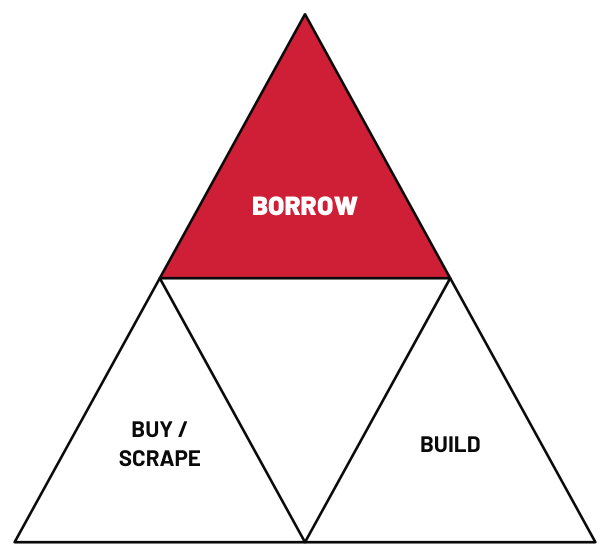
The hardest prospect to reach is the one you grabbed out of the ether. Somebody who has never heard of you, has no relationship with you, and no reason to open your email.
The easiest prospect is a referral, then the one already in your database, the one you already met with, the one already in an association you belong to.
So we're going to build this in four deployments, easiest to hardest. Each one works on its own, worth doing even if you never get to the next.
Meetings you've already booked. Zero new infrastructure. Auto-
mated sales meeting prep.
The pipeline you already paid for. Re-engaging unconverted oppor-
tunities.
The associations and groups you already joined. Value to members.
Net-new markets. Autonomous prospecting into people who don't know you.
Most agency owners want to start at four. Start at one: you'll have a win this week instead of next month, and each deployment teaches you something you need for the next.
If there's no bleeding neck problem, there's no sale. So the single highestleverage move before a sales appointment is arriving able to point at a specific, quantified problem you're prepared to solve.
You're already running some version of the appointment funnel from Chapter 5. Somebody schedules, and the page sells them on what they're going to get: the keyword list, where they rank, where they don't, how they compare to their competition, and why they're not winning online today.
That funnel is selling a report, so it has to exist.
For years, ours was manual. Every time an appointment came in, a team member built the keyword list, ran the ranking report, checked their site, tested their web form to see if anyone replied, and assembled it. It took him 45 to 60 minutes per appointment.
Now it happens automatically. Somebody schedules, triggering the research, and the report is built before anyone on my team looks at the calendar. Review count and rating. Map position. Estimated revenue they're missing. Who's ranking for the keywords that matter. Exactly where they sit against those competitors.
Nobody spends a minute preparing, and we deliver on the entire promise of the funnel.
What this requires from you is less technical than you'd think, and more strategic:
Capture the right fields at scheduling. You cannot analyze what you didn't collect: at minimum, company name, city, website, and primary services. That last one matters more than people expect, since a plumbing company, an HVAC company, and an electrical company are three different analyses the research needs to tell apart.
Trigger on the appointment: when it's booked, that fires the research, a basic automation in whatever CRM or scheduler you already use.
Put the report where your team will see it: a link on the opportunity record and a notification wherever your team works. Ours posts to the channel we live in all day, along with whatever the prospect answered on the pre-appointment survey.
Review before you walk in, especially early on: you're checking that the analysis is congruent and that nothing embarrassing made it in.
That's it: no new domain, no sending infrastructure, no list.
You have opportunities sitting in your CRM that you paid to generate: they took a meeting, seemed interested, weren't ready, and nobody has talked to them in months.
If you shook those bushes, something would fall out. You just don't have the time or energy to follow up with all of them.
An agent does. Give it access to your pipeline and inbox, and it can read the opportunity history, your conversation history with that person, the sales call transcript if you record them, and identify the 20 or 30 opportunities genuinely in play that nobody has touched.
Some of you just clenched up: you can't have AI emailing prospects you met with personally without knowing what it said. Agreed. Don't.
Set it up to draft: it writes the message, puts it in your drafts, and you read it before it goes. You'll correct it a few times over a couple of weeks, then one day you'll notice you're approving everything without changing a word. That's when you let it send.
That trust ladder matters more than the automation. It's the same principle we'll come back to in Chapter 10 with your team: leeway inside limits, with an escalation path when something is outside the lines.
This deployment is worth doing second because the hardest part of outreach, having something intelligent to say, is already solved: you have history with these people, and a real reason to circle back that isn't "just checking in."
Almost everyone belongs to an association or industry group in our niche; if you don't, join one. We'll come back to why in Chapter 7.
We join these groups for good reasons: credibility, events, eventually a stage, the member directory. Then here's what actually happens: we send one introduction, maybe mail a copy of our book, and do nothing else for two years.
Ask yourself honestly: are the members of your association hearing from you a couple of times a month? Almost nobody says yes.
So here's the deployment. Every member of every group you belong to goes into your database, tagged by group. Then, every weekday, a small batch gets pulled, a report gets run for their specific business, and an introduction goes out that earns its opening line: we're members of this association, we ran this analysis for members in your market, and yours came up. Want me to send it over?
Two things make this work. Keep the volume small and send from your real domain, the one you or your salesperson already uses, because you're not a stranger here and the affinity is the whole point: twenty-five a day, not hundreds. And every message is different, not one template with the company name swapped in, because each report is different, because each business is different.
Which brings us to the deployment everybody wants to start with.
Now let's talk about the strangers. People who have never heard of you, aren't in your database, and have no affiliation with you.
FOUR ELEMENTS , IN ORDER
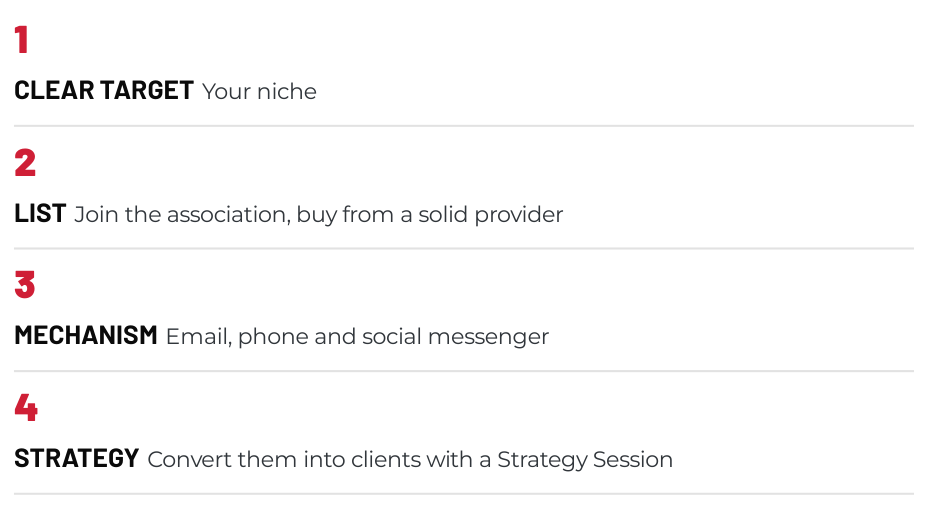
This is how we built Plumbing & HVAC SEO in the first place: one city at a time. We pulled every plumber in Fort Lauderdale and sent them all a message: we're looking to work with one company in this market, here's what we do, first come first served. Then Miami, then West Palm Beach, then Orlando, straight cold to people who had never heard of us. It built an agency.
It also died, because it was tedious and time consuming and we stopped being consistent. That is the entire reason this section exists.
One market, one report, one campaign.
For us the atomic unit is a city. For you it might be a metro, a state, a chapter of an association, a franchise system, a conference attendee list, or a category of business. Whatever it is, it needs to be a unit where you can say something true and specific about the whole group, with a single analysis covering everyone in it.
Get this wrong and nothing downstream works: the report has no coherent subject.
This is where more outbound programs die than anywhere else, and the rules have gotten stricter.
Never send cold outreach from your main agency domain. Use a separate one, a variation of your brand with a different extension and real inboxes for real people. Deployments 2 and 3 can go from your primary domain because those people know you. Deployment 4 cannot.
Warm it up longer than you want to; a brand new domain sending cold email on day one will burn. Guidance is a minimum of about two weeks of gradual ramping before the first cold send, three to four weeks is better, starting at a handful a day.
Cap each inbox at 20 to 30 sends a day and leave it there. That ceiling exists to stop abuse, not to tell you what's safe: a human doesn't send hundreds of near-identical emails a day. Want more volume? Add another warmed inbox rather than raising the cap.
Get SPF, DKIM, and DMARC right before you send anything, keep spam complaints under 0.3%, and honor unsubscribes immediately, every time. Since late 2025 the major mailbox providers reject non-compliant mail outright instead of filtering it, so the failure mode now is a bounce, not the spam folder.
Be careful how you buy domains too: one of our members lost an entire sending infrastructure of ten domains in a single week when a major blocklist purged domains with no real content behind them. His lesson: spread purchases over 30 to 60 days, use more than one registrar, avoid exact-match variations of each other, and put real content on them.
This is the one you should spend real time on. Everything else in this chapter is plumbing. This is the product.
Two things changed my thinking here.
First, when you're going cold into a market, an analysis of the market outperforms an analysis of their company: "We analyzed the top 30 plumbing companies in Orlando, looked at who's winning and who isn't, stacked reviews and rankings and who has online scheduling, and your company came up. Want to see how you stack up?" That's a different email than "I noticed some issues with your website."
Second, data is not insight. Most automated tools produce a keyword list and a rankings table your prospects have already received a hundred times. It doesn't stand out, and it doesn't get a reply.
So interpret it for them. Take the search volume, apply the click-through math, apply their average transaction value, and turn it into the number that actually matters to a business owner: missed jobs, missed calls, missed patients, missed cases, missed revenue. No number, no tension.
The report we run leads with a question, not a company name. Who controls the plumbing calls in this market, and what are they worth? Twenty companies analyzed. Eight keywords tracked. Fifty-seven thousand dollars a month in opportunity. Then who's dominant, who has plateaued, and who's emerging.
Don't sleep on conversion factors either, because this is where you separate from every other agency sending audits: online scheduling, two-way text, speed of lead response, review acquisition. A prospect can have a great website and strong rankings and still lose most of their opportunities because nobody answers the form for six hours. Show them that.
If you don't do SEO, the structure holds and the signals change. Running paid? Analyze the ad libraries and transparency data, show who's spending, on what, and for how long. Social? Analyze posting consistency, engagement, and what the top players are doing. Web? Analyze speed, mobile experience, conversion paths. The question is always the same: who is winning in this market, what is it worth, and where does this prospect stand?
This is where we got stuck for a while. We understood the reports and that an agent could run them, but not how to make it recur without somebody deciding what to do each morning.
The answer was almost embarrassingly simple. A spreadsheet of every market we'd ever want a client in, sorted by population. There are 351 markets in the United States with more than 25,000 people, all markets where we'd happily sell a client.
Start at the top. Every weekday, take the next one down: run the analysis, find the prospects, enrich the contacts, send the introductions, log it, move on. You never instruct it again, just refill the queue.
Twenty to twenty-five prospects a market, five days a week, is roughly 400 to 500 research-backed introductions a month, none of them identical.
One more source most agencies never think about: the supplier, equipment distributor, software vendor, or trade publication already selling to your prospects without competing with you. They have a list and a relationship, and a joint market analysis is a much easier ask than a list swap: "We're running a market study on the top companies in these ten cities and we'd like to co-brand it with you" gets a yes surprisingly often, and now you're not cold at all.
The enrichment piece is worth a note. Scraping the companies in a market is easy; getting the owner's name and a direct email is the hard part, and it's the part that determines whether any of this works. Research alone gets you a good way there, checking business registries, licensing records, and the company's own site. For local businesses, a list service with human researchers gets meaningfully higher accuracy, at the cost of a couple of days of lag. Either way, know your match rate: a wrong name is worse than no email.
You can send every email in the world, but if nobody is there when someone replies, you've created noise, not opportunities. The agent's entire job is to bubble up mild interest. A human closes.
We preach speed to lead to our clients every day: call the lead back in five minutes or they've moved on. Then we violate it in our own pipeline, because a reply sits in an inbox nobody is watching until the end of the day.
Route replies to wherever your team actually lives, not to an inbox: when someone engages, somebody knows within minutes. Then work it:
Hot ("this is interesting, let's talk"): personal reply within 30 minutes, with a calendar link.
Warm ("send more info," "what do you charge?"): re-send the report and offer a short call the same day.
Future ("not right now, maybe next quarter"): into long-term nurture, and mean it.
Not interested: suppress immediately, one polite line, never contact again.
And when you get a tentative reply, pick up the phone. They're not going to reply "you've changed my life, let's meet." They're going to reply "send it." That is your opening. Call the office. "Hey, I just heard back from Bob, he asked me to send the market report. Happy to walk you through it, takes about fifteen minutes." There's a short window after somebody engages where they're thinking about you, and then it closes.
Give the agent a framework, not a template. This is not a style preference anymore. As of early 2026 the major mailbox providers started scoring content with their own AI, looking for mail-merged templates and formulaic openers. Perfect authentication won't save a templated email, but the reportled approach is naturally safe: when every message is built from a different market's actual data, every message genuinely is different. You're not evading a filter, just not doing what it's looking for.
THREE PLAYS FOR THE FIRST TOUCH
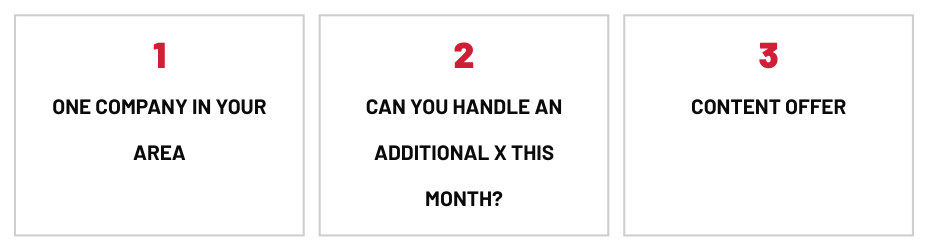
Three angles, in sequence:
The offer. We analyzed the Jacksonville market and noticed something interesting. Three companies are capturing most of the search-driven revenue. Your company appeared in our research and I thought you'd find it useful. Want me to send it over? Ask permission instead of attaching the link. A yes/no question gets a response, and a yes makes them a participant.
The delivery. They didn't answer, so send the report itself: now they can see for themselves it's real and valuable.
The specific insight. One finding about their business, from their section of the report. You've got 396 reviews and you're still not ranking in the map pack for your top three keywords. Want to see who is?
Four rules for every message: every email references the report, since it anchors the sequence; their business name and market appear in the subject line; the first email never pitches, it's a gift, not a sales letter; and personalization comes from their actual position in the report, not merge fields.
The four campaign angles from previous editions still work, better with a report behind them: geographic exclusivity (one company per market), the high-ticket service angle (asking about their most profitable job type instead of "more leads"), a specific observation about their marketing, and the case study open loop (one paragraph on your best client result). Rotate them so a long campaign doesn't feel like a sequence.
Email is easy and it gets delivered. It's also where everybody is flooded, including with reports like yours.
Your prospects get far less volume everywhere else. Once the agent has done the research, that intelligence can travel through every channel you have. One touch anywhere equals zero outcome. Plan on ten touches minimum across channels before somebody moves to long-term nurture.
The highest-responded touch I've found is a personal video. Your SDR or salesperson pulls out their phone: "Hey Bob, glad we connected here. We just did an analysis of the top companies in the Austin market, I sent it over by email, wanted to make sure it landed. Shoot me a quick reply when you get a moment."
An email arrived, then the office got a call, then a real human said their name in a video on LinkedIn - a different impression than another email, and the honest answer to what your SDR does all day now that sending is handled: calls, videos, social touches, and working live conversations, which is what you hired a person for in the first place.
One thing to get right, and it's why this chapter connects to Chapter 8.
Somebody who found your funnel, filled out the pre-appointment survey, and scheduled a call comes to you pre-positioned, having seen something they liked and decided to meet with you. That's your full consultative process.
Somebody you reached out to cold is not that person. Treat an outboundsourced conversation as a 15-minute discovery, not a full consultation. Walk through what you found, ask about them, and earn the right to go further.
On that call: reveal what you found, quantify it, then get permission. "Based on what you're seeing here, what stands out most to you?" Let them own the problem. "If you were capturing another 40 or 50 calls a month, what would that mean?" Then, and only then: "Would you like help closing that gap?"
Most of these turn into a second, longer conversation. That's a win, not a stall.
Two sets of numbers, because you should know which game you're playing.
Generic cold outreach, done well: 25-35% open, 2-5% reply, 0.5-1% booking an appointment, closing at 10-15%.
Here's what we see when report-led outreach is working, from our own campaigns and our members': open rates in the 35-65% range, 8-25% of openers clicking through to the report, and positive replies in the low single digits. Treat these as our benchmarks, not industry averages, and treat your own first market as the number that actually matters.
At 400 to 500 prospects a month, a report-led program should produce four to eight booked meetings and one to two new clients a month once it's running. Not on day one. Once it's running.
Stop and fix if you see any of these:
Open rate under 20% after a full market: your subject lines or your deliverability.
Hard bounces over 30% in one market: your enrichment quality.
Zero replies across three consecutive markets: your report or your message. Don't send a fourth. Fix it.
I've watched enough agencies build this to know exactly where it goes wrong.
Automating before the report works. The report is the product. Prove it manually on ten prospects first.
Sending generic reports. If the market name isn't in the headline and throughout, it reads like software made it.
Skipping the revenue math. No number, no tension, no reply.
Sending from your main domain. A handful of spam complaints can damage a sender reputation you've spent years building.
Responding to replies slowly. Hot leads go cold in hours. Two hours, maximum.
Over-engineering before sending. The best system is the one that actually sends. Start, then refine.
Month 1: Build and warm. Define your atomic unit, build one report and iterate it until you'd be proud to send it to your best client, buy the domain, set up authentication, and start the warmup. Deploy the sales meeting prep too, since it needs none of that and can run this week.
THREE STEPS , IN ORDER
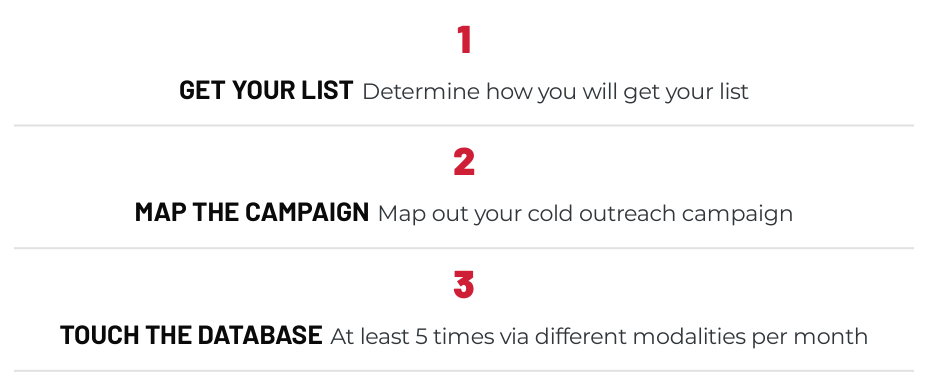
Month 2: Run it daily. One market a day. Real reports, real introductions, first meetings booked. Tune the scripting for how you move a passive reply into a scheduled call.
Month 3: Make it permanent. It runs every weekday. Your only jobs are refilling the queue and working replies.
And one honest note about expectations. I ran this live in a room of agency owners. While we were sitting there, 25 introductions went out to 29 researched prospects in Tacoma. I checked at the break, hoping to tell the room we'd gotten five replies and booked meetings.
Zero replies.
The messages went out. Nobody had to be talked into doing it, nobody burned out, and it happened again the next morning and the morning after that. Outbound has never failed because one day didn't work. It fails because week three doesn't happen.
Only a small percentage of any list raises a hand right away. The real value is what happens over the following two years.
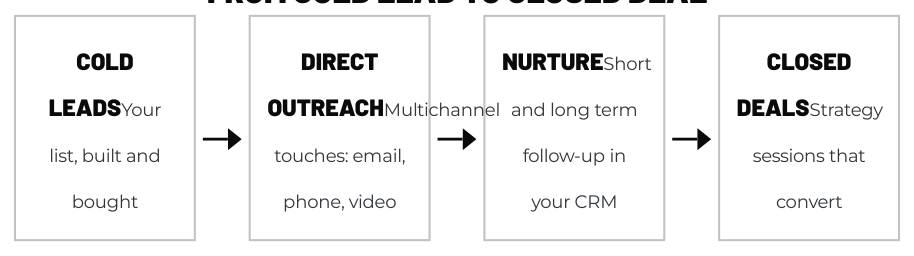
The goal is the phone call that starts with "I've been getting your emails for years and I'm finally ready." At that point you're not convincing anybody. They just need to know if they can afford you.
Everything you learn in Deployment 4 feeds this: weekly value emails with industry insight, case studies, and practical help; monthly distribution of your webinar and podcast content from Chapter 7; every prospect who didn't reply moves into that nurture rather than out of your life.
This is the compounding piece: twenty-five new contacts a day is 500 a month, 6,000 people a year who know your name, in a niche where there are only so many companies worth having.
Danny's journey shows what focused cold outreach plus persistent execution actually produces.
The Starting Point:
Former IT analyst at Fox News
Lost $10K+ on a failed e-commerce business
Power turned off, car repossessed, went through a divorce
A Wells Fargo letter showing minus $417 in his bank account
He HAD to make digital marketing work, or it was over The Breakthrough:
He started as a generalist doing "Contractor SEO," too broad since contractor could mean a roofer, a builder, a deck company, a pool service, or a plumber, so the message resonated with nobody. He narrowed to decorative concrete companies and created Concrete Marketing Crew.
The Execution:
Researched the decorative concrete industry associations and built a targeted list of qualified prospects
Focused on companies with revenue indicators: multiple crews, an established website
Ran the "one company in your area" angle with geographic exclusivity
Used early client results as social proof in follow-up Email as the primary channel, phone follow-up within minutes of a positive reply, and connection building on LinkedIn and Facebook
Persistence until a prospect said "interested" or "stop"
25-50 new contacts a day, 125-250 touches a week, 500+ a month
The Results:
Twelve months of focused execution took him from minus $417 to $53K+ in monthly recurring revenue. Today he's doing multiple seven figures and serving hundreds of clients nationwide.
The Lesson: Danny did all of that manually, in twelve months, with persistence as his only real advantage. Everything he forced himself to do every morning is now something you can systematize. The question isn't whether you have the discipline to do outreach anymore. It's whether you'll build the system.
Cold outreach is your foundation, but it has real limits: you're always initiating the relationship, close rates are lower (10-15% versus 30%+ for warm prospects), it takes more conversations for the same result, and even automated, it still requires your human attention.
Chapter 5 built your conversion infrastructure. This chapter filled it with immediate prospects. Chapter 7 scales beyond outreach with authority-based attraction. Danny rarely does cold outreach today, because he's the recognized expert in his niche and prospects come to him.
One last thing, and it's the reason this chapter got rewritten.
For twenty years, the honest answer to "why isn't your agency doing consistent outreach?" was that it's nobody's favorite job, and it doesn't survive a busy week. That excuse is gone: you can configure this in a couple of hours and it runs every morning whether you feel like it or not.
Nobody has to retire from prospecting anymore. It just has to be built.

Ask April Edwards how she got her first deck builder clients and the answer is short: cold outreach.
It did not look like a sequencer, and that is why it is worth telling. April spent her first year in the niche trying to understand her audience rather than sell to it, and she made a daily task out of it. Fifteen minutes every morning, posting as Deck Builder Marketers rather than as herself, following deck building companies, looking at the projects they had posted, and leaving real comments on real work.
Deck builders post beautiful jobs, so there was always something genuine to say. That is the part most outreach gets wrong. She had a reason to show up in their world every day before she ever had a reason to ask them for anything.
She still does it, at seven figures.
Then she did the second thing this chapter argues for, which is to go where your market already gathers. She joined the industry association and went to the trade show with no booth and no pitch, purely to learn and meet people. That relationship became one of the largest drivers in the business, and it is what Josh has since asked her to speak about at our Member Intensive.
April went to art school and describes herself as not crazy about social media. She is not a natural prospector. She built the habit anyway, in fifteen minute blocks, because the agency needed it.
Deck Builder Marketers now runs past $100,000 a month.
Her advice for anyone waiting to feel ready: stop consuming content. She was paralyzed watching what everyone else was doing. And, she adds, if you don't look back six months from now and feel embarrassed with what you're doing, you're not growing.
"I've already seen what you did for these other plumbers. I want to hear what you could do for me."
"I read your book."
"I sat on that webinar, and you shared those five principles that really made sense to me."
Imagine prospects calling YOU with statements like these. This is the power of shifting from chasing prospects to what we call "The Client Attraction Method"; getting people to come to you pre-positioned to buy.
The biggest thing that helped accelerate our agency from startup struggles to $7 million annually wasn't working harder; it was this fundamental shift from chasing prospects to becoming the authority they seek out. When you make this shift, your sales resistance drops dramatically, your conversations become consultative instead of adversarial, and prospects show up already convinced.
While there's absolutely a place for cold outreach (especially in early growth stages), imagine the difference when prospects call you saying they've already seen your work, consumed your content, and want to know what you can do for them. This is really critical if you're going to get to the next level; you need the Client Attraction Method in play.
To really get this working right, the objective is 4-5 new clients per month. This is a sweet spot almost all of us should be able to hit, and at that level, you can reach seven figures ($83,000+ per month).
To achieve this, you'll need to book about 15-20 strategy sessions per month; people scheduled for appointments who are ready to go through your consultative sales process.
Here's why the math is so compelling:
Cold Outreach Reality:
10-15% close rates from cold prospects
Need 100+ appointments monthly to land 4-5 clients
Hard sells, adversarial relationships
Always initiating the relationship Authority-Based Attraction:
30-50% close rates from warm, pre-positioned prospects
Need only 15-20 appointments monthly to land 4-5 clients
Consultative conversations with interested buyers
They initiate contact with you If you can position yourself as the expert and flip the script from you chasing them to them chasing you, your business totally changes. Your business becomes much easier and more enjoyable to run.
There are many ways to position yourself as the expert. Here are nine powerful assets that can establish your authority in any niche:
THAT MAKE YOU THE EXPERT IN ANY NICHE
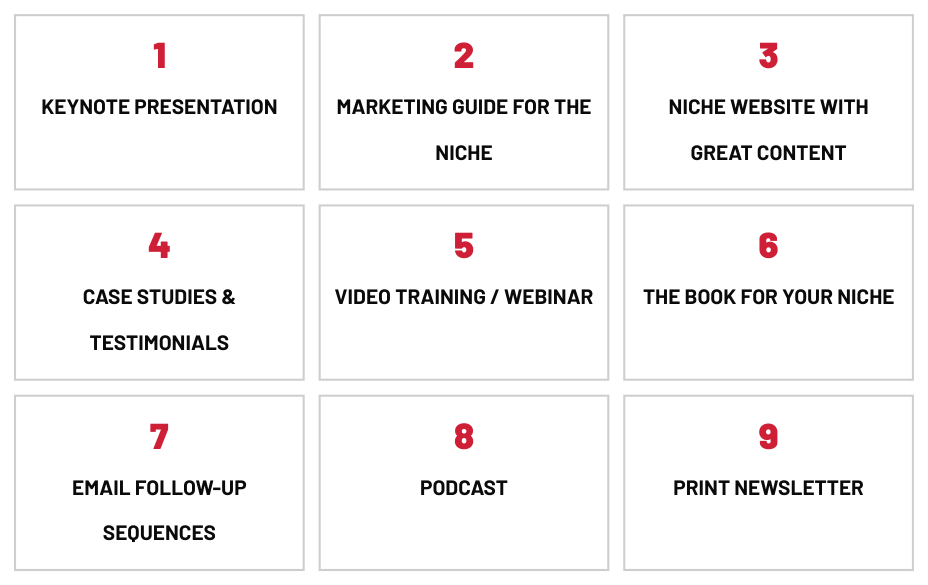
Develop a thoughtful presentation on what somebody in your target market should do to get better results online.
Example: "Nine Things Every Pest Control Company Should Do to Generate More Leads Online"
Cover the fundamentals; great website, ranking optimization, review generation, etc. Record this presentation and distribute it widely on YouTube and social profiles.
Pro Tip: Use this to approach associations: "I've got this great keynote presentation on helping your members generate better results online." When you present to the National Fencing Association, they'll think: "This person really understands our space."
This becomes the baseline of all your positioning work.
Create a condensed version of your keynote: "The Nine Key Steps for Every Pest Control Company to Truly Maximize Their Lead Flow Online."
Two approaches:
Video-first: Record your keynote, then create a written guide from it
Writing-first: Create the guide, then use it to develop your keynote presentation
This isn't LocalAgency.com, it's PestControlMarketing.com. Build awebsite with all content written specifically for your niche.
Example: Our plumberseo.net is entirely focused on helping plumbing and HVAC business owners generate better results online. It includes directory claiming guides, review generation strategies, extensive case studies, and industry-specific optimization tips.
Ground-up approach: Create a dedicated niche website (recommended). Existing brand approach: Add a niche-focused subsection to your current site. Either way, when prospects research you, they need to see you as THE expert in their specific industry.
This is probably the number one play for building authority.
Content makes you an expert in theory. But when you can show actual results from real people in their niche-specific websites, call volumes, revenue increases, and growth from X to 5X, that's ultimate authority.
Case studies should include the client's starting point, what you implemented, specific measurable results, and client testimonials about their experience. As you roll out case study content, your expert status grows exponentially.
Take your keynote presentation and make it available as on-demand training or live webinars. This amplifies your reach and provides multiple touchpoints with prospects.
This is one of the most powerful positioning assets you can create.
Our book: "How to Triple Your Sales by Getting Your Internet Marketing Right for Plumbing and HVAC Contractors" positioned us as THE authority.
Why books work: Who's the expert? Either the person at the front of the room or the author of the book. If you can say you "wrote the book" on internet marketing for your niche, you own that expert status.
Don't overthink this. Ninety percent of people get a book and never open the first page. Put a nice cover on it, have some good content with valuable information, and you have the book. Use it to secure speaking opportunities, as a lead magnet, mailed to dream prospects, and leveraged for industry events. It differentiates you from every competitor.
Automated sequences ensure you're consistently following up when somebody registers for your content. This nurtures the relationship without manual effort.
The easiest format: Expert interviews with successful people in your target industry.
Example: If you work with hotels, interview successful hotel operators monthly about how they grow their business, lead generation strategies, occupancy optimization, and industry challenges and solutions.
Ask 7-8 standard questions for each interview. You'll be surprised how much this positions you as an expert, even when interviewees aren't clients.
Why podcasts work for home services: Your prospects spend a lot of time driving from place to place. While they might not sit down and watch videos or read your entire book, they will absolutely listen to podcasts. There's something intimate that happens; they're listening to you speak directly into their ear.
This isn't just content creation; it's relationship building and business development disguised as content. When you invite someone to be interviewed, you're essentially saying, "I think you're successful enough to feature on my show." Very few people say no to that.
Success Example: Jim Ahlin from Roofer Marketers started his agency just a couple years ago with no authority in the roofing niche. He used podcasting as one of the main mechanisms to position himself. Roofer Marketers, were everywhere in the roofing niche, grew to over $300K monthly recurring revenue and sold the agency through acquisition to JobNimbus for a great exit.
Send a physical newsletter monthly to people in your space. People don't get mail anymore, so when you show up consistently in their mailbox, it's powerful positioning.
There are two things that make you the authority, the expert: you're the published author (if they wrote a book, they must know what they're talking about), and you're the person at the front of the room (if you're speaking, educating, whether at an event, webinar, or podcast, you're looked to as an expert). You should always be looking for opportunities to speak, to educate, to be at the front of the room.
ONE WEBINAR, WORKING THREE WAYS
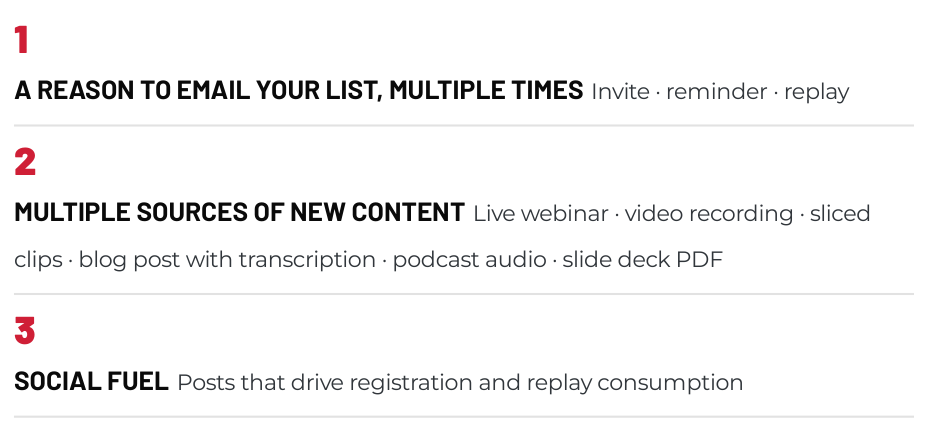
Here's my ultimate shortcut for authority building: combining one topical webinar and one podcast interview monthly creates the ultimate content and relationship-building engine for agency growth.
Monthly Webinars = You teaching your prospects (expert educator positioning)
Monthly Podcast Interviews = You connecting with industry leaders (expert connector positioning)
When I say webinar, I'm not talking about showing up and doing a sales pitch webinar with a value stack. What I'm talking about is a content-based webinar on the fundamentals that would be relevant to your niche.
ONE EVENT, TWO JOBS
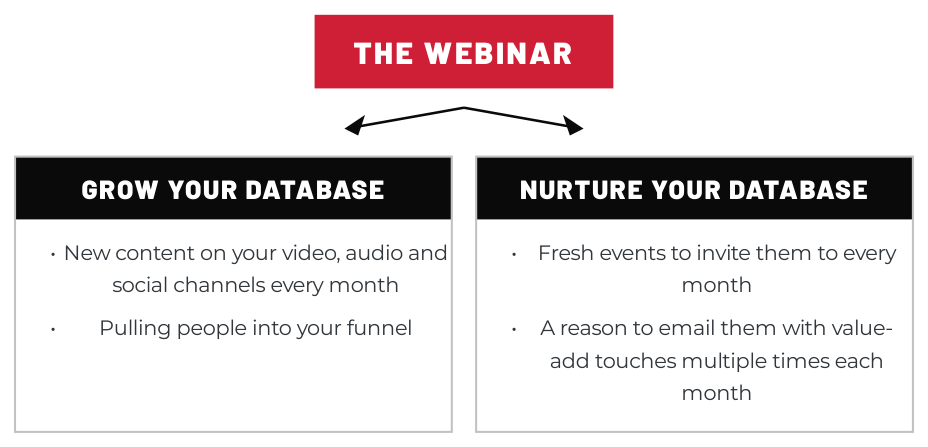
Examples: how to set up your plumbing website to make sure it ranks, how to make sure your website is built to convert, how to run Google Ads to drive leads and sales for your HVAC business.
The reason I say it's the ultimate shortcut is it gives you the ability to grow your database as well as nurture the database.
Here's the critical insight most agencies miss: You need to touch your database of prospects at least 2-3 times per week, but it has to be in a valueadded way. If you're just reaching out, saying "Hey, want more leads? Want more sales? Want to get on a meeting?" they will unsubscribe.
Monthly webinars solve three critical problems:
1. Forces You to Create New Content Monthly: With a blank screen, it's hard to come up with new content. But when you have a webinar scheduled for Thursday at 3 PM, you HAVE to create content. The deadline forces content creation that might never happen otherwise.
2. Gives You Multiple Reasons to Touch Your Database: There's something unique about a live event that feels like you should be able to email about: "Hey, I'm doing a training on [topic] on Thursday at 3. Click here to register." "We're about to start the webinar. Click here to join us." "In case you missed it, you can watch the recording here." You can send multiple emails, which helps you remain top of mind with your prospect base, even if they don't participate.
3. Creates Long-Form Content You Can Syndicate Everywhere: One 45minute webinar multiplies into a dozen pieces of content, YouTube upload, short-form clips, blog post, podcast episode, SlideShare, and social posts, all covered in Step 5 below. One core event leads to these multiple touchpoints, which will absolutely position you as an expert and make you look prolific within your niche.
While webinars position you as the expert educator, podcast interviews position you as the expert connector and industry thought leader.
Why Podcast Interviews Are So Powerful: You don't need to come up with new topics every month. You have the same 6-8 questions, but each guest provides completely different content because they bring their unique experience and perspective. Interviewing successful people in your industry positions you as someone important enough to have access to these leaders, and unlike cold outreach, you're approaching people with value.
Use a live interview format conducted on Zoom or Restream. Don't overthink the technical setup; most business owners won't have fancy equipment, and that's perfectly fine.
Pro Tip: Consider using Restream so you can go live on multiple platforms (Facebook, YouTube, and industry Facebook groups) simultaneously, getting more reach from each interview.
Recording Platform: Zoom or Restream for video and audio capture
Podcast Distribution: WordPress with PowerPressor plugin, hosting
audio on Amazon S3
Syndication: iTunes, Spotify, Audible Podcasts, YouTube
AI Tools: For transcription, show notes, and social media content cre-
ation Don't get hung up on perfection. Find the setup with the least resistance and start creating content.
Create 6-8 standard questions you can ask every guest. This simplifies your preparation and ensures consistent, valuable content:
How long have you been in business, and how did you get started?
Who is your ideal customer, and what area do you serve?
What services do you provide, and what's your unique selling proposition?
What does your marketing look like today? (SEO, PPC, radio, etc.)
Of all your marketing efforts, what generates the best results?
How do you approach recruiting and team building?
What marketing strategies have you tried that aren't working as well today?
How are you leveraging AI in your business?
The beauty: Same questions, completely different episodes because each guest brings unique experience.
One interview should create multiple pieces of content: podcast episode, YouTube video, social media clips, blog post, email content, and case study material if interviewing clients.
Start with three categories of guests.
Category 1: Existing Clients: Reach out with: "Hey [Name], I think you're doing amazing things. Would you be open to being interviewed for my podcast? I'll bring you on Zoom and ask you some questions about your success. How does that sound?" This strengthens relationships while creating case studies.
Category 2: Dream Prospects: This is where the magic happens. Instead of cold outreach, you're approaching your dream prospects with: "I think you'd be a great interview for my podcast. Would you be interested in being featured?" They're much more likely to say yes to being featured than to a sales meeting. During the interview, they get to know, like, and trust you. Many will naturally transition to: "I'd be interested in your services. Let's talk about how you can help me."
Category 3: Industry Influencers: Interview association leaders, industry coaches, and successful entrepreneurs in your niche. This builds your network and positions you as someone important enough to have access to these thought leaders, and opens doors to speaking opportunities.
Kelsey Outram (Lift Auto Repair Marketing) used podcast interviews as a key mechanism to position himself and get the attention of prospects he wanted to do business with. By consistently featuring successful auto repair shop owners, he positioned himself as the go-to authority in automotive marketing.
Matt Plapp (Restaurant Marketing That Works) built his agency to multiple seven figures by being "super religious" with his podcast content, consistently interviewing successful restaurant owners and featuring their strategies.
Monthly Rhythm: Week 1, host a monthly webinar. Week 2, syndicate webinar content across all channels. Week 3, conduct your monthly podcast interview. Week 4, syndicate podcast content and plan next month's topics. This creates a consistent content calendar that positions you as both educator and connector while building valuable relationships month after month.
Step 1: Set Up Your Appointment Funnel with the "Shortcut"
When you promote your webinar, send them to a registration page. But most importantly: offer them a shortcut on the confirmation page.
Why the shortcut works: A lot of people register for webinars but never attend. Your ideal client; the owner of a multimillion-dollar business; is a Type A personality. They're busy. They're not probably the kind of person who's going to sit through your 45-minute webinar.
The shortcut strategy: Take them straight to a confirmation page that says: "Thanks for registering for the webinar. It's going to be awesome. If you're like most plumbing companies, you want to understand how local service ads work, but really, you're looking for someone that can implement this for you and get you the results. If that's you, let's schedule a time where we can show you exactly how we can implement this for you."
The magic: We get almost as many appointments from the shortcut as we do from people who actually participate in the webinar. Even if nobody showed up, you could still generate business from this process.
Touch your database multiple times through 5-6 promotional emails, social media posts, retargeting ads to your custom audiences, and $350-500 of Facebook ad spend to promote to your targeted list. Eventually, it feels like they're seeing you everywhere, and you have this strategy on a constant loop every month.
I'm not giving you permission to promote webinars and phone it in. You do want to show up and create great content. Just know that's not the only outcome or purpose.
Good webinar topics: quarterly digital marketing planning sessions, SEO fundamentals for your niche, website optimization for conversion, Google Maps ranking strategies, pay-per-click advertising basics, annual marketing planning. You just take the fundamentals and cover them specifically to your niche, infused with testimonials and case studies throughout.
Post the recording on your website and YouTube. Email: "In case you missed it, go watch this." Call registrants (whether they attended or not) - this gives you a warm conversation starter. If you're doing a webinar and you look at people who registered, that's a reason to call each and every one of them with a warm conversation.
Don't just do the recording and call it a day. Get maximum mileage: upload to YouTube, put on your website, have it transcribed, use AI tools to create show notes with key takeaways, create tweets and short-form content, put on iTunes as a podcast, upload to SlideShare, and post snippets on social media.
Do this every single month, and without question, you will start to be known as one of the go-to experts within your industry.
Here's what I see happen with most agencies: We get an email list, join some associations, run some ads, get our database with prospects, maybe send a couple of messages or sequences, but eventually they just sit there stagnant.
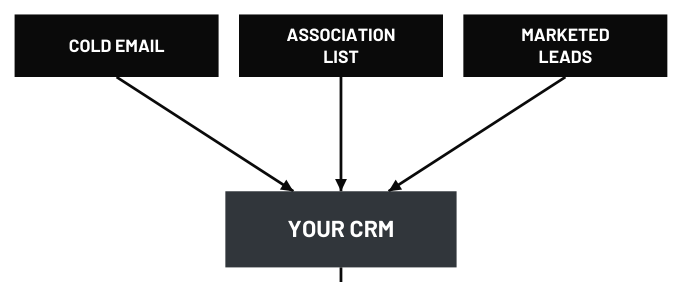
FROM LEAD SOURCE TO CLIENTS AND SALES
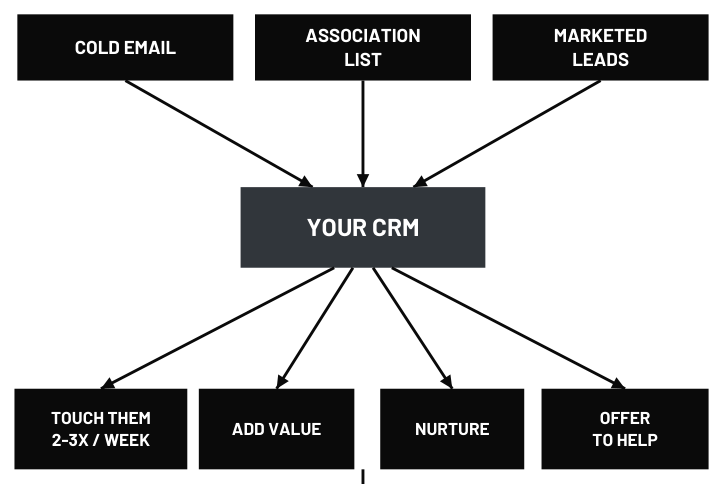
The critical insight: There's a phrase, "the money is in the list." But the reality is, if the list is sitting on a CRM somewhere, it doesn't do anything for you. The money is in the relationship with the list. Those prospects that know you, like you, trust you, that have some affinity with you; that's what turns into clients and revenue.
Find a way to touch your database of prospects at least 2-3 times per week. You might think, "That's crazy. They're going to unsubscribe." Here's reality: with deliverability the way it is, with as many emails as your prospects get, most of your messages aren't going to get their attention. You have to touch them at least a couple of times if you want at least one legitimate impression.
The key: make sure you do it in an added-value way, not "Hey, want more leads? Want more sales? Want to get on a meeting?" The formula: put out good content and offer to help. "If you'd like more ideas and strategies on how we can help you implement this, let's schedule a time to talk."
Wesley Smith runs Tree Service Digital, an agency exclusively serving tree care services. You might think, "Tree care services; are they going to watch webinars? Would there be a match for this kind of thing?"
They do. Wesley's monthly webinar series has landed more clients than any other channel in his business, and it is the largest single driver of booked strategy sessions. One webinar becomes a YouTube video, a podcast episode, a blog post, and a month of short clips.
You met Wesley in Chapter 4, where his full story is. The point here is narrower: the webinar was the lever.
Webinar Platform: Use Zoom meetings (not Zoom webinar). This allows you to see faces, make it interactive, and have two-way conversations. Cost: ~$10/month.
CRM/Automation: HighLevel for opt-ins, landing pages, and follow-up sequences.
Promotion Budget: $350-500 per webinar for Facebook ads to your custom audiences.
Content Creation: Use AI tools for transcription, show notes, and social media content creation.
Your 90-Day Authority Building Action Plan
Month 1: Foundation
Choose your first 3 webinar topics and schedule them
Create your keynote presentation
Set up your webinar registration and "shortcut" funnel
Set up your podcast tech stack and standard questions
Reach out to 3-5 potential podcast guests (start with existing clients)
Month 2: Content Creation and Relationship Building
Host your first monthly webinar
Conduct your first monthly podcast interview
Create and publish your marketing guide/cheat sheet
Begin work on your niche-specific book outline
Begin building your niche-specific website content
Month 3: Amplification and Expansion
Host your second monthly webinar
Conduct your second monthly podcast interview (dream prospect or in-
fluencer)
Syndicate all content across multiple channels
Launch email nurture sequences
Begin case study documentation process
The Evolution from Outreach to Attraction Remember Danny Barrera from Chapter 6? He started with aggressive cold outreach to build his decorative concrete agency from minus $417 to $53K MRR. But today, Danny rarely does cold outreach because he's established himself as the recognized expert in his niche.
This is your evolution path: master cold outreach for immediate results and cash flow, build your database through prospecting, nurture relationships with consistent value delivery, develop authority assets while cold outreach generates revenue, and transition to attraction-based client acquisition over time. Use cold outreach to control your destiny while building the authority that makes outreach unnecessary. Every contact becomes a long-term nurture opportunity.
You now have two paths in front of you. Path 1: continue the grind, chasing prospects, fighting for every appointment, competing on price, hoping your latest marketing tactic works. Path 2: build authority, position yourself as the obvious expert, have prospects come to you pre-positioned to buy, and enjoy 30-50% close rates with consultative conversations.
The agencies in our community generating more than $280 million in combined revenue didn't get there by working harder. They got there by working smarter; by building authority that makes them the obvious choice in their market. Your Client Attraction Method is the bridge between where you are now and the seven-figure agency you're building.
When you implement it, your calendar starts filling with pre-positioned prospects. Instead of chasing down leads and hoping they'll take your call, you'll start receiving messages like: "I read your book and attended your webinar. Can we schedule a time to discuss how you can help my business?" Prospects come to you having already consumed your content, seen your expertise, and decided they want to work with you. They're not comparison shopping; they're ready to buy from the expert they've been following.
But this is where most agencies drop the ball: they build amazing authority, fill their calendar with interested prospects, and then fumble the sales conversation because they don't have a process for converting prepositioned leads into paying clients. Authority gets them in the door. Your sales process gets them to sign the contract.
In the next chapter, we'll walk you through the Seven Figure Agency Sales Process; the exact methodology our members use to convert authoritygenerated leads into long-term, high-value clients without high-pressure tactics or adversarial conversations.
Your authority-building will fill your calendar. Your sales process will fill your bank account.

Pam Mashburn was not struggling. That is what makes her story useful.
She had run a successful agency in Montgomery, Alabama for twenty years, doing around $2 million a year across a publications division and a generalist shop. Most owners in that position spend their energy protecting what they have built.
Two things changed her mind. Montgomery has about 200,000 people, and she had run out of city. And a credit union she had held for years left for a boutique agency that only served credit unions. Then another client said the same thing.
So she took her leadership team, in her words kicking and screaming, into HVAC. Not because it was the exciting choice; she looked hard at med spa first. She chose HVAC because they could reliably get results there, and because HVAC owners already know that growth requires marketing.
Then came the part this chapter is about. Her team tried cold outreach and won a couple of clients. But a salesperson of hers reached out to a man running an HVAC coaching group who happened to live in the same town. That group was already recommending a larger agency, and they asked Pam straight out why they should switch. She told them, unapologetically, that her team was better, in-house, on salary, and more responsive.
That one relationship became the single largest source of growth in the business.
Two HVAC clients became twenty-eight, and $110,000 a month in the niche alone. The company is now around $4 million a year.
You are, as she likes to repeat back to us, one joint venture away.
"I don't hard sell. I set expectations up front. And I will not take your money unless I'm confident that I can put more money back in your pocket each month." - Austin Houser (Base Coat Marketing, $89K MRR)
I'm going to share with you what I've refined over years of testing; a sales process that our members have now run thousands of times, on their own strategy sessions, in their own markets. This isn't theory. It's the system behind the 197 agencies in our community that have crossed seven figures.
The agencies we've watched reach seven figures and beyond all have one thing in common; they know how to sell. Yes, you need great delivery and amazing results for clients, but you also need to be able to convey your value and get prospects to say yes.
The problem I see most agencies struggling with is spending massive effort to get appointments through referrals, cold calling, or paid advertising, only to have prospects say, "This sounds great, we'll be in touch," and then... crickets. You're left wondering if that was a good meeting or not, with no clear next steps and deals sitting in limbo.
The solution is implementing a consultative sales process that always ends with clarity; either a signed client or a definitive "no" with the prospect removed from your pipeline.
This process has been tested across hundreds of agencies in our community:
Step 1: Get Prospects to Raise Their Hand
Step 2: Discovery Call Process
Step 3: Strategy Session
Step 4: Close and Hot Lead Follow-Up Instead of rushing into "Here's what we do and how much it costs," we first understand their specific problems and then demonstrate exactly how we solve those issues.
If all your appointments are coming from cold outreach, you're making sales much harder than necessary. The goal is to position yourself as the expert so prospects call you, already warmed up and ready to hear what you have to say.
THE CONFIRMATION PAGE DRIVES MORE APPOINTMENTS THAN THE WEBINAR ITSELF

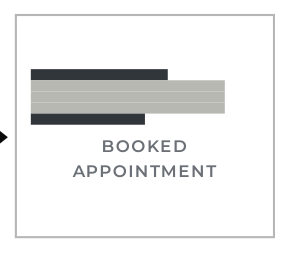
This is where Chapters 5 and 6 become critical to your sales success:
Cold Outreach Foundation (Chapter 6): Use cold outreach to build your initial database and generate immediate appointments while you build authority.
Client Attraction Method (Chapter 7): Implement the nine positioning assets and dual content engine (monthly webinars + monthly podcast interviews) so prospects come to you pre-positioned to buy.
The Ultimate Agency Funnel: Create lead magnets that speak directly to your ideal customer's pain points; e.g. keyword lists, case studies, industryspecific guides. Set up simple forms that capture name, email, and phone number (don't skip the phone number, even though it creates friction).
The key is moving prospects from "I just downloaded this resource" to "I need to schedule a call with this expert who clearly understands my business." When prospects reach your sales conversation, they should be thinking: "I've seen this person get results for businesses like mine. I just need to understand if this will work for me and if I can afford it."
Before doing any due diligence or presenting solutions, spend time understanding whether there's actually a problem to solve and if they're a good fit.
You're looking for two critical elements:
A bleeding neck problem: If there's no perceived problem, there will never be a sale
Good fit indicators: Not everyone should become a client
Key Discovery Questions Start with business fundamentals, then dig into emotional drivers:
Current Situation:
Where are you at today in terms of revenue/growth?
How are you currently marketing your business?
What's working? What's not working?
Future Goals:
Where do you want to be 12 months from now?
What would success look like for you?
Why is this goal important to you personally?
Pain and Urgency:
What have you tried in the past that didn't work?
How is the current situation impacting your business?
Why is this a priority right now vs. staying in the status quo?
On a scale of 1-10, how committed are you to making this change?
Critical insight: People buy based on emotion, but justify with logic. During discovery, you're gathering the emotional raw materials; their frustrations, goals, and why change matters to them personally.
The discovery process can happen in one call (if you're doing single-call sales) or as a separate qualifying call before your main presentation. Either way, don't skip this step.
This is where your preparation and framework make all the difference. You're not giving a generic pitch, you're presenting specific findings about their business.
Before the meeting, conduct thorough research in these areas:
Website Analysis:
Conversion elements (phone number placement, calls to action)
Mobile optimization and loading speed
Use of authentic vs. stock photography Keyword and Rankings Research:
Most important keywords for their industry/location
Current ranking positions for those terms
Competitive analysis in their market Conversion Process Testing:
Call their business; do they answer professionally?
Submit a form on their website. How quickly do they respond?
Test their lead follow-up process
Check their online reviews and reputation Tools for Research:
Google Keyword Planner for search volume data
BrightLocal or Local Falcon for ranking reports
Citation scanning tools for local presence
SpyFu for competitive paid search analysis How Long Should This Take You?
Go back and look at that research list again, and let's be honest about it. Done by hand, done properly, for one prospect? That's an hour. Maybe more.
So what happens? We skip it. We show up with the same slides we used last time, we swap the logo, and then we wonder why the meeting felt like a pitch instead of a consultation.
Here's what's changed: it isn't an hour anymore. The rankings pull, the competitor comparison, the walk through their site, the review check, the summary of where the holes are - all of that can be sitting in front of you before your first conversation, for every prospect, without a person building it by hand.
What still takes you is the judgment. Which two or three of those findings actually matter to this guy, and how do you walk him through them without making him feel stupid? Nothing is going to do that part for you.
Two things follow from this, and they both matter more than the time you save.
First, you don't have an excuse anymore. When prep cost an hour a prospect, cutting corners at fifteen sessions a month was understandable. I did it. Now it isn't, and here's the part that should get your attention: preparation has stopped being your competitive advantage. It's the baseline. The agency that met with him last Tuesday had his numbers too.
Second, don't confuse the research with the conversation. I've watched people make this mistake. They walk in with a forty-page report, slide it across the table, and think the report is going to sell the deal. It won't. What sells is you saying, "You're third for the search that drives your emergency calls, and the company beating you is spending less than you are" - and then getting quiet and letting him sit with that.
The prep buys you the right to lead the conversation. Establishing the gap is still your job.
Start with brief rapport building; connect as human beings, not just business contacts. Spend a little time on them as a person, their day, but not too much time. You want to connect human-to-human on Zoom.
Then set a clear agenda:
"I've done thorough research on your business and online presence. I'd like to spend time understanding exactly where you're at and what your goals are, then show you what we found and how we can help. Does that sound good?"
Get them to agree to your agenda first. You want them to say "Yes, this sounds good," so you're leading the process and they're following your framework.
Critical early question (The Decision Commitment): "Can we both agree that by the end of this call, we'll make a decision one way or the other whether it makes sense to move forward in the next two weeks?"
This is crucial. Almost everybody with any inkling of interest will say yes. This eliminates tire-kickers and sets the expectation for a real decision. If they're not willing to commit to making a decision, they're likely just wasting your time. This also gives you permission to ask for the business at the end and creates urgency for your hot lead follow-up process.
If you did a separate discovery call, briefly recap their situation and goals. If this is a one-call process, go through all the discovery questions here.
The key is connecting their revenue/growth goals to why achieving them matters personally:
"So you want to go from $1M to $2.5M in revenue. Why is that important to you?"
"What will be different in your life/business once you hit that goal?"
"What's preventing you from getting there with your current approach?"
Then present your research findings:
"Based on our analysis, here's what we found with your current online marketing strategy..."
Walk through their website, pointing out both strengths and improvement opportunities. Show them the keyword research and where they're missing rankings. Demonstrate the gaps in their conversion process.
The goal is to stretch the gap between where they are and where they want to be, while showing specific reasons they're not getting there currently.
Get permission to present: "So does everything I've covered here make sense so far? Do you see where there's room for improvement?" Get them to say "Yes, absolutely."
"Would it be okay with you if I walk you through what we would propose for you and how we can help?" They'll always say, "Absolutely, yeah, show me."
Only after establishing the gap and getting permission do you present your solution:
"Based on everything we've covered, here's exactly what we'd do to address these issues and help you achieve your goals..."
Connect each service directly back to the problems you identified:
Website optimization to fix conversion issues
SEO strategy to capture missed keyword opportunities
Local optimization to improve rankings and visibility
Marketing automation to solve lead follow-up problems Show 1-2 case studies of similar businesses where you've solved these exact problems: "Here's one of our clients, you can see their website and why it converts. Here's their tracking showing they're getting over 575 leads per month."
Get confirmation: "If we could deliver these results for you, would this feel like a good fit? If you're trying to get from $1M to $2.5M, do you see how this is going to help?"
End with: "Any questions about what we've covered? Are you comfortable with everything so far? Where do you think we should go from here?"
This pulls them to ask about next steps and pricing. You want them asking, "How do we get started? How much does this cost?"
You'll close 0% of the deals you don't ask for. Here's the refined, lowerresistance closing process that significantly outperforms asking for a credit card outright:
AUTOMATED TOUCHES BETWEEN THE SESSION AND THE CLOSE
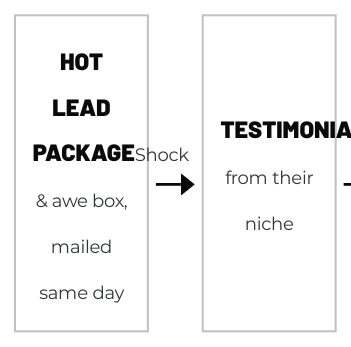
Step 1 - Trial Close:
"How does everything feel? Does this seem like it would be a good fit for what you're trying to accomplish?"
Get confirmation first. You want them to say, "Yeah, this sounds great. I think this is going to be a good fit." Don't move to the next step until you get this buy-in.
Additional trial closes: "Can you see how once we get the website, the content, the local reputation all in place, this is going to drive better results and help you get the goal you're after?"
Step 2 - Assumptive Schedule:
"Great! Our next step is to schedule your kickoff call. Does tomorrow at 11 AM work?"
This is powerful because they're not committing money yet, but they're mentally committing to move forward. It's like the old-school sales technique of "Do you want it in blue or white?"; when they choose a color, the deal is done. When they agree to schedule the kickoff call, the deal is done.
Most prospects will either:
Ask for a different time: "Actually, tomorrow doesn't work. How about Thursday at 3?" (also deal closed)
Express hesitation (giving you a chance to handle objections)
Step 3 - Get Payment:
"Perfect, I've got Thursday at 3 PM locked in. All we need now is a credit card to take care of the first payment."
Step 4 - Send Agreement:
"I'll send you the agreement via Digital Signature Agreement right after this call. We're all set for Thursday at 3 PM."
This sequence feels much more natural than asking for payment upfront. The kickoff call commitment creates momentum that naturally leads to payment.
If they're not ready to schedule the kickoff call:
"Hey, no worries. This sounds great. I'm glad to get you some additional details and send you the agreement so you can review it and answer any follow-up questions you need."
Then use the 1-10 qualification: "On a scale of 1-10, with 1 being 'this is not going to happen' and 10 being 'Josh, this sounds really good, I just need to talk with some people,' how would you rate yourself in this moment?"
This gives you a real indication of whether this is a legitimate opportunity:
If they give you 8, 9, or 10: "What would we need to do to move that to a 10?" They'll give you specific objections you can address, then try asking for the business again.
If they give you 7 or below: This probably isn't a qualified opportunity. You can still follow up, but temper your expectations.
Always schedule the next conversation: "I know you're going to get busy, I'm going to get busy. Let's just make sure we schedule our next call now. We agreed at the beginning we'd make a decision sometime in the next two weeks. Can we pick a time in the next couple of days to follow up, discuss next steps, and get things moving?"
For qualified prospects who need time to decide, implement this 14-day follow-up process that significantly increases close ratios:
Immediately after the meeting, deploy both digital and physical follow-up:
Digital Sequence:
Days 1-7: Case study from similar client, video testimonial relevant to their industry, "What to expect in first 90 days" document
Days 8-14: Additional social proof, urgency messaging around timeline commitments, countdown to decision deadline
Physical "Shock and Awe" Package (Mail): Send a physical package within 24 hours containing:
Copy of your niche-specific book
Client testimonials and case studies
Program overview document
Personal note referencing your conversation Why this works: Your prospects get dozens of emails daily, but almost no physical mail. The physical package stands out and reinforces your professionalism and commitment.
Automate this process so when you move someone to "Hot Lead Followup" in your pipeline, both the email sequence and physical package are triggered automatically.
Day 14 - The Takeaway/Disconnect Message:
"Hi [Name], just checking in. We agreed we'd make a decision sometime in the next two weeks, and this is the deadline. Are you in or are you out? I can only assume you decided to go a different direction. No hard feelings; I'd love to get your feedback on how we can improve for future prospects."
This "takeaway" message is powerful: it stops you from chasing prospects indefinitely, and it often triggers responses from serious prospects who were just busy.
Important: Physically remove non-responders from your pipeline. This creates mental clarity and prevents you from carrying "ghost deals" that will never close.
The Problem: You've done your prep work, have all your tabs up, you're excited about the meeting... and they don't show up. It's frustrating and disrespectful.
The Simple Three-Step Process That Doubles Show-Up Rates
Step 1: Connect on Social Media After they schedule, find them on Facebook or LinkedIn and send a connection request. When they see you're a real person trying to connect, they're much more likely to show up.
Once connected, send a simple message with just their first name: "Rocco." They'll almost always reply with "Hey," "Yeah?," or "Who's this?"; now you've started a human conversation.
Record a quick 10-second video: "Hey Brian, I see you just scheduled. Looks like you're doing great things at XYZ Plumbing. Really excited to meet and show you what we're seeing with your internet marketing."
This simple process can double or triple your show-up rates.
Stage 1: Opted In - raw leads from all sources, including non-qualified leads and fake emails, requiring research and verification.
Stage 2: Qualified Lead - your VA team has verified they're a legitimate business in your target industry with accurate contact information and the revenue/marketing spend to qualify.
Stage 3: Scheduled Strategy - a pre-qualified prospect with a confirmed, warmed-up meeting, ready for the consultative sales conversation.
Stage 4: Hot Lead Follow-up - had the strategy session, sees the value, in your follow-up sequence awaiting a final decision.
Stage 5: Won/Lost - a clear resolution that moves them out of the active pipeline and gives you data for optimization.
Having this visual pipeline makes a huge difference in tracking and moving prospects from interest to signed contracts.
Target Metrics:
25-30% opt-in rate on landing pages
5% opt-in to appointment conversion (with proper follow-up)
30% close ratio minimum (20% acceptable starting point)
15+ strategy sessions monthly for consistent momentum
97%+ client retention rate
Mathematical Formula: Hit these numbers with service packages between $1,500-$3,000/month, that's $108,000 annually from new clients alone, and the math naturally leads to seven-figure growth.
Austin Houser runs Base Coat Marketing for painting contractors, and the way he sources content is worth copying directly. He became an admin in a Facebook group with 150,000 painters and reads it constantly for the questions that keep coming up, including questions about work he doesn't even do, like how to bid a painting job. He isn't guessing at what his market wants. He's watching them ask.
He also disqualifies aggressively. Before a call he looks at the prospect's reviews and their competitors' reviews, and at what previous agencies may have left behind. He turns away roughly two thirds of the prospects who are technically qualified to buy. That sounds like leaving money on the table until you watch what it does to retention.
And he sets the frame before anything else happens. The line that opens this chapter is not a slogan he repeats in interviews. It is the first thing he says on a call, and it does more selling than any close in this chapter, because it tells the prospect the conversation is about whether this will work, not about whether they will buy.
Your sales process is working when prospects say: "I've been following your content for months. I'm ready to get started. When can we begin?"
In the next chapter, we'll explore how to deliver services that make clients want to stay with you long-term, ensuring the revenue you close through this sales process becomes reliable, recurring income that compounds month after month.
Your authority builds the pipeline. Your sales process fills it. Your retention systems keep it flowing.

Cohen Wills is a CPA who bought a dry cleaning business in 2019.
Then COVID arrived and his sales went to zero overnight. He had put everything into that one business, he had a wife and three kids, and he was trying to avoid bankruptcy. After a few months of what he describes as being frustrated, drinking too much and blaming the world, he decided to solve it himself.
He built software for dry cleaners. It failed, and the reason it failed is the most useful sentence in this chapter. Someone told him: you took a business owner who was already so busy, and you gave them another full-time job. Don't sell them a tool. Use your tool to deliver them a result.
So he started an agency instead. At $8,000 a month, working eighty-hour weeks alone, he actually signed a contract to sell it. In his words, being a solo agency owner at $8,000 a month was just enough money to make him hate his life.
What changed was a partner and a price. His father-in-law mentioned the business at a Bible study, which led him to Justin Kane, a former pastor and a natural with people where Cohen preferred the weeds. Then they raised prices. Repeatedly. The same service that once sold for around a thousand dollars a month now sells for $2,999, and their higher tier runs about $3,500. Every increase held.
They pair that with real risk reversal: use the system, and if it doesn't produce a return, they refund the money.
Cleaner Marketer went from $8,000 to $123,000 a month.
Justin's take on what was actually in the way: there is nothing more special about the people already doing it. We can do it. Anyone can do it. Those are barriers you can break.
Yesenia here. This chapter is mine to open, because retention is the part of this business I built, and because the lesson that built it cost us nine clients in a single month.
I want to tell you about that month from my side of it.
We were celebrating. Ten new clients in a month. For where we were then, that was a huge month, and the energy in our office was so good.
And I was sitting with the cancellations.
That was part of my world, because I had the account management side. So while everybody was celebrating the ten, I was the one processing the nine. Nine businesses that had said yes to us at some point, that we had onboarded, set up, tracked, built for, and who had now told us they were done.
I remember not wanting to walk into that room and say it out loud. Nobody wants to be the person who deflates a good month.
But here's the thing I've never been able to unsee since. Those nine weren't strangers. I knew their names. I knew which one had a wife who did the books, which one was nervous about spending the money in the first place, which one had told me on a launch call that he'd been burned by two agencies before us.
He got burned by three.
That's what got me, you guys. Not the math. The math was brutal, and Josh will tell you it was the treadmill, and he's right. But for me it was that I could put a face on every single one of those nine, and I hadn't seen a single one of them coming.
So I said it out loud, and everything changed after that.
Here's what I want you to take from it, and it's not the number.
Somebody in your company has to own the leaving. Somebody has to be sitting with the cancellations the same way your sales team sits with the wins, and it has to be a person with enough standing to walk into a celebration and say the hard thing.
If nobody owns it, here's what happens: your wins get counted every single month, out loud, in front of everybody. Your losses get absorbed quietly, one at a time, by whoever happens to answer the email. And you will genuinely believe you're growing.
So go do this today. Do not wait until Monday. Count what you sold last month, then count what you lost, and put both numbers on the same page in front of the same people.
For a lot of you, that's going to be the most uncomfortable page in your business.
Look at it anyway. I promise you it's the most honest one.
One of the most important factors in growing a Seven-Figure Agency is being able to keep your clients so satisfied that they stay with you long term. However, it makes no sense to invest a ton of time and energy getting clients if you can't retain them.
Josh here. I want to pick up where Yesenia left off, because what she brought me that day reset how I thought about growth entirely. We'd been landing 8, 10, sometimes 12 new clients a month and I was proud of it, so when she told me we'd lost nine in our best sales month ever, I couldn't believe it. We had essentially run in place, selling 10 and losing 9, running as fast as we could just to stay exactly where we were, like a mouse on a treadmill.
It forced us to ask ourselves some hard questions. We felt like we were really good at digital marketing, so where was the missing component? Just having a sales focus, or even a service focus, isn't enough. Unless you execute well and provide a world-class experience, you're going to wind up in a bad place.
Based on that wake-up call, Yesenia and I had to completely reimagine how we approached client relationships: the way we were kicking off clients, the expectations we were setting, our onboarding, our ongoing communication, and how we showed value. In this part of the book, we focus on helping you establish those fundamentals from an account management perspective so you can retain as large a percentage of your clients as possible based on what we learned through our mistakes.
From our experience, there are three key elements to this:
World Class Onboarding
Ongoing Communication Rhythm / Reporting
Client Success Management We'll look at each of them in more detail, starting with the importance of having a strong kickoff.
According to Bain & Company research, a 5% increase in retention can improve profits by 25-95%. At 90% retention, you lose 10% of your revenue every month and need constant new client acquisition just to stay flat. At 97% retention, you lose only 3% monthly, which means most of your growth efforts actually compound instead of just replacing what you lost.
Most agency owners think clients leave because of poor results. That's rarely the case.
The number one reason clients cancel is perceived indifference; they feel like you don't care about them, their business, or their success. They feel like they're just another line item on a spreadsheet, another recurring payment in your bank account.
This is actually good news, because perceived indifference is completely within your control to fix. You don't need better results (though you need good results). You don't need lower prices. You need better systems for making clients feel valued, heard, and cared for.
When clients feel genuinely cared for, they'll stay with you through algorithm changes, economic downturns, and even temporary dips in performance. When they don't feel cared for, they'll leave even when you're getting them amazing results.
The solution is engineering that feeling of being cared for into every client touchpoint through three pillars.
P I L L A R # 1
The first 30 days after a client signs determines whether they'll be with you for 30 months or cancel after their first billing cycle. This isn't theory, it's based on retention data across our entire community.
Your onboarding process must answer three critical questions every new client has:
"Did I make the right decision?" (Emotional validation)
"What happens next?" (Clear expectations and timeline)
"When will I see results?" (Tangible proof of progress)
Fail to answer any of these questions clearly and quickly, and you'll see month-one cancellations that destroy your growth momentum.
In the early days of our agency, Yesenia and I made a critical mistake with our onboarding approach. We were focused solely on SEO services, and we thought being upfront about timelines was enough.
We'd sign a client and say, "Great! We're going to get to work. We'll build your website, write the content, build the links and citations, and set up all the tracking. You should probably expect to see ranking improvements and phone calls in about three to six months."
We thought we were managing expectations properly. We believed that being honest about the timeline would prevent any issues down the road.
We were wrong.
What we didn't realize was that we were creating a massive gap between when they paid us and when they saw any tangible results. Even though we were working incredibly hard behind the scenes, building websites, creating content, optimizing pages, building citations, etc., from the client's perspective, they were experiencing what I now call "radio silence."
Here's what was happening: We'd get the client signed up, collect their information, and then disappear into our work. For weeks, the client would hear nothing from us. We were cranking away; Yesenia managing the account details, me overseeing the technical work, our team executing tasks in our project management system.
But the client? They were sitting there thinking, "I gave these people $2,000, and I have no idea if anything is happening. Am I getting ripped off?"
Then, around months three and four, we started getting cancellation emails: "Hey, sorry, we're moving in a different direction. Please send us the passwords."
It was devastating. We knew we were doing good work. We knew our SEO strategies would eventually pay off. But we were losing clients before they could see the results.
That's when Yesenia and I realized we had to solve two problems: the time-to-results issue and the communication blackout issue.
Based on our hard-learned lessons, here are the five elements every world-class onboarding process must include:
Create a professional information gathering system that makes it easy to collect what you need to get started quickly, including usernames, passwords, main keywords, and key business information. This seems simple, but it genuinely helps you get started quickly while coming across as professional and having a structured process in place.
This isn't "Hey, thanks for signing up. We'll be in touch in 30 days once your website is ready." This is an in-depth consultative conversation lasting 30-90 minutes where you:
Reconnect with their goals and what they're hoping to accomplish
Learn what else they're doing to market their business
Understand their unique selling proposition and market positioning
Extract detailed insights about their business and passion
Set clear expectations for the relationship moving forward Having this structured conversation consummates the relationship. It makes them feel like "I made an investment and there's somebody real on the other side who understands my business and where I'm going."
I've found that the longer this launch call goes, the deeper the relationship becomes right out of the gates, and ultimately, the better long-term relationship we have with the client. Some of our best account managers have launch calls that go two hours because they're really pulling information and building that connection.
This is what had the biggest impact on our retention. The more you can communicate with the client on the front end, right after they sign up, the higher the probability they really buy into what they signed up for.
Physical Welcome Elements:
Welcome Basket: We invest about $75 through Gourmet Gift Baskets delivered within 48 hours, saying "Welcome aboard, we're excited to have you"
Welcome Kit: Custom printed binder with testimonials, program overview, timeline, and copy of this book
Handwritten Note: Personal note from the sales rep or owner saying "Thanks for your business, excited to help take your company to the next level"
Why Physical Matters:
Very few companies do this today. Every time someone buys something and receives something physical in the mail, it changes their whole outlook of the company. When clients get the binder, they often say, "I got your binder in the mail, and I know I'm with the right company."
Automated Email Sequence:
60-90 days of emails dripped out weekly using HighLevel, including:
Welcome message: "You made the right decision, we're excited to work with you"
Video explaining what they're getting over the next 90 days
Introduction to their account manager
Behind-the-scenes look at your office and team
Regular requests for additional information and feedback
Element #4: Quick Win Implementation After experiencing those painful cancellations in months three and four, Yesenia and I realized we had to engineer quick wins into our process. We couldn't wait three to six months for SEO results to kick in.
We racked our brains: "We know the SEO is going to pay off long-term, but what can we do in month one? What can we do in the first week to generate some actual results?"
That's when we decided to add pay-per-click campaigns to our SEO services. We'd launch a targeted PPC campaign for very specific keywords within the first week so clients could start seeing leads and phone calls immediately while the SEO developed.
We also started implementing database reactivation campaigns, taking their past customer database and unconverted leads and sending targeted emails and text messages with special offers. This generated immediate results from their existing contacts, and we set up live chat and lead conversion automation to convert more of the traffic they already had.
The goal wasn't perfection, it was momentum. We needed clients seeing tangible results before the honeymoon period wore off and before they started questioning whether we were actually doing anything.
This element came directly from our "radio silence" mistakes: our team was getting plenty done behind the scenes, but the client was experiencing complete communication blackouts. Set up automated and manual communication checkpoints:
When domain is configured: "Just wanted to let you know we got your domain squared away"
When design comp is ready: "Here's what your new website will look like and why we built it this way"
When call tracking is set up: "Your call tracking is now active and measuring results"
When PPC campaign launches: "Your paid search campaign is now live and driving traffic"
This prevents the client from wondering, "Has anything happened? Am I getting ripped off?" You want them feeling like you're over-communicating rather than under-communicating during this critical period.
We learned this lesson the hard way. Instead of doing all our work in a vacuum and then presenting finished results, we started communicating every step of the process. Even small wins became opportunities to reinforce that we were actively working on their account.
Yesenia here. Josh just walked you through the five elements. I want to talk about why they work, because if you install them as a checklist you'll get about a third of the value out of them.
Here's what I learned running our onboarding for years: the first thirty days are not a logistics problem. They feel like one. There are usernames to collect and access to get and a kickoff to schedule, and it's very easy to believe that if you get all of that done efficiently, you've onboarded the client.
You haven't. You've processed him.
Think about what's actually happening on his side. He just agreed to spend more per month than he's ever spent on marketing, on something he can't see, with people he met three weeks ago. Then he signs, and it gets quiet. And in that quiet, he is not thinking about your project timeline. He's thinking, what did I just do, and what is my wife going to say if this doesn't work.
So when you look at those five elements again, look at what each one is really doing.
The launch call isn't information gathering. You already have most of it. It's the first time he hears his own goals repeated back to him by somebody who was listening.
The physical package isn't a gift. It's proof that something happened, sitting on his desk where his team can see it.
The quick win isn't strategy. It's evidence, delivered before evidence is due.
The communication checkpoints aren't project updates. They're the answer to the question he's not going to ask you out loud.
That's the whole thing, you guys. In the first thirty days you're not proving you're good at marketing. It's way too early for that and he knows it. You're proving he made a smart decision, and that somebody over here is paying attention.
Here's my challenge for you this week. Go find your newest client, the one who signed in the last thirty days, and call him. Not an email. Not your account manager. You.
Don't bring a report. Ask him one question: how are you feeling about this so far?
Then be quiet and listen to how long it takes him to answer. That pause will tell you everything about your onboarding.
Make information collection frictionless by using:
Progressive Collection: Instead of overwhelming them with a 20-question form, collect information over multiple touchpoints as it becomes relevant to specific project phases.
Live Collaboration: When they don't have access to something you need, schedule screen-sharing sessions to access accounts together rather than waiting for them to figure it out alone.
Proactive Problem-Solving: If they don't have their hosting login, reset it together. If they can't find their Google Analytics access, add them as users. Take ownership of moving things forward.
P I L L A R # 2
Most agencies fail here: they think an automated report counts as communication. Real communication means strategic conversations about the client's business, goals, and how your work connects to their revenue growth.
After we solved our initial onboarding issues, Yesenia and I discovered another retention challenge around the 90-120 day mark. Clients would be getting good results, but something still felt off.
We'd set up monthly review meetings with all our clients, thinking this would solve our perceived indifference problem. But we encountered a new issue: about 60% of our clients were skipping these meetings.
They'd say things like: "Hey, you guys are doing fine. We don't need to meet this month. We'll catch up next time."
We thought, "Well, it's not our fault they don't want to meet." But then, month three or month four, we'd get that dreaded email: "Sorry, we're moving in a different direction. Give us the passwords. We're out."
This was incredibly frustrating. We could blame the clients for not attending meetings, but Yesenia and I realized we had to take accountability. How could we fill in that communication gap when clients were too busy to meet with us?
That's when we implemented what became one of our most effective retention strategies: the two-step communication process.
Lead every client conversation with what matters most to them:
The Three Numbers That Matter:
Total Investment: What they spent with you this month (your fee + any ad spend)
Qualified Leads Generated: How many potential customers you drove to their business
Projected ROI: Based on their historical close rates and average transaction values
Everything else; keyword rankings, click-through rates, and bounce rates, is secondary unless they specifically ask for technical details.
This approach transforms conversations from "Here's what we did" to "Here's the revenue growth we're driving for your business."
Part 1: Results Celebration (10 minutes) Start with wins. Show them exactly what you accomplished and how it impacts their bottom line. Use visuals, charts, and specific numbers they can get excited about.
Example: "You invested $3,500 with us this month. We generated 47 qualified leads. Based on your 30% close rate and $2,800 average sale, that's approximately $39,480 in revenue attributed to our work, an 11x return on investment."
What's happening in their business over the next 90 days?
What seasonal opportunities can we capitalize on?
Are there new services, locations, or markets to explore?
What challenges are they facing that impact their marketing?
This positions you as a strategic partner invested in their entire business, not just someone who manages their digital marketing.
Part 3: Next 30-Day Vision (10 minutes) Paint the picture of what's coming next. Give them specific projects and improvements to anticipate. Assign them homework, that makes them active participants in their success.
Here's how we solved the "meeting skip" problem:
Step 1:
We attempt to schedule and conduct a live monthly review call with every client.
Step 2:
If they can't meet or skip the meeting, we automatically send a personalized Loom video review.
The Loom video includes: "Hey Kevin, I know you're busy this month, no worries at all. I wanted to shoot this quick video just to show you the reporting, show you what we got done, and show you where things are headed next."
This simple two-step process solved our perceived indifference problem. It showed initiative, demonstrated care, and ensured that every client received monthly strategic communication, whether they attended the meeting or not.
The impact was immediate and dramatic. Our retention improved significantly because clients never felt ignored or forgotten, even when they were too busy to meet with us.
Give your clients specific tasks that support your strategy: generate 15 customer reviews using the system you implemented, take photos of the team and recent projects using your shot list, send you testimonials from their three most recent satisfied customers, and schedule the team training you discussed for their phone answering process. When clients complete homework, they become invested in the process. When they don't, you have legitimate reasons to follow up and stay engaged.
Right around the 90-120 day mark, that initial excitement wears off and clients start saying, "Okay, now I need to start seeing return on this investment." You can't just let that initial welcome sequence carry you through and expect clients to stay for years. You have to earn that relationship every month through focused, strategic communication.
We learned this lesson painfully: Great results alone don't ensure retention. We've had clients getting amazing ROI who still canceled because of perceived indifference.
Here's a story that perfectly illustrates this: We had a plumbing client who was ranking #1 for every major keyword in his market. His phone was ringing constantly from our SEO work. His revenue had increased by 40% since working with us. The ROI was undeniable.
But we got complacent. We thought, "This guy's making a fortune from our work. He'll never leave."
We stopped having regular check-ins. We'd send the monthly report, but wouldn't follow up. We assumed he was happy because the results were so good.
Three months later, we got the cancellation email.
When we called to ask what happened, he said, "The results were great, but I felt like you guys forgot about me. I never heard from anyone unless I had a problem. It felt like you took my money and moved on to the next client."
That taught us that the harsh reality is there are many reasons someone might decide to move on, so you have to take steps to minimize that risk. You have to make them feel pursued, loved, and cared for.
This might sound sentimental, but when clients are paying $1,500-$2,500 monthly, you can't just "set it and forget it." You have to continuously work the relationship using both technology and personal communication.
P I L L A R # 3
Here's another lesson Yesenia and I learned through painful experience: You can personally manage about 10-15 client relationships while still growing the business.
We discovered this when we were doing everything ourselves; I was handling sales and strategy, Yesenia was managing client relationships and team coordination, and we were both involved in overseeing service delivery. We were hoping that if results were good, clients would just stay with us.
But we had retention issues because we didn't have time to properly nurture all the client relationships. We were spread too thin to give each client the attention they deserved, and our retention suffered as a result.
During this period of analyzing our retention issues, Yesenia and I made another crucial discovery by examining our client base more closely.
We were working with plumbing companies of all sizes, from one-man operators to large plumbing operations. Initially, we thought any plumbing company would be a good fit. After all, they were all in our niche.
But when we analyzed who was staying with us long-term versus who was canceling early, a clear pattern emerged: the one-man operators were taking all of our attention and time, constantly had questions and concerns, and were the ones canceling in the first month, first three months, or first four months. Meanwhile, the more established companies were staying longer and required less hand-holding.
Yesenia and I made a conscious decision that changed everything: We would only work with companies doing over $1 million per year in revenue.
These companies already had infrastructure in place. They had teams to answer phones, plumbers in the field, and systems to handle growth. Most importantly, they could afford to let our strategies develop without putting the entire investment on a credit card and hoping this month would pay for next month's services.
This decision alone had a massive impact on our retention. By moving up the value ladder and choosing our clients more carefully, we eliminated many of the retention issues we'd been experiencing.
The good news is you can eventually manage yourself out of the account management process. There was a time when I thought clients were buying what I personally had to sell and would want to deal with me directly. But we found that with a structured process, clients are just as happy working with trained account managers.
Team Structure:
Include both the account manager and project team members (like writers) on key calls
Pull as much information as possible to understand their business pas-
sion
Use that insight in content creation and overall service delivery The Training Reality: We've had account managers who do quick, surfacelevel calls just to check boxes, and others who really dig deep, sometimes having launch calls that go two hours. The thorough ones consistently build stronger, longer-lasting client relationships.
Documentation Requirements: Record every client call and strategy session. Document scripts for common conversations and objection handling, standard operating procedures for all client touchpoints, and playbooks for handling difficult situations.
Quality Control: Have new managers shadow experienced calls for 2-4 weeks, then gradually transition client relationships with proper introductions. Maintain consistency in communication style and frequency through regular performance reviews and coaching sessions.
We learned that tracking retention requires more than just measuring the numbers; you need to proactively identify and address issues before they become cancellations.
Weekly Team Reviews: Every week, account managers rate each client and strategize on moving red clients to yellow and yellow clients to green through specific action plans:
Green Clients (Thriving): Getting great results and positive feedback, paying on time, and a good candidate for service expansion.
Yellow Clients (Caution): Results are okay but not outstanding, some communication or payment challenges, needs extra attention to prevent issues.
Red Clients (At Risk): Poor results or communication problems, expressing dissatisfaction or considering alternatives, and requiring immediate intervention: enhanced reporting, owner involvement, service adjustments, or even physical mailings to rebuild the relationship.
The traffic light system works. But I want to point out the one hole in it, because it's the hole every client falls through.
It runs on memory.
Your account manager sits down in the weekly meeting with twenty-eight clients to rate, and she rates them based on what she happens to remember. The loud clients get remembered. The client who called twice last week upset about something, she's got that one covered.
But there's another client. He hasn't complained. He hasn't called. He just quietly stopped opening the emails. His leads are down fourteen percent over five weeks, a little at a time, never enough to notice. His reviews slowed down. He skipped the last review call and nobody chased it.
She's going to rate him green. He's not green.
That's how clients get discovered as red on the call where they cancel. And I've been in that call. There is nothing worse than a client telling you something about his own account that you should have told him first.
So stop relying on somebody noticing. Almost everything that predicts churn is something a system can watch every single week without getting tired or busy or distracted:
Leads trending down against that client's own prior months, not against some benchmark
Tracking that quietly broke, which happens more than any of us want to
admit
Rankings slipping on the terms that actually drive their revenue
Ad spend buying less than it did last quarter
Review velocity slowing down And this is the one everybody forgets: engagement. Has he stopped replying? Has he skipped two review calls in a row?
Watch those things weekly and route whatever moved to the person who owns that relationship. Now your account manager walks into the weekly meeting with the list already in front of her instead of taking a memory test. More importantly, she walks into the monthly client call already knowing what he's about to bring up.
That's the whole game right there. Think about the difference between these two calls.
In the first one, he says, "Hey, my leads seem down." You say, "Let me look into it and get back to you." You've just told him nobody was watching his account.
In the second one, you say, "Before we get into anything else, I want to talk about the dip we caught three weeks ago. Here's what caused it, and here's what we already did about it." He was worried nobody was paying attention. You just proved somebody was.
The second call is the strongest retention move in this book. It's better than a report, better than a gift basket, better than a discount.
Two guardrails on this before you go set it up.
First, the system flags it, a human decides what to do about it. Nobody gets an automated "we noticed your leads are down" message that a person didn't read and approve. A seasonal dip in December for a plumbing client is not a crisis, and you need somebody who knows that.
Second, don't turn this into another dashboard. You've probably already got two of those and I'd bet you haven't opened either one this week. It has to interrupt somebody with something specific, or it doesn't exist.
You don't need a dozen tools, you need four categories covered. HighLevel for Client Communication handles onboarding sequences, review collection, and SMS/email management. Project Management (we recommend ClickUp) handles workflow automation, task tracking, and team collaboration so nothing about a client's account lives only in someone's head. Call Tracking and Analytics (CallRail, Google Analytics, and your platform dashboards) gives you the numbers for the monthly review. And Automation ties them together, so a new signup, a milestone, a review coming due, or a client's health status changing all trigger the right notification without anyone having to remember to send it.
Talking about what you've accomplished isn't enough to make clients stay long-term. After you recap results, pivot to what you're doing over the next 30, 60, 90 days: seasonality coming up, new services worth considering, upcoming events or promotions, and new opportunities to capitalize on. This re-anchors the relationship around future growth instead of just past performance.
Keep the homework habit going every month too. Always have one or two specific requests: "Here's what we've accomplished, isn't this exciting? Now here's what we need from you." Then circle back next month: "What's the progress on those photos?" or "I noticed you haven't been requesting reviews consistently." This coaching approach makes it a collaborative process rather than them thinking they can just pay and ignore their role.
Real Success Story: Austin Houser from Base Coat Marketing (painting contractors) built this future-focus and homework approach into his retention strategy. "We achieved 100% client retention because we focus on delivering results, but more importantly, we make our clients feel like they're our only client. Every monthly call includes specific homework that makes them part of their success story." Austin grew from negative $2K MRR to $89K MRR across 46 clients with perfect retention using these collaborative communication strategies.
Not every client will want monthly calls at this level, and that's reality. But communicating this way monthly, or at least quarterly, eliminates the perceived indifference that causes most cancellations.
What gets measured gets done. You need some type of metric in place because this is a key performance indicator of your business health. Even if you only have five or ten clients, start tracking your retention rate now.
Tracking churn is actually easier than calculating retention directly. Here's the formula you need:
Example:
Started the month with 100 clients
Lost 5 clients during the month
Churn Rate = (5 ÷ 100) × 100 = 5%
Retention Rate = 100% - 5% = 95% Don't manually track this data. Use a sales and retention tracking sheet that monitors:
Monthly Tracking:
How many clients did we start with?
How many new clients did we land? (What was our goal?)
How many clients did we lose? (What was our goal?) What's our churn rate for this month?
What's our retention rate? (100% minus churn rate)
Get the template at tracking.SevenFigureAgency.com.
Josh here, because this number was mine to watch and for a stretch of time it was genuinely painful.
We fell to about 93% monthly retention several years in. I was tracking it, watching it slide, thinking, "Man, what are we doing here?" At 93% you are losing 7% of your client base every single month, which means you are running the acquisition machine at full speed just to stay level. Every new client we closed was backfilling one we had already lost. It felt like working twice as hard for a flat line.
Here is the part that matters for you: almost every retention strategy in this chapter was built during that stretch. We were not communicating with clients enough. We did not have a real process for it. We were not onboarding effectively or setting proper expectations. The welcome box, the launch call, the setup sheet, the monthly review rhythm, all of it came out of that dip. We did not design these systems from a position of strength. We built them because we were bleeding and had to stop it.
That is why we can tell you the benchmarks below are real rather than aspirational. We have been at the bad end of them.
Here are the benchmarks you should aim for based on our experience with hundreds of agencies:
Excellent: 3% or lower monthly churn (97%+ retention). This is worldclass performance at scale, and our agency averages 97%+ monthly retention.
Good: 3-5% monthly churn (95-97% retention). Still solid performance, with room for optimization but not crisis mode.
Warning: 5-6% monthly churn (94-95% retention). Red flag territory, investigate immediately before it becomes a larger problem.
Crisis: 6%+ monthly churn (below 94% retention). Major systemic problems requiring a review of the entire client lifecycle from sales through delivery, and possibly a pause on aggressive growth.
Emergency: 10%+ monthly churn (below 90% retention). Put the brakes on sales immediately and focus exclusively on retention until you understand and fix the core issues.
Don't expect perfect retention - it's not feasible even with world-class service. Some churn is natural: businesses get sold or change ownership, companies pivot in different strategic directions, economic conditions affect client budgets, and industry changes impact individual businesses.
The goal is excellence, not perfection. If you can maintain 97%+ retention consistently, you're doing exceptionally well.
Calculate churn and retention rates, identify patterns in lost clients (industry, size, tenure, etc.), interview departing clients to understand root causes, implement improvements based on what you learn, and communicate benchmarks and goals to your team.
Remember what those retention percentages mean for growth: at 90% you need constant acquisition just to stay flat, at 95% moderate growth still requires a steady stream of new clients, and at 97% most of your new client efforts compound instead of just replacing what walked out the door.
When churn exceeds 6% monthly, examine your sales process (are you setting unrealistic expectations, attracting the wrong type of clients, or pricing in a way that draws bargain-hunters instead of value buyers), your service delivery (are results meeting expectations, and is your team delivering consistently with real quality control in place), and your account management (are managers following up proactively, and do clients feel heard and valued).
Retention Case Study: From COVID Crisis to $4M Run Rate
Cris Rodriguez - GrowPro Agency (Martial Arts Studios) Cris Rodriguez's retention strategy helped her agency survive a 30% client loss during COVID and scale to a $5 million run rate with $430K MRR and seventy-two employees, proving that clients truly "stay where they are loved."
The Challenge
April 2020: $30K MRR serving martial arts studios when COVID hit
Lost 30% of clients when government shut down martial arts schools Industry-specific crisis: "Martial arts is a combat art. I can't get better unless I'm punching, kicking, and grappling"
Needed retention strategies to survive and rebuild
Core Philosophy: "People flock to excitement, but they stay where they are loved."
Stay Ahead of Problems: "If there is an issue with an account, be ahead of it. Your clients want to know two things: Do you have their back? Do you have a game plan?"
Phone-First Approach: Train your team to call instead of endless email chains with older clients
Immediate Transparency: "I want to get ahead of the objection before the objection comes"
Monthly Masterclasses: Teaching clients digital marketing skills they can implement
Recent Example: "The Only Phone Script You Ever Need" - helping clients convert leads to walk-ins
Philosophy: "For me to help my clients level up their skill sets so they can get better results." Ultimately this will keep them as a client longer.
Reality Check: Same strategy for 130 clients yields $1 cost per lead for some, $40 for others
Two Variables: Client-provided assets (photos/videos) and location competition
Value Positioning: "We give results, not reasons" - take ownership and provide solutions
Communication Standards: Phone calls over text chains ("if you can pick up the phone and answer the question in 30 seconds, that's better than 15 emails going back and forth"), communicating in the client's preferred style rather than the team's, and constant touchpoints to prevent perceived indifference.
Authority Building Integration: Monthly webinars, book publishing, conference speaking, local association involvement, JV partnerships, and a Facebook group for marketing and community building. "The absolute best marketing tactic is to become famous in your niche."
Business Transformation: From $30K MRR with 30% COVID losses to a current $430K MRR ($5M annual run rate) with seventy-two employees.
Growth Stages: 0-$1M was pure sales focus with an "RGA" (Revenue Generating Activity) post-it note; $1-$2M meant refined delivery and fulfillment with triple-digit client numbers; $2-$3M brought team expansion and mid-management; $3M+ meant leveled-up hiring and talent acquisition.
Retention Success: Target of 3% monthly attrition (97% retention rate), against a 2020 performance of 5% attrition despite the 30% COVID losses, with growth now coming through acquisition and 6 active JV partners.
Current Focus: Growing through acquisition and strategic partnerships while maintaining retention excellence. Future Vision: continue dominating the martial arts niche (serving martial arts and dance studios) before expanding to other markets.
The Lesson: "It's such a great feeling to know that anything I will ever experience in my agency, somebody else in this community has experienced it and they have the answer to solving it."
Cris's retention success demonstrates that surviving industry-specific crises and scaling to multiple seven figures requires treating clients as partners, not just customers, while building systems that show consistent love and value.
Start with Foundation Assessment: calculate your current retention rate, audit your onboarding for gaps, and look honestly at your team's client load.
Then move into Onboarding Optimization, building the welcome sequence, sourcing the physical gifts, and writing the launch call scripts, before shifting your attention to the monthly review process and getting it running for every active client.
As your client base grows, turn to Team Development: recruit account managers, document your processes, and put quality control in place so relationships stay consistent as someone other than you is running them.
None of this is a one-time project. Treat it as Ongoing Optimization, revisiting your numbers, refining onboarding based on what clients tell you, and expanding the team as you go.
From an account management perspective, what we've discussed gives you the ability to be world-class within your niche: kick things off on a solid basis so customers feel good about you and your company from the start, have a consistent strategy for communicating with them and showing them results month by month, and paint an exciting vision of the future so they're encouraged to stay.
Based on implementing these steps, the same ones we built our way out of that 93% stretch with, we've been able to average about 97% monthly retention, which is exceptionally high in this industry. If you follow them, there's no reason you can't achieve the same results.
Perfect retention creates perfect predictability, and predictability transforms agencies from stressful cash flow rollercoasters into revenue machines: you can forecast revenue 6-12 months out with confidence, your team focuses on growth rather than firefighting, you can raise prices because clients see ongoing value, and satisfied long-term clients become your best referral sources and a valuable, sellable business asset.
Don't underestimate the power of physical elements in your retention strategy. We're in a strictly digital business, and very few SEO or marketing companies do this. None of the big players do it, most small ones don't; they just set it and forget it with maybe an online form.
By being hands-on with physical mailings, welcome packages, and ongoing surprises, you create an advantage that costs just a few dollars but cements relationships in ways your competitors can't match. We're always thinking of new things to put in customers' hands: quarterly gifts, coffee mugs with Starbucks cards, and industry-specific items.
One client who'd been with us for three years received a coffee mug during a particularly difficult day. She called to say it completely turned her day around and reinforced why she loved working with us. That same week, a brand new client received the same mug and called to thank us for the nice touch. These small gestures cost virtually nothing, and no one else is doing them.
Start this week: calculate your current retention rate, send one physical surprise to your newest client, and identify your highest-risk client and build an intervention plan for them. Over the next 90 days, get the welcome sequence and health tracking system running, and hire your first account manager if you're managing more than 15 client relationships on your own.
The clients you keep today become the foundation of your seven-figure agency tomorrow. Our journey from losing 9 clients while gaining 10 to averaging 97%+ retention didn't happen overnight. It took painful lessons, honest self-assessment, and better processes, but every mistake taught us something that made the agency stronger. These strategies aren't theory, they're solutions born from real struggles Yesenia and I faced building ours.
You choose your niche and package premium services. You attract prepositioned prospects through authority building. You close 30%+ of qualified prospects. And now you've got retention systems that keep clients for years, not months.
The next challenge is that success creates its own problems. When client attraction, sales, and retention all start working, you'll face a new hurdle: how to deliver exceptional results to more clients without working 80-hour weeks or burning out your team.
This is where most agency owners get trapped. They've built systems for landing and keeping clients but not for scaling delivery, so they become the bottleneck in their own success, busier and more trapped than when they started.
In the final section of this book, we'll show you how to break through that ceiling by building Pillar #4: Scale Up, the systems and team structure that let you serve more clients while working fewer hours, so you go from being the person who does the work to the person who leads the team that does it.

Austin Houser launched Base Coat Marketing on February 1, 2022, at negative $2,000 a month.
Eight weeks later, on his thirty fourth birthday, his wife handed him an MRI. There was a tumor sitting against his brain stem. Surgery carried a five percent chance he would not come out of it, and he was told not to book a return flight.
He had signed clients by then. Here is what he did with them. He called every one, explained exactly what was happening, and cancelled their subscriptions. He told them he would call back if it went well.
Read that again, because it is the whole chapter. He had a business three months old, no revenue to spare, and every incentive to keep billing and hope. He gave the money back instead, because he could not guarantee the work.
He survived. He had to learn to walk again, and a week later a case of meningitis gave him a forty percent chance of dying. Less than two months after brain surgery he hired his first account manager. Eleven months after launch the agency was at $89,000 a month across 46 clients, and when I asked him about retention he told me he had not lost a single one.
Both halves of that are true, and they come from the same instinct. The owner who releases his entire client base rather than deliver badly is the same owner clients do not leave. What he credits it to is not results. It is communication: he over communicates in the first thirty days, and he built that onboarding process before he built almost anything else.
Growth and retention are not two projects. Retention is what makes growth accumulate, and it is built out of what you are willing to do when it costs you.
"The reason we run these agencies is for money, freedom, and impact. We want a profitable business that provides the money we need to live a great life, but we also want freedom to structure the business so it's not all on us, so we don't have to work 60 hours a week. And ultimately, we want impact; knowing that what we're doing creates genuine value for the clients we serve and meaningful opportunities for our team." - Josh Nelson
You've followed the frameworks in this book. You've chosen your niche, packaged your services, built your funnel, and systematized your client acquisition. Revenue is growing. Clients are getting results. By most measures, you're succeeding.
But there's a problem: Success is starting to trap you.
The better you get at landing clients and delivering results, the more your business depends on you personally. Every client relationship, every strategic decision, every quality control check runs through you. You're making good money, but you're working more hours than ever. Taking a vacation means returning to chaos. Your business owns you instead of serving you.
This is the freedom trap, and it's exactly where most agency owners get stuck.
After building our agency to $7 million annually with 47 team members while working fewer hours than when we were smaller, and watching 197 members in our Seven Figure Agency community achieve similar transformations, we've learned the secret: You must scale for freedom first, and revenue follows naturally.
Most agency advice focuses on growth tactics; more marketing, more sales, more clients. But growth without the right operational foundation just creates a more expensive prison. More clients means more custom work and firefighting. More team members means more management overhead. More revenue means more stress, because higher overhead means you can't afford mistakes. More success means less freedom, because everything depends on your personal involvement.
Our approach is the opposite: build systems that work without you before adding complexity, hire strategically to remove yourself from operations rather than just add capacity, create leadership structures that enable decision-making at the right level, and focus on the profit margins and cash flow that fund true freedom. Are you building an agency that can scale, or are you just making your current model bigger?
To transform your agency from a successful job into a business that gives you your life back, you must master three scaling systems: Team Architecture, Systems and Procedures, and your Operating System. Let's explore exactly how to implement each one.
The goal isn't just to hire people, it's to build a team structure that enables others to make decisions, solve problems, and deliver exceptional results without your constant oversight.
An accountability chart maps not just who reports to whom, but who's genuinely responsible for specific outcomes in your business: client acquisition, service delivery, account management, operations, and finance and administration. Right now, you might be in most of these seats. That's fine, but having the chart forces you to think strategically about which roles to fill first and how responsibilities will shift as you grow.
VISIONARY AND INTEGRATOR AT THE TOP, FUNCTIONS BELOW
Most agencies hire reactively when overwhelmed. Freedom-creating agencies hire strategically to build capabilities. Our proven framework has four steps. Step 1: Role Definition. Create crystal-clear job descriptions based on your accountability chart, not just immediate needs. Step 2: Cultural Assessment. Skills can be taught, but cultural fit determines long-term success; hire people who align with your values and vision. Step 3: Practical Evaluation. Instead of take-home assignments, which often get outside help, we do 30-minute live assessments during interviews so you see exactly how they think and perform. Step 4: Reference Verification. Always verify past performance and cultural alignment with previous employers.
Just like your client onboarding creates retention, your team onboarding determines whether new hires thrive or churn. The essentials: a welcome experience that creates real excitement about the opportunity, a clear 90-day success path with specific milestones, cultural integration into your mission and operating principles, and progressive, documented skill-building training.
Here's a question that didn't exist when I wrote the first edition of this book, and it now belongs in this chapter ahead of everything else in it.
For each seat on your accountability chart: does that seat need a person?
Some of them absolutely do, and always will. But if you go straight from "I've got a bottleneck" to "I need to hire," you're going to hire your way into overhead you didn't need and management you didn't want. Work the chart first. Then decide.
So before you post a job, run the seat through three questions.
Is this mostly judgment, or mostly execution against a known standard? Your head of account management is exercising judgment about human relationships all day long. That's a person. Watching every client's numbers every week and flagging the ones sliding the wrong direction is execution against a known standard. That one doesn't need a person.
Is the standard written down anywhere? If it only lives in your head, you can't delegate that seat to anybody, human or otherwise. That's not a hiring problem. Hold that thought, because it's the real problem in most agencies and I'm coming back to it.
What happens if it gets this wrong? Bad content published on a client's site is recoverable. A bad message sent straight to a client is not. That answer tells you where the human approval sits. It doesn't tell you whether to use an agent.
Almost every agency owner reading this is already using AI. Whenever I'm in a room and I ask for a show of hands, every hand goes up. But watch what happens when I keep asking.
Keep your hand up if that AI has one specific role and one specific outcome it owns in your organization. Most hands stay up.
Keep it up if it acts on its own, whether you prompted it or not. Some hands come down.
Keep it up if it's got a scorecard, so it knows whether it's on track or off track. More come down.
Keep it up if it's got an escalation path, so it knows what it can decide and when it needs to come get a human. By this point almost every hand in the room is down.
Nearly everybody is using AI. Almost nobody is building agentically. That gap is the whole opportunity, and the difference is simple.
AI is a tool. You prompt it, it answers, you copy and paste, you do it again tomorrow. One person, one chat window, starting from zero every time.
Agents are a team. They monitor, they decide, they execute, they remember, and your whole team can work with them.
Now here's what I want you to see: this isn't a technology shift at all. It's the same delegation upgrade you've been making since day one.
You started out doing everything yourself. Then you handed off tasks - maybe to a VA, maybe to somebody on the team. Then you upgraded to SOPs, which let you hand off a whole process instead of a list of chores. The next rung on that same ladder is handing off a role. An outcome somebody owns, with the context and the room to figure out how to get there.
You already know how to do this. You've been doing it for years with people.
When we define a role for an agent, we use four things. And you'll notice right away that they're the same four things that make a job description work for a human being, which is exactly the point.
R is for Result. Don't start with the task, start with the business outcome that seat exists to produce. Not "look at client reports." The result is "figure out which clients are at risk of leaving us, and why, before they tell us." One of those is an activity. The other is a seat on your accountability chart.
O is for Operational context. You can't hand somebody a job without telling them how your business works. Playbooks, client history, brand voice, examples of work you'd actually be proud of, your business rules, and the decisions you've already made and why. This is the part everybody skimps on, and it's the whole difference between output that sounds like a stranger wrote it and output that sounds like your agency.
L is for Leeway and limits. Leeway means you're not dictating the method. You're naming the outcome and letting something smart figure out how to get there. Limits are the fence: it can't spend money, it can't contact a client before a human approves, it can't touch a live campaign. Leeway with no limits is reckless. Limits with no leeway is just a slower way of doing it yourself.
E is for Escalation path. It has to know what it can decide and when to stop and come get you. Every good employee has this. Almost nobody gives it to their AI, and then they're shocked when it makes something up instead of asking.
Then give it a scorecard, same as you would for anybody else. Here's the job, here's roughly how it's done, and here's how we'll judge whether you're doing it well. If a seat has no scorecard, nobody sitting in it can tell whether they're winning. That's always been true of people too.
Now the part that decides whether any of this actually works. And it's the reason a lot of owners stay the bottleneck no matter how many people they hire.
Your agency has a memory problem.
Here's how it happens, and I'm describing myself. You start using a tool. You realize it needs context, so you train it up. Here's who I am, here are the companies I run, here are the clients we serve, here's what we're trying to do. Great, it's useful now.
Then a different tool comes along that's better at something else, so you do it all again.
Meanwhile your COO is over on his side doing the same thing for delivery. Your director of account management is doing it on hers for the monthly review process. Every one of you is building your own private, partial version of the company's brain.
And even if you all agree to standardize on one tool, the problem doesn't go away, because what I put in doesn't cleanly pass over to what he put in. Every person is a silo. Nothing compounds.
Do this before you read any further. Get a piece of paper and list every AI tool in use across your agency. For each one, write down who uses it, what context has been loaded into it, and whether anybody else can see that context. Most owners are surprised by how long the list is and how little has been shared.
What you need isn't a better tool. It's a shared brain. One place where the context lives, where the memory sticks so nobody re-explains the business every time, where the systems your team actually works in are connected, and where your whole team can use it without going through you.
That last part is the one that matters, and it's the trap I walked right into.
Josh here, because this one is mine and it is not flattering. I had it running. It was genuinely good. And everything still came back to me.
Somebody on my team built a landing page. Nice work, fast. "Josh, can you deploy it? You're the one with the login."
Somebody built a dashboard. Exactly what we needed. "Josh, I can't pull the revenue numbers in, the billing connection is on your account."
Somebody wanted it live on a subdomain. "Josh, the domain access isn't shared."
Three times in a week I had to stop what I was doing to unblock work I had specifically delegated so I would stop being the person who had to stop what he was doing.
Read that again, because it's this chapter's whole argument in a new costume: if you're the only one who knows how to use the system and the only one with the keys, you have not created freedom. You've created more work for yourself. Which is precisely the thing you were trying to escape.
The fix is the fix it's always been. Elevate and delegate. Pick which team members go first. Pick the handoffs that will no longer run through you. Then actually give them the access, which is the part that stings a little and matters most.
One warning, and it's why I haven't named a single product in this section.
We've tried most of them. We run this way in both of our companies today. And every one of these platforms is going to change, and some of them won't be here in three years.
Your investment isn't the platform. It's the operating system - the documented outcomes, the context about your niche and your clients, the playbooks, the standards, the rules you paid to learn. Keep all of it in plain, portable files you own. Then when something better shows up, you carry your agency's brain across and start on day one instead of day zero.
The lesson of the last two years isn't that some particular tool won. It's that the agencies who wrote down what they know can move fast, and the ones who didn't are starting over every time the ground shifts.
None of this replaces the hiring sequence coming up next. It changes what you're hiring for.
Position 1 still gets you out of doing the work. But "the work" now includes defining outcomes and approving output instead of producing everything by hand, so your first operations hire needs judgment more than raw production speed. That's a different interview.
Account management is still a person. The relationship is the entire job. But the monitoring underneath it doesn't have to be a person, and that's a big part of why the old ceiling on accounts per manager is moving.
Administrative support is where this changes most. A lot of what an assistant used to spend the day on - sorting the inbox, surfacing what's actually important, drafting the routine reply - is now the most reliable and lowest-risk place to start. You're never going to hire an assistant for every person on your team. You can give every person on your team that kind of help, and the hours it hands back is the first thing they'll thank you for.
And sales stays last, for the same reason it always has.
One more thing, said plainly, because I know some of you are quietly worried about it. None of this is about running an agency with nobody in it. We have more than forty full-time people. The point is that your people should be spending their days on judgment, relationships, and craft - the work they're good at and the work clients actually pay for - instead of on production nobody enjoys and coordination nobody ever sees.
Yesenia here, because this is the mistake I have made more than Josh has. He has you thinking about which seats need a person and which ones don't. Good. Now let me tell you about the mistake that costs more than either of those decisions.
It's the person you love who is in the wrong seat.
Everybody prepares you for the bad hire. The bad hire is honestly the easy one. They don't fit, everybody can see it, and you deal with it. Uncomfortable, but clear.
Nobody prepares you for the good one in the wrong chair. This is somebody who shows up, who cares, who your team likes, who has been loyal to you through hard seasons. And they are quietly not able to do the job you've put them in. Their numbers say so. And you know it, and you've known it for months, and you keep telling yourself they just need more time. Or more training. Or that you haven't supported them well enough.
Here's what I've come to believe about why we do this.
We think we're being kind. We're not. Kind is telling somebody the truth about whether they're in a position where they can win. Leaving a person in a seat they're drowning in isn't loyalty. They know. They wake up every morning knowing, and they carry that home to their family, and we let them do it because it's more comfortable for us.
And here's the part that should get your attention: it isn't just costing them. It's costing every person on your team who is watching you tolerate it. Your A players are looking straight at that situation and drawing conclusions about what standard actually applies here.
So do this. Pull up your org chart, and next to every name write one thing: is this person in a seat where they can win?
Not "are they a good person." Not "have they been here a long time." Not "do I like them." Can they win where I've put them?
You already know the name you hesitated on. You thought of them before you finished reading the question.
Go have the conversation. And go into it looking for the right seat for them, not for the door. Most of the time that seat exists, and they'll thank you for it.
You need documented processes that enable your team to deliver excellent results without your constant guidance.
An effective playbook defines the outcome success looks like, includes a screen-recorded video of the actual process, breaks the steps into a written checklist, and states the quality standard for verifying excellent execution. Priority playbooks for most agencies: client onboarding and launch, core service delivery, account management and retention communication, hiring and training, and monthly financial review. Focus on the 20% of processes that drive 80% of your results; don't try to document everything at once.
While playbooks describe what to do, project management ensures it actually gets done consistently and on time. It guarantees you deliver what you promised clients, gives you visibility into workload and bottlenecks, maintains quality across team members, and enables accurate timeline and capacity planning. We use ClickUp because you can pre-build templates for each service offering; when you onboard a new client, the entire project structure automatically populates with tasks, deadlines, and responsible parties. If you're the agency founder, you probably shouldn't be managing daily project execution. You're likely a high quick-start, low follow-through personality; hire someone with high follow-through to own task completion and deadlines.
Growing revenue without profit visibility is dangerous. You need professional bookkeeping with monthly financial statements in QuickBooks or Xero, clear visibility into revenue, costs, and operating profit, regular reviews of key metrics, and a systematic approach to maintaining target margins. At scale, 25-35% net profit is optimal for digital marketing agencies. This includes owner compensation, profit distributions, and executive benefits.
This is how your business runs systematically: the meeting rhythms, decisionmaking processes, and continuous improvement systems that keep your agency growing without constant founder intervention.
We implemented EOS (Entrepreneurial Operating System) when we hit $1.5 million annually. It was transformational for creating the leadership team that enabled our growth to $7M+ while giving us more freedom than ever.
Before EOS, Josh and his business partners were making all decisions themselves, and the business plateaued because everything ran through the founders. After EOS, a true leadership team was created where department heads take ownership, make decisions in their areas, and solve problems without constant escalation: Founder/CEO for vision, strategy, and culture; an Operations Director for systems, execution, and quality control; a Head of Client Acquisition for marketing, sales, and lead generation; a Head of Service Delivery for SEO, PPC, and content teams; and a Head of Account Management for retention, client success, and expansion.
The problem is constant "got a minute" interruptions where team members bring you every issue throughout the day. The solution is a structured 90minute weekly meeting that never gets skipped: a check-in (10 minutes) with personal and professional updates, a scorecard review (10 minutes) of key metrics for each department, and an issues list (70 minutes) where you identify, discuss, and solve problems. When your team knows there's dedicated time to bring issues and actually solve them, the daily interruptions virtually disappear. Run it at the leadership level weekly, then have each department head run their own Level 10 with their team, and problems get solved at the right level.
Every quarter, review performance, set goals, and identify the major initiatives ("big rocks") you'll focus on next quarter. At $2M+ annually, consider hiring a certified EOS implementer. When you facilitate as the owner, you tend to dominate conversations, and your leadership team won't fully step up.
Based on our experience and analyzing successful Seven Figure Agency members, here's the optimal order for removing yourself from operations.
Position 1: Operations Management and Service Delivery. Remove yourself from the hands-on SEO, PPC, content creation, and website building. If you're still doing the work, you have a job, not a business; you can't focus on vision and growth while executing daily tasks. Start with someone who handles multiple services, then let them become the operations manager who builds and manages the delivery team.
Position 2: Account Management. Remove yourself from client onboarding, monthly review calls, day-to-day communication, and retention management. As the founder, you'll bottleneck around 17 client accounts; your account managers can handle 25-30 accounts each. Account managers are "quarterbacks"; they don't do the work but manage relationships and coordinate with the delivery team, focusing on retention while identifying expansion opportunities.
Position 3: Marketing Support and Administration. Remove yourself from email management, calendar scheduling, webinar setup, content syndication, social posting, and other administrative tasks. If your time is worth $200+ per hour but you're doing $25/hour tasks, you're bleeding profitability. This person can handle both marketing assistance and personal administration, managing your calendar, booking travel, paying bills, and coordinating marketing activities.
Position 4: Sales. Remove yourself from strategy sessions, discovery calls, proposal presentations, and deal closing. This is typically the hardest role to delegate because most agency founders are naturally good at selling. The ultimate freedom moment: the day someone signs a new client that you never spoke with. They discovered you through marketing, met with your salesperson, signed up, got onboarded by operations, and are managed by account management, all without your involvement.
Consolidate wherever you can. One system that handles your CRM, your marketing automation, and your client communication beats four systems that almost talk to each other. We build on HighLevel and it's what most agencies in our community use. But the reason isn't the feature list. It's that a new team member learns one thing instead of four, your data actually flows, and putting a client report together stops being a manual assembly job every month.
Then there are two rules that will outlast whatever tool you're using when you read this.
Own your context, not your tools. Your playbooks, your standards, your client history, your niche expertise - that's the asset. Keep it in portable files you control so you can carry it to whatever comes next.
Buy for your team, not for yourself. The most capable system in your agency is worthless if you're the only one who can run it. If it takes technical comfort your team doesn't have, it's going to quietly turn into one more thing that runs through you, and you already know how that story ends.
As for where to point agents first, start where the standard is already clear and a mistake is cheap: lead research and qualification, inbox triage, putting reports together, content production behind a review gate, and client health monitoring. Keep anything client-facing and anything that spends money behind a human who approves it.
Budget $500-$1,500 monthly for tools supporting seven-figure operations; CRM, project management, design software, and communication platforms. Expect to sacrifice short-term profit margins when hiring strategically; a temporary reduction in profit percentage is worth long-term freedom and scalability. Maintain 3+ months' operating expenses in reserve to weather growth investments and potential setbacks.
Yesenia here, and this one is mine because Josh has never once been handed this problem the way I was. This chapter is about getting things off your plate at the agency. I want to talk about the other half of your plate, because I have watched a lot of agency owners get very good at delegation between nine and six and then go home and personally handle every single thing.
And then they wonder why they still feel underwater.
Here's the math nobody wants to look at. Sit down sometime and actually add up the hours you put into running a household in a week. The groceries, the errands, the laundry, the school forms, the appointments, the cooking, the cleanup. For most of the owners I've walked through this, it lands somewhere in the range of a part-time job. And none of it shows up anywhere in your time audit, because you don't think of it as work.
So you'll pay somebody to write content you don't want to write. Good. But you'll spend your Saturday on the grocery store, the pharmacy, the dry cleaner, and the school forms, and then Monday you'll tell me you don't have time to work on your business.
Let me say the part that I think actually stops people, because it isn't logistics.
It's guilt. Especially for the women reading this, and I'm going to say it plainly: somewhere along the line we picked up the idea that if you outsource the parts of running a home that don't require you, you've failed at something. That it's indulgent. That a good mother, a good wife, a good partner does it all herself.
That's a story. It isn't true, and it's expensive.
Because here's what's really happening when you spend Saturday doing errands anybody could do. You're not more present with your kids. You're in the car. You're not more available to your husband. You're tired. The hours you protected didn't go to your family, they went to logistics, and your family got whatever version of you was left over.
So here's the exercise, and I want you to actually do it and not just nod at it.
Write down everything you personally did last week that was not your business and was not your family. Just the tasks. Then put a dollar figure next to each one, what it would cost to have somebody else do it.
Now compare that column to what one hour of your time is worth in your business.
The gap is going to make you a little bit sick. Sit in it for a minute. Then pick one thing off that list, just one, and hand it to somebody this month.
Start with your pinky toe. But start.
The five that come up most: hiring before systems, which creates chaos instead of capacity, so build playbooks first, then hire to execute them; delegating tasks instead of outcomes, which makes you a full-time coordinator instead of a leader; skipping cultural fit for immediate skills, which creates team dysfunction; keeping every decision at the founder level, which prevents true scaling; and neglecting profit margins while chasing revenue, which creates cash flow stress and kills the investments freedom actually requires.

To see these scaling principles in action, let's examine Tony Ricketts from Lawnline Marketing, who serves the lawn care and landscaping industry.
When Tony joined Seven Figure Agency, he was generating $60,000 monthly recurring revenue but felt completely bottlenecked. As he put it, "I was trying to remove myself 100% from fulfillment and make sure that my team could handle everything. Because without that, we have no ability to scale."
Tony was skilled at websites, SEO, and custom projects, but everything ran through him. He had hit the ceiling of what one person could manage effectively, a problem familiar to most agency owners at that revenue level.
Tony didn't just hire more people; he built the right operational foundation first.
Tony focused on creating an environment where people wanted to work, not just needed a job: free lunch every Friday for the entire team, high-end equipment and stand-up desks, team activities and games, and a focus on attracting people who wanted to be part of something bigger. The result was higher quality hires who stayed longer and performed better.
Tony treats recruiting as seriously as marketing, consistently hiring 3-4 people per month and spending $3,000-4,000 monthly on a recruiting budget across Indeed, LinkedIn, and Facebook, building toward 70-80 employees by year-end.
His initial hiring process included take-home assessments, but candidates were getting outside help. He replaced them with 30-minute live assessments during interviews, resulting in much better quality hires who could perform independently from day one.
The organization: a Content Team of 6 with a dedicated content director, 2 account managers handling 100% of client communications, senior and junior web developers, a Marketing Team of 7-8 handling paid ads, social media, and email, and an operations manager overseeing everything. Tony's leadership team consists of himself plus the head of each department, and department heads have an ownership mentality through incentive structures and clear bonus structures tied to company growth.
Growth trajectory: January 2021, $60K monthly recurring revenue. November 2021, $170-180K monthly recurring revenue. Current, $212K+ monthly recurring revenue. That's over 250% growth in less than two years. Tony removed himself completely from daily operations; his leadership team makes decisions independently in their areas, and the business runs without founder bottlenecks.
Tony's current goal is to scale from $212K to $800K monthly recurring revenue within the year, nearly 4x growth, through multiple acquisition channels including joint ventures, paid advertising, content marketing, direct mail, and strategic partnerships. As he put it: "I'm not trying to add $50,000 or $100,000 to our revenue. I'm trying to add a million and a half or more. So it's going to take drastic measures."
Invest heavily in culture. Treat recruiting like marketing. Refine your processes rather than defending them. Build true leadership by developing people who can own their departments. And once the systems and team are in place, set ambitious goals that seemed impossible at your previous capacity.
You can listen to Tony's complete Agency Success Interview at www.SevenFigureAgency.com/tony-interview
Complete the three-pillar assessment to identify your weakest area, create your accountability chart, document your first critical process using the playbook method, and plan your next strategic hire based on your biggest bottleneck. Start weekly Level 10 meetings, even if it's just you and one team member, and put a monthly financial review in place. Set up basic project management for client deliverables, and either begin self-implementing EOS or research certified implementers. Build your 90-day plan around systems first, then strategic hiring, and communicate the vision so your team understands how scaling creates better opportunities for everyone.
The frameworks in this chapter have enabled 197 agencies in our community to reach seven figures. They work when implemented consistently.
You now have the complete Seven Figure Agency Roadmap: a foundation of business model fundamentals and niche specialization, client acquisition systems that fill your pipeline with pre-qualified prospects, service delivery frameworks that create exceptional results at scale, retention strategies that keep clients long-term with minimal effort, and scaling operations that create freedom while driving continued growth.
However, having the roadmap and successfully traveling the journey are two different things. We've seen agency owners read every chapter and download every template yet still struggle to break through to seven figures, and others implement just one or two of these frameworks and get dramatic results within 90 days. The difference isn't intelligence or market conditions. It's implementation.
After working with hundreds of agencies, we've identified the exact sequence that ensures success, the mistakes that derail it, and the support systems that keep momentum going when challenges arise. A seven-figure agency is genuinely within reach when you implement these frameworks in the right order with the right support, and in this final chapter, we'll give you the implementation mastery that turns knowledge into results.

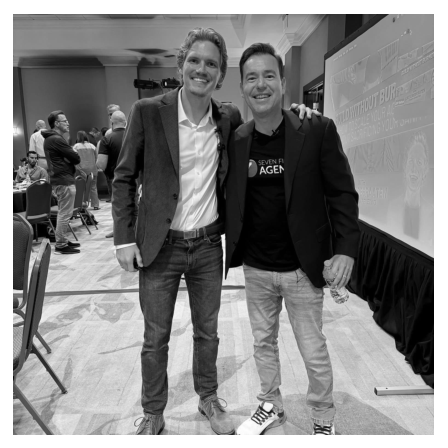
On June 15 Luke Eggebraaten and his wife Olivia left for Germany, Austria, five weeks in Italy, and two weeks in Japan. They came back on August 15.
Sixty days. In that window he attended three L10 meetings, ninety minutes each, on Wednesdays. His team ran everything else. Phaser Marketing grew while he was gone.
Here is the line worth sitting with, in his words: I don't even know if they needed me back. I forced myself back in.
That is what the top of this chapter is describing, and it is worth being precise about how he got there, because it was not a decision he made in the spring before the trip. It started in 2022 on his honeymoon, fourteen days in Italy, when the agency was around $25,000 a month and consisted of him, one teammate, and a stack of contractors. On paper he could not leave. He left anyway, because the wedding was already booked, and the forcing function made him do the thing he had been avoiding: write down everything he personally did and decide who else would own each piece.
He repeated that exercise at every level. Today Phaser serves the excavation niche, what he calls doing marketing for the dirt bags, at about 82 clients and $128,000 a month.
He teaches five things, and the second one is the one most owners fail: let them cook. You gave your team the systems, the processes, and the resources. Stop stepping in. The other four are systems and processes, finding your integrator if you are the visionary, knowing your numbers, and reciprocity.
What he is careful to say is that none of this was about working less. When he mapped his own tasks he found that the work itself sat in his peak zone. He was excited to get home. Buying back your time is not the same as wanting less of it. It is refusing to spend it on the parts of the business that anyone else could own.
The agency that can survive sixty days without you is the only one you actually own. Everything else owns you.
"You now have the exact roadmap that has generated more than $280 million in revenue across our member community. The difference between agencies that plateau at $20K-$30K monthly and those that break through to $83K+ monthly (seven figures annually) isn't working harder, it's implementing these four pillars systematically." - Josh Nelson
You understand the four-pillar framework. You know how to select a profitable niche, package your services, build client acquisition funnels, master consultative sales, create retention systems, and scale operations. You have the same frameworks that took Tony and Angela Ricketts from $60K to $212K MRR, Austin Houser from negative territory to $89K MRR, and 197 agencies in our community to seven figures and beyond.
Here's what we've learned watching hundreds of agencies try: having the roadmap and executing the roadmap are two entirely different skills.
We've seen brilliant owners read every chapter, attend every training, download every template, and still be sitting at the same revenue eighteen months later. We've also seen owners with less experience and fewer advantages pass seven figures because they picked one thing and finished it before starting the next.
The difference isn't intelligence or market conditions. It's implementation discipline. So this chapter isn't more strategy. It's the sequence.
The Perpetual Learner consumes everything and implements nothing. Their competence grows, their revenue doesn't, and the next course always feels like the missing piece. The Tactical Implementer executes pieces but never the system: a lead magnet with no follow-up sequence, a niche chosen but never announced, a sales script without a retention system behind it. The Systematic Implementer commits to the full framework in order, finishing one pillar before starting the next.
The systematic implementers aren't smarter. They've just accepted that sequence matters more than speed, and that a half-built system produces nothing at all.
This is the part to actually do. Everything before this chapter was context. What follows is twelve weeks, in order, and it is the same sequence we walk new members through.
WORK THROUGH THIS IN THE HOW YOU WILL SCALE WORKSHEET, FREE AT SEVENFIGUREAGENCY.COM/KIT.
Objective: complete niche selection and program packaging.
Week 1: Complete the assessment and goal-setting exercise from Chapter 1, audit your business model against seven-figure fundamentals, identify your #1 growth constraint, research 3-5 potential niches using the four criteria, then run the decision process and choose. If you're still asking "what if I pick the wrong niche," you haven't committed. Choose the best available option and commit for 12 months.
Week 2: Update all marketing materials to reflect the specialization, join your industry association and research the key players, start following the trade publications, begin creating niche-specific content, and announce your specialization publicly.
Week 3: Audit current services against the five packaging foundations, research your niche's core business challenges, design a foundational program (minimum $1,500/month) and a growth program at 2-3x that price, then calculate true delivery costs and apply the 3.5X profitability rule.
Week 4: Create your program presentation materials, develop case studies and proof points, build sales pages and proposal templates, practice presenting until it sounds natural, and launch with existing prospects and clients. The test: can a prospect clearly understand what they get and what results to expect? If you're still explaining hourly rates, you haven't packaged anything.
Outcome by day 30: clear niche positioning, a profitable program structure, and your first program sales.
Objective: build the acquisition engine.
Week 5: Create your lead magnet, build the opt-in page and thank-you sequence, set up HighLevel and your automation workflows, create the strategy session booking system, and test the whole flow end to end.
Week 6: Build a list of 1,000+ qualified prospects in your niche, research and segment by priority, create your outreach templates and sequences, set up sending infrastructure and domain protection, and launch a first campaign to 100 prospects.
Week 7: Analyze the results and fix the messaging, scale to 25-50 new contacts daily across channels, add multi-channel follow-up, start your authority content, and lock in a routine you can hold.
Week 8: Optimize show-up rates, rehearse the consultative sales process, build hot-lead follow-up with real deadlines, and push for 15+ strategy sessions a month. If you're not there, stop everything else and work on this until you are. Nothing downstream matters without appointments.
Outcome by day 60: a funnel producing 15+ strategy sessions monthly.
Objective: convert consistently and keep what you close.
Week 9: Implement the four-step consultative framework from Chapter 8, build your prospect research and prep process, practice assumptive closing and objection handling, and push toward a 30%+ close rate on qualified prospects.
Week 10: Launch the monthly client review call, stand up green/yellow/red client health tracking, build your onboarding sequence and client success playbook, and drive monthly retention toward 95%+.
Week 11: Document your most critical delivery processes, create quality control checklists, build the onboarding workflow and templates, establish your project management system, and train anyone already on your team to run them.
Week 12: Complete the assessment from Chapter 10, build your accountability chart, identify your first strategic hire, write the job description and hiring criteria, set the timeline, and take a minute to look at what changed in ninety days.
Outcome by day 90: 4-5 new clients a month, 95%+ retention, and processes documented well enough to hand to someone else.
Months 4 through 6 are about scaling what's working. You're running the sales framework consistently, the retention system is live, and your job is to write the playbooks and build the project management structure that let the work happen without you. The benchmark for month six is simple and uncomfortable: your agency can deliver excellent work for one full week while you're not involved.
Months 7 through 12 are about people. Make the first strategic hire, operations or account management, and onboard them properly instead of throwing them at the backlog. Start delegating outcomes instead of tasks. Put a weekly leadership meeting on the calendar and don't cancel it. Implement EOS or an equivalent operating system, build real departmental accountability, and then test it the only way that counts: take two weeks off. If the business grows while you're gone, you've built the thing this book is about.
Through hundreds of agencies, the same five failures show up over and over.
Shiny object syndrome: starting the sequence, then abandoning it for whatever new strategy showed up in your feed. Perfectionism paralysis: waiting for the perfect niche, the perfect time, or complete certainty before acting. Lone wolf mentality: implementing alone with no community, accountability, or outside perspective. Implementation without commitment: "trying" the framework instead of running it, which produces neither results nor a fair test. And execution without measurement: doing the work without tracking whether it moved anything.
That last one is easy to fix. Four numbers, one per pillar: strategy sessions booked and close rate for Land Clients; client satisfaction and case studies produced for Deliver Results; monthly retention rate and account expansion for Retain Long-Term; your weekly hours and how much your team handles without you for Scale Up.
Time: 15-20 hours a week of focused implementation on top of your existing client work, in protected blocks on the calendar. Plenty of our members buy those hours by starting two hours earlier, because the early morning is the only time nobody else can claim.
Money: expect $500 to $1,500 a month for the stack that supports sevenfigure operations: CRM, design, project management, communication. One additional $2,000/month client pays for all of it for a year. Don't let tool costs be the reason you stayed small.
Mindset: technician to CEO is the real work. You have to stop thinking about doing the work and start thinking about building the systems that do the work, and that shift is harder than any tactic in this book. Right behind it: good enough now beats perfect later.
Support: the owners who move fastest are almost never the ones doing it alone. Isolation is not free. It's paid in months.
Pathway 1: Self-Implementation. Best for disciplined self-starters. You get the complete toolkit of templates, worksheets, and checklists, the 90-day roadmap with daily actions, the video training library covering each framework, the email sequences and sales scripts, and the financial tracking dashboards. Download it at www.SevenFigureAgency.com/Kit and trackyour progress at tracking.SevenFigureAgency.com.
Pathway 2: Accelerated Implementation with guidance. Best for owners who want to compress the timeline and skip the expensive mistakes. Includes strategic analysis of your position across all four pillars, a custom roadmap built around your actual constraints, direct access to the frameworks behind more than $280 million in member revenue, accountability, and a community of owners implementing alongside you. Book a complimentary Agency Acceleration Session at www.SevenFigureAgency.com/Schedule.
Knowledge without implementation is worth nothing. Every month you delay is another month at the plateau, and the plateau is more expensive than the work.
So here's the honest version of what's in front of you. You can commit to the sequence or keep hoping. You can execute what you already have or go learn more things you won't use. You can do it alone or do it with people who've done it. Those three choices, made this week, largely determine where you are a year from now.
Tony Ricketts didn't get to $212K MRR by reading more books. He got there by implementing this framework in order, one pillar at a time, and by treating the sequence as non-negotiable.
Download the toolkit at www.SevenFigureAgency.com/Kit. Block 15-20hours a week on your calendar before anything else can claim them. Join yourniche's primary association. Find one person who will ask you every Fridaywhat you finished.
We've watched this happen 197 times. The question was never whether you could build a seven-figure agency. It's whether you'll start.
Start Monday. Your seven-figure agency is waiting.
Everything in this book was built and proven by people who were, at some point, exactly where you are right now. Not theorists. Operators.
Ricky Shockley had a dozen word-of-mouth clients and a business that was really a job. He is at forty clients and approaching $100,000 a month. SevenFigureAgency.com/case-studies/ricky-shockley
April Edwards did not know what MRR meant. She chose deck builders, went all in, and built a seven-figure agency. SevenFigureAgency.com/case-studies/april-edwards
Matt Foreman sold $99 clients. He went from zero to $112,000 a month in under two years, and started a family. SevenFigureAgency.com/case-studies/matt-foreman
Brady Sticker signed 108 clients in a single month and crossed seven figures at twenty-five. SevenFigureAgency.com/case-studies/brady-sticker
Sean McMeen was a generalist at $15,000 a month. He niched into med spas, decided that was wrong, and niched again into restoration. He is at roughly $110,000. SevenFigureAgency.com/case-studies/sean-mcmeen
Pam Mashburn was stuck on Agency Island with three clients. She went all in on HVAC and now runs a $4 million agency. SevenFigureAgency.com/case-studies/pam-mashburn
Cohen Wills and Justin Kane worked a year for nothing, then went from $8,000 to $110,000 in fourteen months. SevenFigureAgency.com/case-studies/cohen-wills-justin-kane
Austin Houser launched at negative $2,000, was diagnosed with a brain tumor eight weeks later, cancelled every client subscription rather than deliver badly, and rebuilt to $89,000 a month. SevenFigureAgency.com/case-studies/austin-houser
Luke Eggebraaten serves the excavation niche. He and his wife took a sixty day trip through Europe and Japan, and the agency grew while he was gone. SevenFigureAgency.com/case-studies/luke-phaser-marketing
Stephanie Dove Blake grew revenue and tripled her margins at the same time. Cris Rodriguez lost thirty percent of her clients to COVID, rebuilt, and is now targeting eight figures. Jennifer Goddard had twenty-five years in before she joined. Sandy Waggett went from $25,000 to $100,000 a month.
Not one of them had an advantage you do not have. They had a roadmap, a room full of people doing the same thing, and the willingness to start before they felt ready.
You have the roadmap now.
Every one of these interviews, and hundreds more →

We want to end with the member who answers the question this chapter exists to answer, which is what actually happens if you just do the work in order.
Cris Rodriguez founded Grow Pro Agency, serving martial arts and dance studios. She joined in April of 2020 at $30,000 a month across about fifty clients. She did not have a leadership team. She had a niche, a program, and herself.
Six years later Grow Pro is on a $5 million run rate with seventy-two employees, a full leadership team, and mid-management underneath it. She has grown through acquisition as well as through the growth system. She has made the Inc. 5000 four years running.
Here is what she says the difference was, and notice how unglamorous it is.
"Started at thirty thousand MRR. In six years, we're at four hundred and thirty thousand MRR because we followed the playbook. That's all you gotta do. Plug in, follow the playbook, listen to your coach, and execute."
And on why she has never missed an event: "They say your network equals your net worth, and that is just absolutely true. Getting to be in a room with people who get it, who understand, who are having similar challenges that you are, can really help you overcome those bottlenecks."
That is the whole thing. Not a secret, not a hack, not a tactic nobody else knows. A niche, a program, a system run on a schedule, a room full of people doing the same work, and six years of not quitting.
"It's such a great feeling to know that anything I will ever experience in my agency, somebody else in this community has experienced it and they have the answer to solving it."
The eleven agency owners you met in these chapters all did the same thing you now have a plan for. Every one of them sat down and talked through it in full: what they tried first, what it cost them, what finally worked. Those interviews run an hour or more and they are free.
Everything referenced in this book is built, and it's yours at no cost. The complete toolkit of templates, worksheets and checklists. The 90-day roadmap with daily actions. The video training library covering every framework in these eleven chapters. The email sequences and sales scripts. The financial tracking dashboards.
We didn't hold the useful parts back. The book gives you the sequence and the reasoning; the kit gives you the assets so you're not rebuilding from scratch on Monday morning.
Book a Scale Session. It's a working session, not a pitch. We look at your actual numbers first, then tell you which of the four pillars is costing you the most money right now and what the next ninety days should look like if you fix it. You leave with the plan either way.